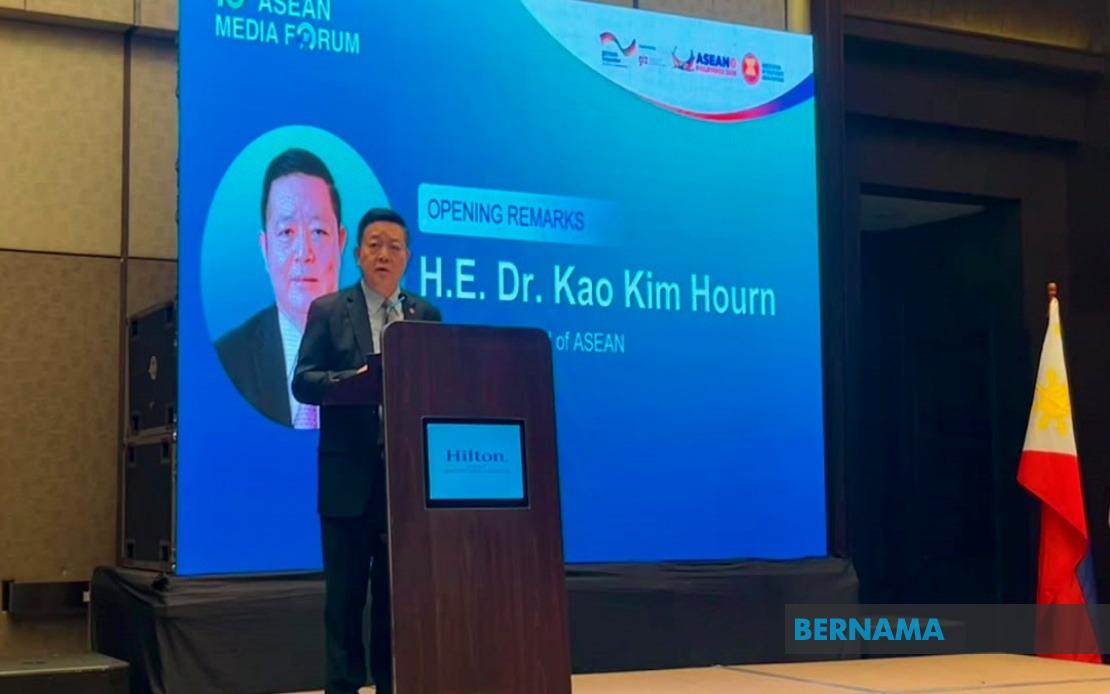
The ASEAN Secretary-General has placed the region's news media at the centre of efforts to build stronger public connections with the bloc and reinforce a cohesive regional identity as it pursues its long-term strategic agenda. Speaking at the 10th ASEAN Media Forum in Manila this week, Dr Kao Kim Hourn outlined how journalism serves as more than mere documentation of events, but rather as an active force capable of translating complex regional policies into terms that resonate with ordinary citizens across Southeast Asia.
The gathering came at a pivotal moment for the 10-member association. With ASEAN Community Vision 2045 establishing the framework for the region's development over the coming two decades, officials are grappling with how to ensure member states' populations understand and embrace the goals of deeper economic integration, political cooperation and social connectivity. The challenge has become more acute as the bloc navigates competing geopolitical pressures from major powers and internal differences on key issues.
Kao emphasised that the information landscape has undergone dramatic transformation within a single decade. The rise of digital platforms, social media networks and artificial intelligence technologies has fundamentally altered how news circulates, who produces it and how audiences consume it. These changes have democratised information in some respects, allowing grassroots voices and independent journalists to reach wider audiences without traditional gatekeepers. Yet this same accessibility has created vulnerabilities that bad actors exploit with alarming efficiency.
Among the most pressing concerns is the accelerating problem of false and misleading content crossing national boundaries with little friction. Misinformation, deliberate disinformation, miscommunication and artificially manipulated content now spread across the region faster than correction mechanisms can address them. The challenge is particularly acute in Southeast Asia, where multiple languages, different media consumption patterns and varying levels of digital literacy create fragmented information ecosystems. What starts as a false claim in one country can rapidly become accepted as fact in another before fact-checkers can intervene.
Generative artificial intelligence has introduced new complexities to this equation. While the technology offers genuine benefits—newsrooms can process information more efficiently, translate content into multiple languages in real time and expand their investigative capacity—it simultaneously creates opportunities for sophisticated manipulation. Deepfakes and synthetic media can convincingly portray events that never occurred, making the task of distinguishing truth from fabrication increasingly difficult for ordinary citizens.
In this environment, Kao argued that professional journalism grounded in verification, contextual reporting and ethical standards becomes more valuable than ever. Credibility represents perhaps the most critical asset a news organisation possesses, yet it remains remarkably fragile. Once public trust in media institutions erodes, rebuilding that confidence requires far more effort than maintaining it in the first place. This dynamic has significant implications for ASEAN's ability to communicate its message to citizens across the region.
The Philippines, holding the ASEAN chair this year, characterised the media's role as fundamental to realising Vision 2045 across all three pillars of the regional agenda. According to Undersecretary for Foreign Affairs Leo M. Herrera-Lim, responsible journalism directly supports political and security cooperation, economic integration and socio-cultural development. He stressed that as geopolitical tensions escalate in the Indo-Pacific region, the region's dependency on credible, accountable reporting has never been greater. Without reliable information sources, member states struggle to build consensus on critical issues and populations cannot make informed decisions about their regional future.
The ASEAN Media Forum itself represents an institutional response to these challenges. First established in Manila in August 2017 as part of ASEAN's 50th-anniversary celebrations, the gathering has evolved into a structured platform bringing together journalists, media executives and policymakers annually. The forum creates dedicated space for discussion about how news organisations can strengthen their coverage of regional issues, improve collaboration across borders and deepen public understanding of ASEAN's work.
For Malaysian media professionals attending the forum, the discussions carry particular relevance. As a founding ASEAN member with significant influence in regional affairs, Malaysia's news outlets play an outsized role in shaping how the bloc is understood both domestically and internationally. Malaysian journalists frequently serve as bridges between ASEAN's decision-making structures and public discourse, translating statements from ASEAN Secretariat and member governments into narratives that resonate with local audiences. The standards they uphold and practices they adopt thus influence broader regional information quality.
The practical implications extend beyond journalism itself. As digital platforms increasingly become the primary news source for younger Southeast Asians, and as algorithmic content distribution replaces traditional editorial judgment, media organisations face pressure to compete for attention while maintaining standards. This tension between engagement and accuracy has produced a marketplace where sensationalism sometimes crowds out careful reporting on important regional developments that lack immediate dramatic appeal.
The ASEAN Secretariat's partnership with Germany's GIZ in organising the forum reflects broader recognition that strengthening regional media capacity requires sustained investment and international support. Member states recognise that individual national efforts to counter misinformation prove inadequate without coordinated regional approaches. Yet such coordination must respect editorial independence and press freedom—values that remain contested across ASEAN's diverse political landscape.
Moving forward, the media sector faces competing demands. Professional journalism requires time for verification and contextualisation, yet digital audiences expect instantaneous reporting. Building regional identity through shared narratives requires nuance and acknowledgment of member states' distinct national interests, yet commercial pressures often favour simpler, more polarising stories. These tensions will likely define the evolution of ASEAN media engagement in coming years.

