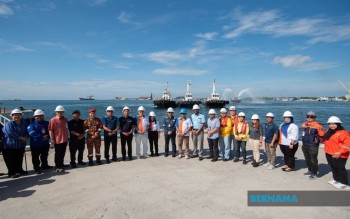
Megah Port Management Sdn Bhd (MPM) has formally inaugurated its marine services division at Labuan Port, marking a significant expansion of the operator's capabilities through a RM23 million investment in modern tugboat infrastructure. The launch ceremony, held at Dermaga Merdeka Jetty, represents the company's commitment to strengthening port operations across the strategically important federal territory hub that serves as a gateway for regional maritime commerce and energy sector activities.
Managing director Datuk Seri Patrick Tiong positioned the tugboat acquisition as a cornerstone of MPM's broader mandate under the recently executed Operation, Facility and Management Continuation Agreement with the Labuan Port Authority (LPA). Rather than viewing marine services as an optional enhancement, Tiong emphasised that providing comprehensive towage and vessel assistance falls squarely within the company's contractual obligations, making the fleet investment less discretionary than foundational to fulfilling its operational charter. This framing underscores how port management in Malaysia increasingly involves multi-layered responsibilities extending beyond traditional cargo handling into safety-critical maritime functions.
The four tugboats will perform a spectrum of essential functions that directly impact port safety and efficiency. Their primary role involves assisting vessels during delicate manoeuvres—guiding ships through confined waters, managing berthing and unberthing operations, and providing directional control in challenging weather or current conditions. For a port like Labuan, which handles sophisticated marine operations including offshore supply base activities and chemical transfers, such precision support is non-negotiable. The tugboats effectively extend MPM's operational reach into the technical aspects of seamanship, transforming the company from a passive facility manager into an active participant in every vessel movement.
Beyond routine operations, the tugboat fleet dramatically enhances MPM's emergency response capabilities, a consideration that has gained prominence in Malaysia's maritime sector following various incidents in regional waters. The vessels can be rapidly mobilised to combat shipboard fires, relocate vessels away from dangerous zones, and provide initial rescue and evacuation support until specialist maritime rescue agencies arrive. Tiong's emphasis on emergency preparedness reflects growing industry recognition that modern port operators must function as first responders to maritime crises, protecting not only vessel crews but also the port infrastructure and surrounding environment. This capability becomes particularly critical in Labuan's context, where proximity to active energy facilities and busy shipping lanes elevates incident risk profiles.
The marine services framework extends across multiple operational zones within Labuan Port's jurisdiction, encompassing the DG Terminal, Petronas Chemicals Methanol Labuan Terminal, Asian Supply Base Fuel Terminal, and Shell Timur Terminal. Each facility presents distinct operational challenges—methanol transfers require specialised handling protocols, fuel operations demand precision positioning, and dangerous goods terminals necessitate heightened safety protocols. By deploying tugboats with integrated situational awareness across these diverse terminals, MPM creates operational synergies that improve response times and reduce the likelihood of costly or dangerous delays during critical cargo operations.
The integration of marine services with existing port authority enforcement structures represents an important dimension often overlooked in port development discussions. Tiong stressed ongoing coordination with the Malaysian Maritime Enforcement Agency, Marine Police Force, and other governmental entities, establishing tugboat operations as components of broader maritime security and law enforcement ecosystems. This coordination model prevents the dangerous siloing of maritime activities and ensures that commercial vessel movements align with national maritime law, safety regulations, and security protocols. For Malaysian readers concerned about regional maritime security, this integration signals that port privatisation does not compromise governmental oversight of strategic maritime activities.
The demonstration of emergency response capabilities during the launch ceremony served a crucial communicative function, converting abstract operational descriptions into visible proof of competency. Showcasing how the tugboats could respond to simulated fire incidents in Labuan waters provided stakeholders—including regulatory authorities, terminal operators, and the broader shipping community—with tangible confidence in MPM's technical preparedness. Such demonstrations matter considerably in Malaysia's maritime sector, where catastrophic incidents remain vivid in industry memory and where operators must continuously validate their safety credentials to maintain terminal operator relationships and regulatory approval.
From a Malaysian port development perspective, Megah Port's investment exemplifies how modern port concessions increasingly require operators to maintain integrated maritime service ecosystems rather than merely managing land-side infrastructure. This evolution reflects global port industry trends where competitive advantage stems not from facilities alone but from comprehensive operational capabilities. Labuan Port's positioning as a regional energy hub and transhipment centre demands precisely this calibre of integrated service delivery. The RM23 million investment signals confidence in Labuan's medium-term commercial viability and represents genuine capital commitment by the private operator rather than minimal service levels.
The tugboat fleet also carries implicit significance for Labuan's broader economic development trajectory. Efficient vessel movements reduce turnaround times, lower operational costs for shipping lines, and enhance the port's attractiveness within Southeast Asian shipping networks where competition between regional hubs intensifies constantly. When a port operator invests substantially in marine services, it sends competitive signals across the region's maritime sector that the facility intends to maintain world-class operational standards. This matters considerably for energy companies and supply base operators that locate facilities strategically based on port efficiency assessments.
Tiong's expressed openness to guidance and feedback from enforcement agencies and industry partners reflects a collaborative governance model increasingly favoured in Malaysian port operations. Rather than positioning commercial operators and regulatory bodies as antagonistic, this approach recognises mutual interests in port safety, security, and sustainable operations. Such cooperation frameworks become particularly valuable when managing complex multi-user ports where diverse operators maintain separate terminals with varying operational protocols and risk profiles. Regular dialogue between MPM and enforcement agencies helps identify emerging challenges before they crystallise into incidents.
The marine services launch also underscores broader trends in Malaysian port sector evolution, where operators progressively assume responsibilities traditionally handled through separate service contractors. By bringing tugboat operations in-house, MPM achieves greater operational control and unified accountability for vessel movements. This vertical integration—while creating capital requirements—streamlines decision-making and eliminates complications arising from coordinating multiple independent service providers with potentially misaligned priorities. For port users, unified operational responsibility simplifies communication and accelerates problem resolution during critical situations.
Looking forward, the tugboat investment positions Labuan Port to compete effectively within the regional maritime services market, particularly as energy sector activities in Southeast Asia continue evolving. The RM23 million commitment demonstrates that despite Malaysia's evolving competitive position globally, significant domestic capital continues flowing into maritime infrastructure improvements. This investment confidence, visible through concrete equipment purchases and service expansions, contradicts narratives of stagnation in Malaysian port sector development. Labuan's ongoing transformation from a primarily financial hub into an integrated energy and maritime services centre reflects diversification strategies that characterise modern Malaysian economic development.

