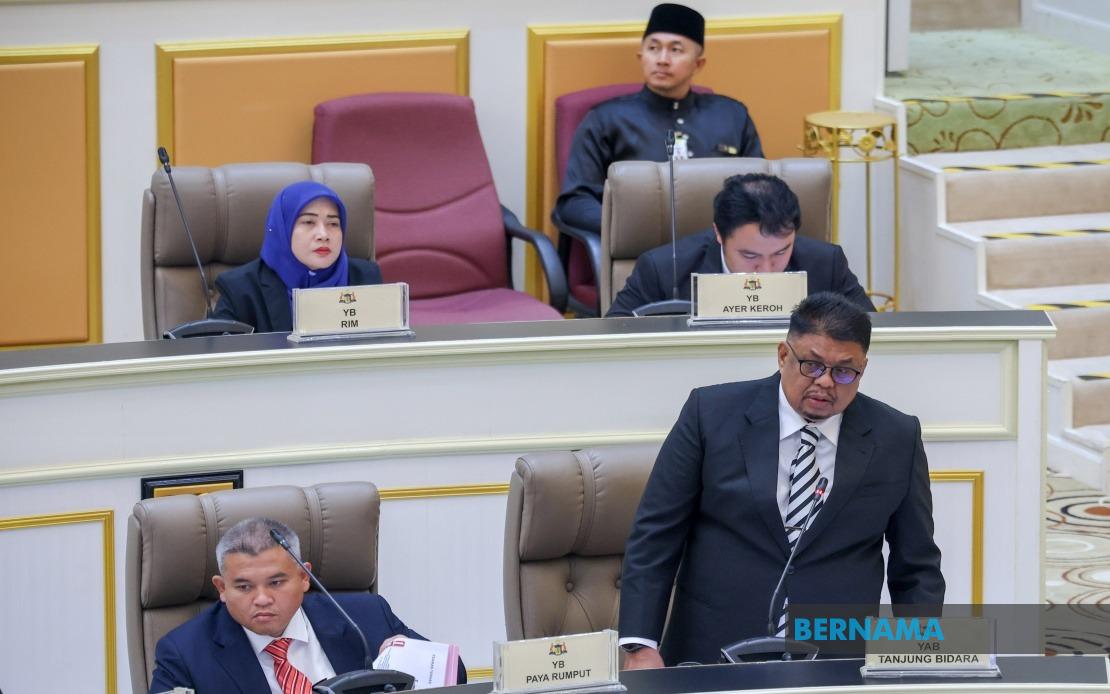
Melaka's State Legislative Assembly has cleared the way for a significant institutional reform by endorsing a constitutional amendment that will permit the appointment of up to seven nominated state assemblymen. The Melaka State Constitution (Amendment) Bill 2026 secured legislative approval on July 14 with substantial backing, receiving 23 affirmative votes against five dissenting votes, signalling broad consensus across the chamber on this governance restructuring initiative.
Chief Minister Datuk Seri Ab Rauf Yusoh championed the amendment, emphasizing that the reform would strengthen parliamentary representation by creating avenues for qualified individuals to serve in the assembly regardless of their electoral viability. Supported in the chamber by Senior State Executive Councillor for Housing, Local Government, Drainage, Climate Change and Disaster Management Datuk Rais Yasin, Ab Rauf articulated a vision of legislative bodies enriched by specialists and experienced professionals who could otherwise be excluded from the political arena.
The rationale behind the constitutional change extends beyond simply expanding the assembly's membership. According to Ab Rauf, the appointments are designed to inject technical expertise and sectoral knowledge directly into policymaking deliberations. Individuals with backgrounds in law, economics, education, investment, technology and state development could contribute perspectives grounded in professional practice and empirical understanding, potentially elevating the calibre of legislative debate and policy scrutiny.
Equally important to the government's positioning is the diversity dimension. The amendment explicitly creates mechanisms to enhance participation from constituencies historically underrepresented in electoral politics. Women, young citizens, Orang Asli communities, ethnic minorities, technical professionals and industry stakeholders have often struggled to translate their aspirations into legislative seats through conventional democratic contests. Appointed positions offer an alternative pathway for these groups to influence state governance and advocate for their constituents' interests within the assembly itself.
Proponents also contend that nominated members would strengthen institutional checks and balances. By introducing assemblymen selected on meritocratic or representative grounds rather than partisan affiliation, the state legislature could develop more balanced scrutiny of executive actions and legislative proposals. Such appointees, unburdened by the need to maintain electoral constituencies or party machinery, might offer more detached and objective assessments of government policies and administrative performance.
The amendment underwent parliamentary scrutiny during its debate phase, with speakers from both government and opposition benches offering perspectives. Three assemblymen contributed to the discussion, including two government-aligned lawmakers and one opposition representative, reflecting the chamber's engagement with the proposal across ideological lines. This measured consideration suggests the amendment addressed concerns about process and legitimacy from multiple political quarters.
Notably, opposition voices did not obstruct the passage. Melaka Opposition Leader Dr Mohd Yadzil Yaakub articulated conditional support, endorsing the principle provided implementation remained transparent and genuinely oriented toward public benefit. His intervention referenced the federal precedent of appointed members to the Dewan Negara, where nominees with demonstrated expertise and national contributions have functioned as legislative participants. By drawing parallels to an established national institution, Dr Mohd Yadzil established a framework within which nominated participation could be perceived as consistent with Malaysian democratic practice rather than antithetical to it.
This constitutional amendment traces its origins to the Barisan Nasional manifesto pledges made during the 2021 Melaka state election campaign. Under the rubric of Thrust 1—Political Stability, subtitled Promoting Mature Politics—the coalition committed to exploring mechanisms that would deepen legislative sophistication and institutional maturity. The amendment's passage demonstrates follow-through on that electoral undertaking and reflects a broader conversation across Malaysia's state governments about optimising representational structures.
From a regional perspective, Melaka's reform sits within a pattern of governance innovation occurring across Southeast Asia. As democracies in the region grapple with the tension between electoral legitimacy and technocratic competence, appointed or nominated parliamentary seats represent one attempted reconciliation. Singapore's system of Non-Constituency Members of Parliament and Thailand's various constitutional experiments with appointed legislatures offer contrasting models that countries like Malaysia continue to evaluate and adapt.
For Malaysian readers, the Melaka amendment carries implications extending beyond one state. If the appointed assemblymen mechanism proves effective in elevating legislative discourse and broadening representation, other state governments might pursue similar constitutional modifications. The precedent also signals that Malaysia's federal system retains significant autonomy for institutional experimentation, with states serving as laboratories for governance practice. Conversely, if implementation reveals problems—whether through opaque appointment processes, partisan manipulation, or symbolic rather than substantive participation—the model may face pushback.
The practical implications hinge substantially on the appointment mechanism itself. Constitutional text alone cannot guarantee that nominated seats will function as envisioned. Transparent, meritocratic selection processes, genuine delegation of portfolio responsibilities, and meaningful platform access within legislative debates all determine whether appointed assemblymen contribute authentically or languish in ceremonial roles. The coming months will test whether Melaka's administrative apparatus can operationalize these principles faithfully.
Additionally, the amendment raises questions about electoral representation's completeness. While nominated seats may enhance diversity and expertise, they inevitably introduce an element of selection—and therefore filtering—that democratic constituencies circumvent. Whether Melaka's electorate perceives appointed assemblymen as legitimate voices or parallel power structures will likely shape public confidence in the reformed legislature. Managing that perception through communication and demonstrable contribution will challenge the state government's implementation capacity.

