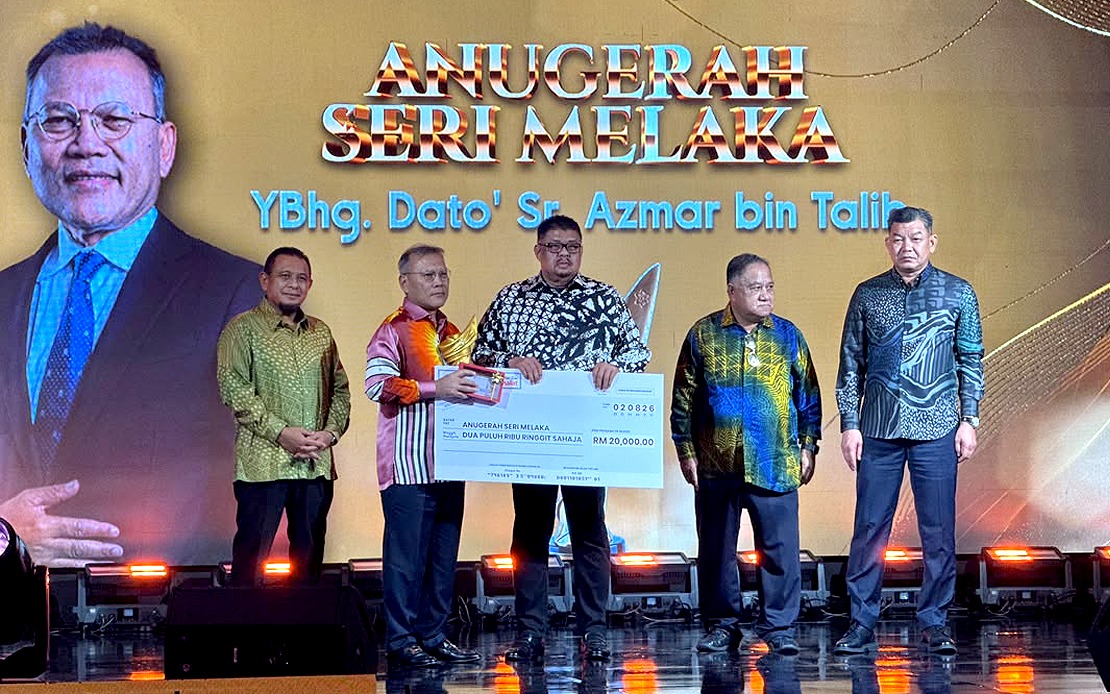
Melaka's Chief Minister Datuk Seri Ab Rauf Yusoh has launched an ambitious appeal to the state's most accomplished citizens, urging them to transform their personal achievements into collective resources for regional development. Speaking at the prestigious Anugerah Seri Melaka (ASM) Gala Night held at the Melaka International Trade Centre in Ayer Keroh, Ab Rauf articulated a vision wherein successful Melakans would transition from individual triumph to roles as institutional partners working alongside the state administration. This reframing of excellence—from personal legacy to public asset—represents a deliberate effort to harness the intellectual and professional capital that has accumulated within the state's diaspora and established elite.
The Chief Minister framed his proposal within the broader Melaka Sayang Rakyat (MeSRa) initiative, positioning it as an infrastructure for converting inspiration into tangible opportunity. Rather than allowing accomplishments to remain confined within individual biographies, the government seeks to create a systematic repository of success narratives that can guide aspiring Melakans navigating their own professional and personal journeys. This approach acknowledges a persistent challenge in developing economies: talented individuals achieve success but rarely institutionalise the knowledge and networks that enabled their advancement, creating missed multiplier effects for their home states.
Ab Rauf's framing carries particular relevance for Melaka, a state competing for regional prominence against larger counterparts like Selangor and Kuala Lumpur. By mobilising successful natives as ambassadors and mentors, the state government hopes to reverse brain drain patterns and create self-sustaining ecosystems wherein achievement at one level becomes a launchpad for others. The invitation extended to these individuals—to leverage accumulated experience, professional expertise, and established networks—positions them as bridge-builders between institutional capacity and entrepreneurial ambition.
The Anugerah Seri Melaka programme itself demonstrates this philosophy through concrete recognition. The award scheme operates across four distinct categories: Public Service, Corporate, Sports, and Arts and Culture, reflecting the government's understanding that excellence manifests across multiple spheres. The diversity of categories signals an intentional effort to celebrate not merely commercial or administrative achievement but also cultural and athletic prowess, acknowledging that state identity extends far beyond economic metrics.
The inaugural awards recognised individuals whose career trajectories exemplify the calibre of talent the state seeks to mobilise. Datuk Azmar Talib, chief executive officer of TRX City Sdn Bhd, claimed the Corporate category award, representing achievement within Malaysia's dynamic urban development sector. Aaron Chia's recognition in Sports, specifically for his accomplishments in national badminton, highlights excellence in a sporting sphere where Malaysia maintains considerable international standing. Performing arts director Lokman Abd Ghani's Arts and Culture award acknowledges the creative industries, an increasingly significant economic and soft-power dimension for Malaysian states.
The Public Service category award to Datuk Zamri Misman, director-general of the Legal Affairs Division at the Prime Minister's Department, underscores the government's desire to involve high-ranking civil servants in state-level partnerships. This inclusion suggests that the initiative aims beyond private sector engagement, seeking to mobilise bureaucratic expertise and institutional relationships that senior government officials possess. The Special Category award to international medical science researcher Dr Saiful Anuar Singar extends the programme's reach into academic and research domains, vital sectors for technology-driven regional competitiveness.
The programme attracted robust participation, with more than 200 nominations received across categories, indicating genuine interest from Melaka's achievement-oriented demographic. This nomination volume suggests awareness and acceptance of the initiative within professional and social networks across the state. Each nomination, according to Ab Rauf, encapsulates distinctive personal journeys shaped by dedication, sacrifice, and perseverance—narratives that carry persuasive power for younger audiences navigating their own career uncertainties.
Financially, the initiative demonstrates meaningful commitment. Individual category winners received RM10,000 in cash alongside trophies, while the overall ASM award recipient garnered RM20,000. While modest in absolute terms, these financial commitments signal institutional recognition and create tangible incentives for participation. More significantly, the public ceremony and formal recognition provide reputational benefits that extend beyond monetary compensation, particularly for professionals operating in competitive fields where visibility and credibility drive opportunity.
The underlying strategic calculation reflects broader Southeast Asian development patterns. States and regions increasingly recognise that formal infrastructure—roads, ports, industrial zones—requires complementary human capital ecosystems to maximise returns. Melaka's Chief Minister appears to understand that attracting and retaining talent requires creating structured pathways whereby accomplished individuals receive recognition while gaining platforms to mentor peers and successors. This represents a form of institutional networking that transforms individualistic success into community asset.
For Malaysian stakeholders, this initiative carries implications extending beyond Melaka itself. The model suggests how other states might mobilise their respective talent pools without requiring massive capital investment. By formalising relationships between accomplished natives and government development objectives, states create low-cost mechanisms for knowledge transfer and opportunity creation. This approach proves particularly valuable for medium-tier states competing against federal economic dominance.
The mentorship dimension warrants particular attention. Ab Rauf explicitly positioned excellence as transmissible—one individual's success providing pathways for others. This philosophy contradicts zero-sum framings of professional advancement while creating positive incentives for knowledge sharing rather than gatekeeping. In sectors where Malaysia aims to develop regional competitiveness, such collaborative frameworks could accelerate capability development beyond what conventional education systems alone achieve.
Moving forward, the programme's success depends substantially on translating ceremonial recognition into sustained partnership mechanisms. Formal recognition and financial awards must connect with concrete collaborative projects wherein award recipients provide actual mentorship, facilitate network access, or contribute expertise to state initiatives. Without such structural follow-through, the initiative risks becoming performative—recognising achievement without catalysing transformation. The most accomplished Melakans likely possess demanding professional commitments elsewhere, requiring clearly delineated partnership frameworks to ensure meaningful engagement.
Melaka's Anugerah Seri Melaka initiative ultimately represents an evolved understanding of regional development. Rather than viewing talented individuals as brain-drain losses, the state government proposes incorporating them as strategic assets whose influence and expertise buttress institutional capacity. Success hinges on translating inspirational rhetoric into operational partnerships wherein accomplished individuals genuinely facilitate opportunity creation for succeeding generations.

