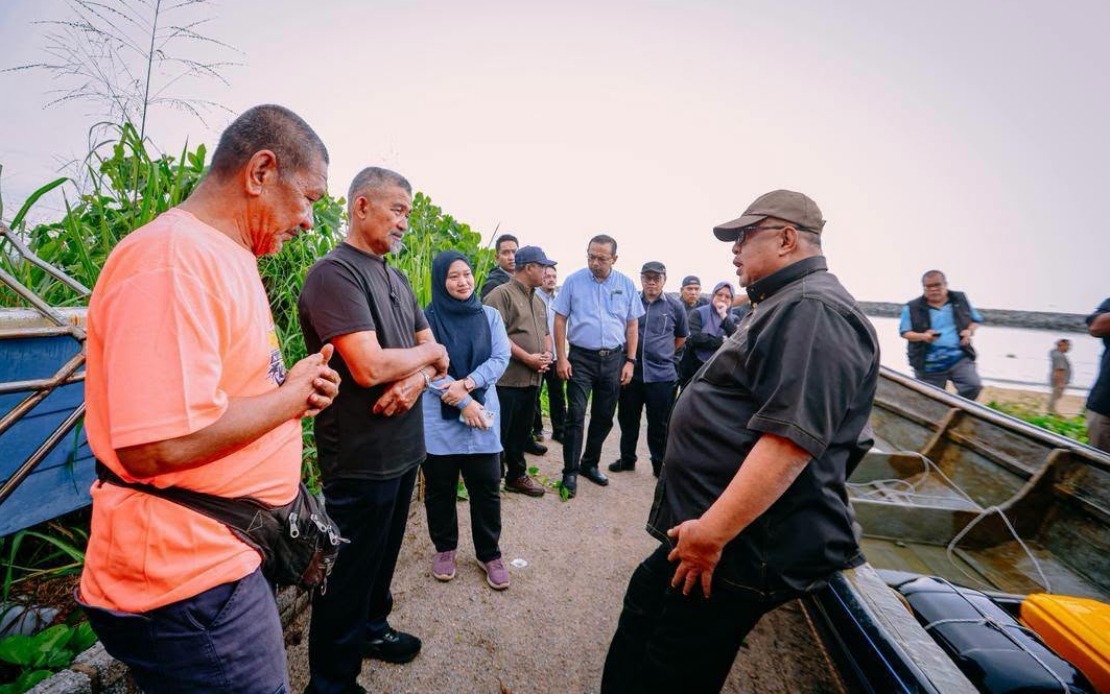
Melaka's leadership has mobilised multiple government agencies to tackle mounting challenges facing the fishing community in Pasir Gembur, Tanjung Bidara, signalling a direct intervention at the administrative level. Chief Minister Datuk Seri Ab Rauf Yusoh announced the coordinated action following an on-site assessment where he engaged directly with local fishermen and residents to understand the pressures they face. The decision represents an escalation from routine administrative processes, indicating the state government views these issues as requiring immediate executive attention and resource allocation.
The problems confronting the fishing community centre on infrastructure inadequacy and environmental vulnerability. Fishermen have raised concerns about water channels insufficient for their vessels and the risk of seawater intrusion and tidal flooding threatening the proposed new fishermen's complex. These issues strike at the heart of operational viability for a coastal community dependent on predictable access to the sea and secure facilities. The infrastructure deficits also hint at broader development pressures in coastal areas where competing land uses and rising sea levels complicate planning and investment.
In response, the Drainage and Irrigation Department has been assigned to conduct a thorough feasibility study examining the possibility of deepening the channel between Pasir Gembur and Batu Tenggek. This investigation will determine technical and financial viability, establishing whether enhanced waterway capacity can be achieved sustainably. The Public Works Department, meanwhile, faces the task of identifying and preparing an alternative site for the fishermen's complex that reduces vulnerability to tidal surge and saltwater damage. Relocating the facility represents a significant undertaking, requiring site assessment, acquisition procedures, and potential community relocation discussions.
The state government has also introduced regulatory controls aimed at preventing further encroachment and unauthorised development in coastal areas. A freeze on private structures within the coastal wave-breaker zone aims to protect maritime safety and environmental integrity. Crucially, all existing and future development within the coastal reserve must now obtain a Temporary Occupation Licence from the Land Administrator and secure clearance from relevant technical departments. This formalisation of land use controls tightens oversight but may also create administrative friction and compliance costs for current occupants and future investors.
The regulatory framework reflects an attempt to balance coastal access rights with environmental protection and public safety. By requiring licensing and departmental approval, the state establishes a mechanism for vetting proposals against flood risk, maritime security, and ecological considerations. However, implementation will depend on agency coordination and resource availability. Neighbouring localities and other Malaysian coastal zones facing similar pressures may observe how Melaka's approach functions in practice, particularly regarding the enforcement of licensing requirements and the timeline for facility relocation.
Ab Rauf's public statements emphasise this response as evidence of substantive governance rather than symbolic engagement. His characterisation of the site visit as motivated by problem-solving rather than ceremonial duty attempts to reframe political accountability around tangible outcomes. The Chief Minister framed the intervention within the broader state narrative of "Melaka Sayang Rakyat" (Melaka Cares for the People), suggesting that this case exemplifies how state policy translates into direct community benefit. For residents in Pasir Gembur, the credibility of such commitments will ultimately depend on delivery speed and effectiveness.
The coordination architecture established through this intervention involves multiple agencies including the Alor Gajah Municipal Council, reflecting recognition that water management, land administration, and local governance must operate in concert. Such multi-agency coordination can be complex and time-consuming, with competing priorities and budget cycles often delaying implementation. The success of these initiatives will partly hinge on whether participating agencies prioritise the fishing community's needs and whether the Chief Minister's office maintains political pressure to prevent bureaucratic inertia.
For Malaysia's fishing sector more broadly, the Tanjung Bidara case illustrates persistent infrastructure gaps in small-scale fishing communities. Many coastal settlements across Peninsular Malaysia and East Malaysia contend with similar challenges: inadequate maritime facilities, flooding risk, and limited investment in dedicated fisheries infrastructure. State-level interventions like Melaka's are therefore significant for demonstrating how political will can activate problem-solving machinery, though they also highlight that such solutions often depend on individual chief ministers' priorities rather than systematic, nationwide policy frameworks.
The fiscal implications of these interventions merit consideration. Channel deepening, site relocation, and regulatory enforcement all carry costs that must be accommodated within state budgets often constrained by competing demands. Whether Melaka's commitment translates into adequate budget allocation remains uncertain, particularly if initial feasibility studies identify expensive solutions. The fishing community's long-term security also depends on whether these interventions address root causes or merely treat symptoms of unsustainable coastal development patterns.
Regionally, Malaysia's coastal management challenges echo across Southeast Asia as urbanisation, climate variability, and sea-level rise intensify pressure on fishing communities. Melaka's approach—combining infrastructure investment, regulatory control, and inter-agency coordination—reflects strategies attempted throughout the region. However, outcomes vary significantly depending on implementation quality, political continuity, and community participation in planning decisions. The Tanjung Bidara case will merit monitoring to assess whether announced measures materialise and whether they generate models applicable to other Malaysian fishing localities.

