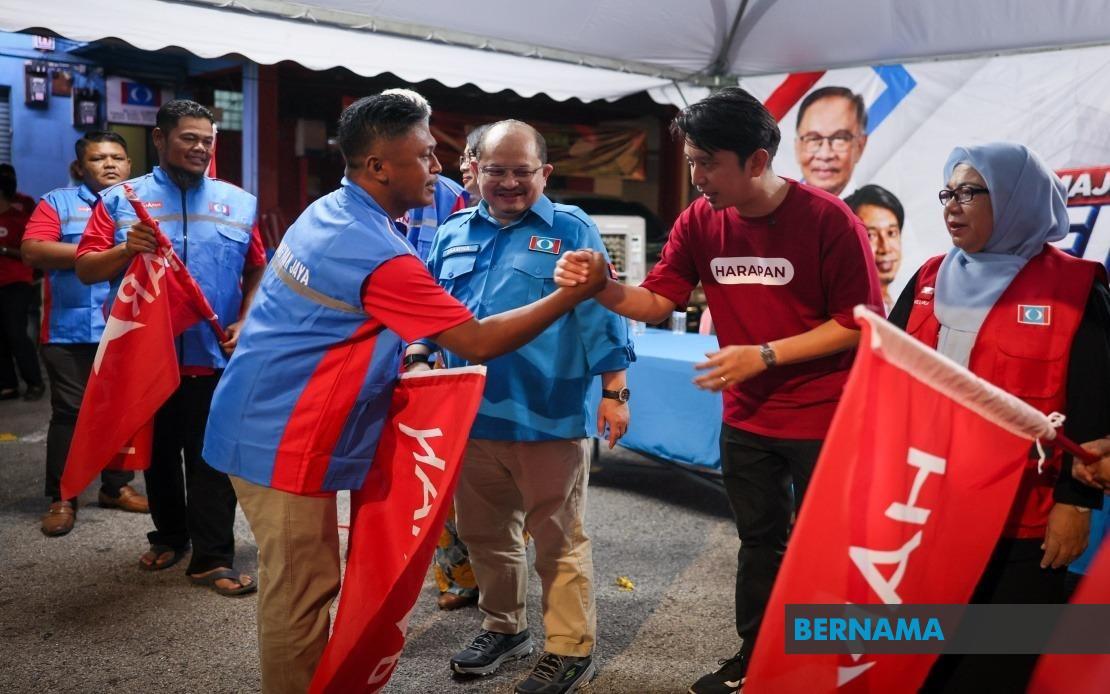
The People's Justice Party (PKR) in Melaka has signalled its intention to move up the timeline for announcing its slate of candidates for the forthcoming state election, seeking to give newly selected contenders sufficient runway to prepare for the campaign. This strategic decision reflects the party's commitment to field fresh political talent while maintaining organisational rigour in what has historically been a challenging selection process constrained by competing pressures and last-minute adjustments.
Adam Adli Abdul Halim, who serves as acting chairman of the Melaka PKR Leadership Council and Deputy Minister of Higher Education, outlined the reasoning behind the accelerated schedule during remarks made following the launch of the Keadilan Election Machinery for the Hang Tuah Jaya branch in Taman Bukit Piatu. The party leadership has evidently learned from previous cycles where candidate announcements were delayed, creating cascading difficulties for campaign preparation and public engagement. By moving the announcement forward, PKR hopes to eliminate the last-minute scrambles that have repeatedly undermined its ability to mobilise supporters effectively.
The candidate selection mechanism being employed involves a carefully structured vetting process that operates across multiple organisational layers. Potential contenders undergo initial screening at the branch level, followed by evaluation at the state headquarters, before files are transmitted to party central authorities where the president ultimately approves the final list. This hierarchical approach aims to balance grassroots input with party discipline, though it also creates multiple potential bottlenecks where consensus building becomes necessary.
A critical dimension of PKR's candidate strategy centres on demographic representation and ideological renewal. The party is explicitly attempting to elevate what it terms "new faces"—presumably meaning candidates without prior electoral experience or those entering politics at younger ages. Simultaneously, party leaders are prioritising greater inclusion of women candidates and younger party members, acknowledging that generational refresh and gender parity represent both moral imperatives and electoral necessities in contemporary Malaysian politics. Achieving this balance requires time for proper vetting, media training, and ground familiarisation.
The extended preparation timeline also reflects PKR's recognition that untested candidates require substantial institutional support to mount credible campaigns. Rather than parachuting new contenders into unfamiliar constituencies mere weeks before polls open, the party intends to embed them within functioning electoral machinery, allowing them to build personal networks, understand local issues, and develop public profiles before formal campaigning commences. This investment in candidate development represents a longer-term thinking about party sustainability beyond any single electoral cycle.
Beyond candidate selection, PKR is undertaking a parallel initiative to strengthen its election machinery across multiple parliamentary constituencies within Melaka. Planned activation launches in Tangga Batu, Hang Tuah Jaya, Alor Gajah, Masjid Tanah and Jasin indicate systematic efforts to reinvigorate ground organisations that may have atrophied since the last election. This ground-up reconstruction work occurs independently of candidate announcements, ensuring that robust campaign infrastructure exists regardless of who eventually carries the party's banner in each contest.
Adam Adli emphasised that operational readiness of the party machinery takes precedence over the identity of specific candidates. This seemingly counterintuitive prioritisation actually reflects sophisticated campaign theory: a strong organisational foundation can accommodate various candidate profiles and adapt to changing circumstances, whereas an exceptional individual candidate cannot overcome institutional weakness. By front-loading investment in machinery and preparation, PKR aims to insulate itself against the vulnerabilities that plagued previous campaigns.
On the broader political front, potential cooperation between Pakatan Harapan (PH)—the coalition encompassing PKR, Democratic Action Party, Amanah, and allied parties—and Barisan Nasional (BN) has proceeded at an exploratory level rather than advancing to formal negotiations. Adam Adli characterised such discussions as ongoing informally but noted that substantive negotiations to determine the specific form of any electoral cooperation arrangement have not yet materialised. PH election director Datuk Seri Amirudin Shari and Melaka Chief Minister Datuk Seri Ab Rauf Yusof have established communication channels, though scheduling a formal negotiation session remains pending.
The possibility of PH-BN alignment at the state level reflects broader patterns of pragmatic coalition politics now prevalent across Malaysia. Rather than ideological rigidity, many politicians prioritise electoral mathematics and resource deployment. However, such arrangements remain politically sensitive, particularly for PKR, which has historically positioned itself as an oppositional force to BN's decades-long dominance. Any cooperation agreement would require careful political messaging to avoid accusations of abandoning democratic principles or compromising with an allegedly corrupt ancien régime.
Adam Adli explicitly stated that formal cooperation should not only facilitate vote coordination but also elevate the quality and tenor of political discourse in Melaka. Both coalitions have ostensibly recognised that electoral campaigns characterised by personal attacks, unsubstantiated allegations, and divisive rhetoric damage democratic culture and public confidence in institutions. By negotiating ground rules, even informally, coalition leaders hope to model more responsible political competition—though implementation frequently fails to match rhetoric.
The contingency planning implicit in PKR's statements indicates readiness to contest the Melaka election independently if PH-BN negotiations prove inconclusive. This maintains party autonomy and avoids appearing desperate for alliance arrangements while providing a credible alternative should discussions stall. The party's substantial organisational investments in state-level machinery simultaneously hedge against multiple electoral scenarios: success under coalition arrangements, competitive performance in a three-way race, or independent contestation.
Malaysia's state politics have become increasingly volatile following the complex reshuffles of Kuala Lumpur and Putrajaya governance and the succession of political crises affecting Selangor and other territories. Melaka, despite being physically compact, punches above its weight in national political narratives due to its historical significance and swing-state characteristics. How PKR manages its candidate selection and coalition positioning in Melaka often signals broader strategic directions that filter through to other state elections and federal politics. The party's emphasis on preparation, inclusivity, and organisational strength suggests it is preparing for a competitive electoral environment where margins will remain tight and voter sentiment volatile.

