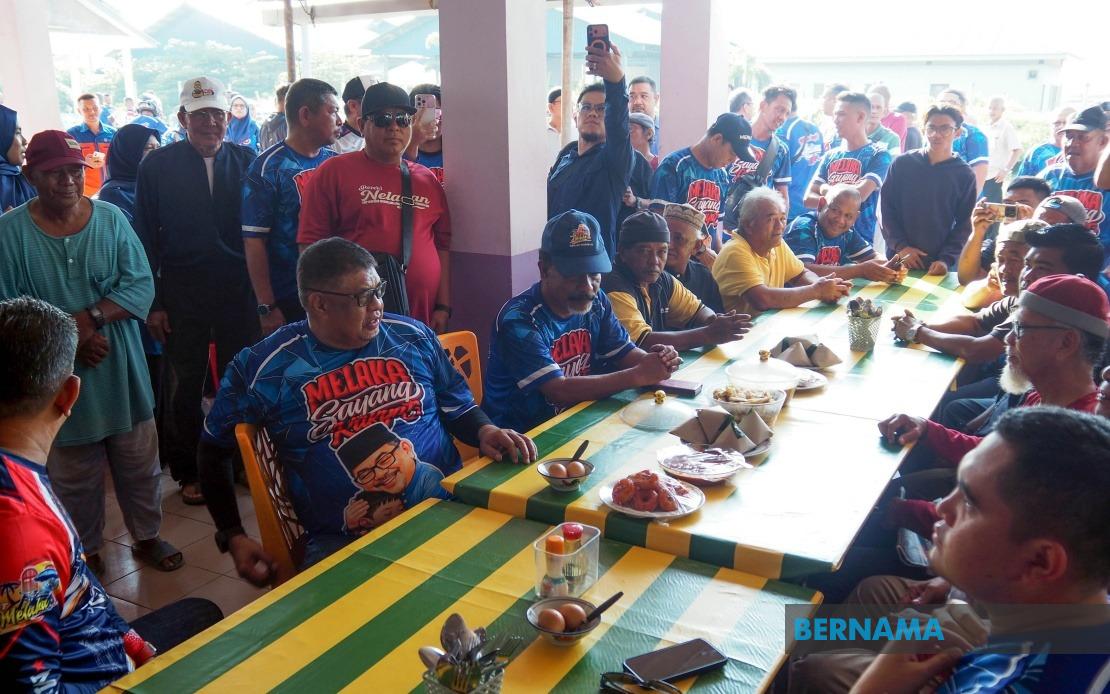
Melaka's state government has unveiled a comprehensive package of support measures targeting the livelihoods of registered fishermen, centring on mandatory social security protection through PERKESO and the provision of modern fish-detecting equipment. The announcement came during Chief Minister Datuk Seri Ab Rauf Yusoh's fifth community engagement tour across the state, held at Kuala Sempang Jetty in the Merlimau constituency on July 17.
The rollout reflects a deliberate shift in governance approach by the Melaka administration, one that prioritizes direct engagement with working communities rather than reliance on centralised policymaking. Ab Rauf stressed that government officials must venture into the field to observe conditions firsthand and respond authentically to grassroots concerns. By touring with State Executive Council members across different constituencies, the administration seeks to identify practical gaps in existing support structures and design interventions that resonate with those affected. This philosophy underscores the broader initiative, positioning it as evidence-based rather than symbolic.
The PERKESO component addresses a longstanding vulnerability in Malaysia's informal maritime economy. Fishermen operating at sea face considerable occupational hazards, yet many lack adequate social insurance. By extending mandatory coverage to all registered fishermen, Melaka effectively bridges a protection gap that left workers exposed to income loss from injury or illness. This aligns with broader social security trends in Southeast Asia, where governments increasingly recognise that informal-sector workers require institutional safeguards to maintain household stability and reduce poverty risk. For Melaka's fishing communities, the move signals formal recognition of their economic contribution and vulnerability.
The fish-finder provision addresses productivity directly. These electronic devices, which detect underwater fish concentrations using sonar technology, transform fishing from an experience-based guesswork exercise into a data-informed operation. Amirul Shah Fuad Shah, a 35-year-old fisherman with over two decades in the trade, articulated the practical value: devices costing between RM1,000 and RM2,000 privately become affordable when subsidised by government, enabling operators to locate productive waters faster and reduce wasted effort. The efficiency gains matter considerably in an era of declining catches across Southeast Asian waters, where climate change and overfishing have contracted traditional fishing grounds. Technology adoption thus becomes a survival strategy for small-scale operators.
Immediate relief measures accompanied the longer-term initiatives. The government distributed RM21,400 in cash assistance through the Bantuan Jaring Nelayan scheme, averaging RM200 per fisherman across 107 recipients. Additionally, 360 kilogrammes of fish stock—valued at RM3,600—was distributed to the public at approximately 1.5 kg per person. These transfers serve dual purposes: they provide tangible household income support while helping fishermen offload catch during periods of market glut or low prices, a common seasonal challenge in maritime communities.
Md Khalil Md Jadi, chairman of Kampung Sempang Fishermen's Association, characterised the initiatives as meaningful acknowledgment of a demographic reality. Many fishing-community members are elderly individuals who lack alternative income sources and depend entirely on maritime labour. For this population, both the social security safety net and productivity-enhancing technology address real constraints: the risk of economic catastrophe from injury or illness, and the declining catch volumes that make traditional methods increasingly untenable. The combination of protection and modernisation reflects an understanding that welfare and economic development are interconnected rather than competing priorities.
The technological dimension merits particular scrutiny for its implications across Malaysian fisheries policy. Fish-finder adoption represents gradual mechanisation of artisanal fishing, a transition with mixed implications. On one hand, it improves efficiency and income for individual operators, potentially supporting household wellbeing. Conversely, sector-wide adoption could accelerate resource depletion if not coupled with strict catch limits and marine spatial planning. Melaka's initiative does not explicitly address sustainability constraints, raising questions about whether technology provision should integrate environmental management frameworks.
The Jelajah Ketua Menteri Sayang Rakyat tour represents a broader political communication strategy. By visiting constituencies sequentially and announcing targeted assistance, the government generates media coverage and demonstrates responsiveness to constituent concerns. For fishing communities, often geographically dispersed and politically marginalised, such visible engagement signals inclusion in state priority-setting. Whether this translates into sustained investment or remains a campaign-cycle phenomenon will depend on implementation consistency and budget allocation in subsequent fiscal years.
Comparative context enriches understanding of Melaka's approach. In Thailand and Vietnam, governments have similarly introduced subsidy schemes and technology assistance for fishing communities facing resource scarcity and market pressures. However, such initiatives vary significantly in scope and integration with broader fisheries management. Melaka's dual-track approach—combining social protection with productive capacity enhancement—represents a more holistic intervention than many programmes that focus narrowly on either welfare or technology transfer alone. This integrated model offers potential lessons for other Malaysian states managing comparable fishing-sector challenges.
Implementation logistics will determine actual impact. PERKESO coverage expansion requires administrative coordination to register eligible fishermen and process contributions. Fish-finder distribution involves logistics, training, and maintenance support to ensure devices remain functional. Funding sustainability also requires clarification: whether the scheme operates as a one-time programme or reflects permanent budget allocation shapes its long-term benefit trajectory. Without transparent implementation timelines and performance metrics, announcing initiatives can exceed actual capacity to deliver equitable outcomes across all registered operators.
For Malaysia's fishing communities more broadly, Melaka's announcement signals emerging policy recognition that artisanal fishing faces structural challenges requiring multifaceted state intervention. Rather than treating fishing as a declining sector to be gradually abandoned, these initiatives reframe it as worthy of public investment in security and modernisation. This stance contrasts with some policy narratives that emphasise fish farming or tourism-oriented restructuring as superior alternatives. Whether this Melaka-led model influences state-level policy elsewhere in Malaysia, and whether federal fisheries policy evolves accordingly, will shape opportunities for Malaysia's remaining artisanal fishing populations.

