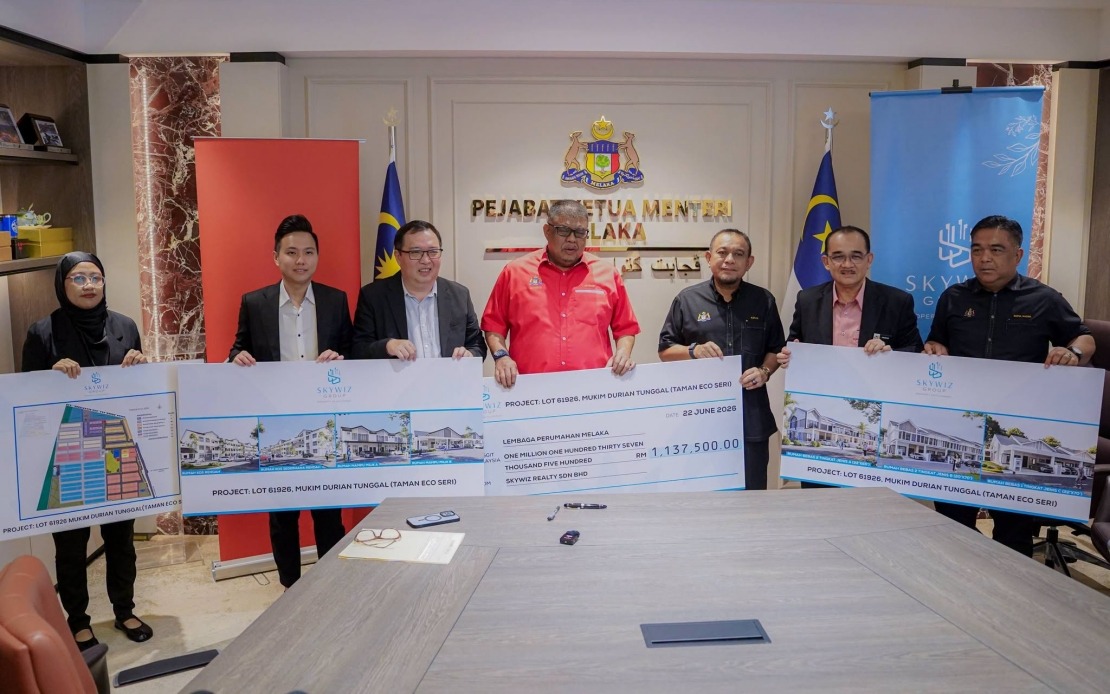
Melaka's Chief Minister Datuk Seri Ab Rauf Yusoh has signalled the state government's intention to make lift installations a requirement rather than an optional upgrade in new multi-storey property developments, addressing a persistent challenge affecting both buyer accessibility and market performance across the state. Speaking after overseeing the signing of an Affordable Housing Development Agreement involving the Melaka Housing Board and Skywiz Reality Sdn Bhd, Ab Rauf characterised lift facilities as fundamental infrastructure rather than a luxury amenity, particularly for elderly residents navigating residential and commercial spaces.
The push comes as Melaka grapples with a notable inventory problem in its property sector. Developments scattered across established districts including Kota Laksamana, Banda Hilir and Melaka Raya have experienced prolonged periods without sales, a situation Ab Rauf attributed partly to the absence of vertical accessibility infrastructure. By proposing a policy that would require proposed shoplots and three-storey residential properties to incorporate lifts, the state government is attempting to remove a significant barrier to both practical usability and consumer confidence in these properties.
The timing of this announcement reflects broader housing challenges in the state. Melaka has completed 23,514 affordable homes to date but remains committed to a far more ambitious target of constructing over 38,440 additional affordable residential units in coming years. This expansion represents a critical component of the state's Melaka Sayang Rakyat initiative, which positions homeownership as foundational to strengthening family structures and fostering sustainable community development across the state.
For property purchasers in Malaysia, particularly ageing populations and families with mobility considerations, the availability of lifts transforms the practical utility of multi-storey buildings. In many Southeast Asian markets, developers have historically treated such facilities as premium features justifying higher prices, restricting their availability to upper-market segments. Melaka's proposed policy would shift this expectation, potentially establishing a baseline standard that competitors in other Malaysian states may eventually be pressured to match.
The developer accord signed during the announcement illustrates how this accessibility focus is being operationalised on the ground. Skywiz Reality Sdn Bhd will construct 903 housing units across a 26.56-hectare site in Mukim Durian Tunggal, Alor Gajah, with completion targeted within three years. Of these units, 453 are designated as affordable homes distributed across four categories: 61 low-cost houses, 54 low-medium cost homes, 200 Type A affordable units and 138 Type B affordable units. The remaining 450 units will target the open market, generating RM2.38 million in returns for the Housing Board.
The developer has been mandated to commence construction within 90 days of receiving Form B approval from the Hang Tuah Jaya Municipal Council, establishing a clear timeline for project activation. This contractual framework reflects the state government's determination to prevent the lengthy delays that have plagued other residential initiatives, while also creating accountability mechanisms tied to specific performance milestones regarding schedule adherence, construction specifications and quality standards.
For Malaysian investors and property professionals, this policy direction signals an evolution in how state governments are approaching residential development standards. Accessibility requirements historically relegated to niche segments are moving into mainstream consideration, driven by demographic realities and stalled inventory issues. Developers operating across Malaysian states may find themselves navigating increasingly divergent regulatory expectations, with some jurisdictions potentially following Melaka's lead in mandating lift installations as development prerequisites.
The state government's monitoring framework underscores its intention to move beyond aspirational policy rhetoric toward concrete implementation. The Melaka Housing Board will actively oversee the Skywiz Reality project, verifying compliance with agreed specifications and project timelines. This supervisory approach contrasts with less rigorous oversight structures that have historically allowed some developments to proceed without meeting original commitments.
From a broader Southeast Asian perspective, Melaka's initiative addresses accessibility challenges increasingly recognised across the region's rapidly urbanising landscapes. As demographic projections indicate growing proportions of elderly residents in Malaysia and neighbouring countries, property markets face mounting pressure to accommodate mobility limitations. Governments that fail to address these requirements through regulatory frameworks may experience rising inventory problems in aging-targeted segments, mirroring challenges already evident in Melaka's property landscape.
The financial implications also merit consideration. For developers, mandatory lift installations increase construction costs per unit, potentially affecting pricing strategies and profit margins. However, Ab Rauf's framing suggests that improved marketability and reduced inventory periods justify these additional expenditures, particularly in markets where properties have languished without meaningful sales activity. This cost-benefit analysis may prove influential as other Malaysian states evaluate similar policies.
Melaka's approach also reflects recognition that affordable housing policies require complementary measures addressing quality-of-life factors beyond pricing. By pairing affordability mandates with accessibility standards, the state positions homeownership not merely as a financial transaction but as a determinant of genuine habitability. This holistic perspective may resonate with Malaysian policymakers increasingly aware that housing affordability divorced from usability creates hollow victories, leaving residents in properties they cannot practically occupy.
Moving forward, the success of this policy will depend substantially on implementation consistency and developer compliance. Early outcomes from the Skywiz Reality project will likely influence investor confidence in Melaka's development ecosystem and potentially attract or deter future participation from major developers. Should the initiative demonstrate tangible benefits through accelerated sales and improved occupancy rates, other Malaysian state governments may embrace similar mandatory standards, gradually reshaping how the nation's property sector approaches accessibility infrastructure.

