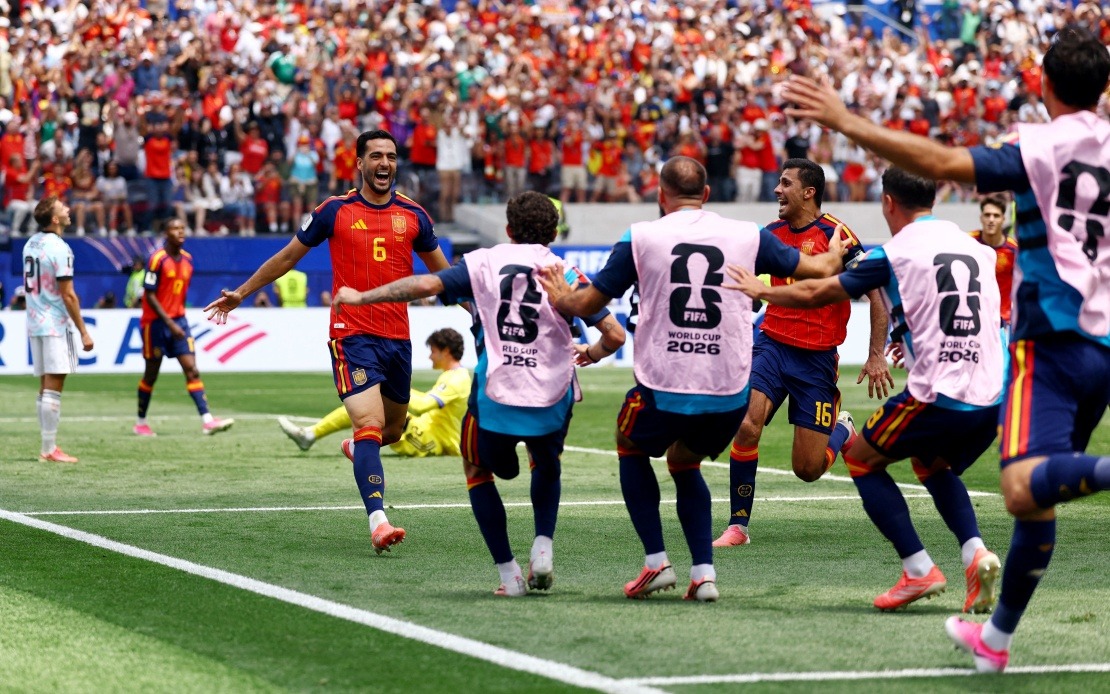
Spain has advanced to the World Cup semi-final following a 2-1 victory over Belgium in Inglewood, California on Friday, setting up a high-stakes encounter with France that will serve as a rematch of this year's European Championship semi-final. Mikel Merino, introduced as a second-half substitute, settled the match with a goal in the 88th minute, continuing a pattern of crucial contributions from the Arsenal midfielder off the bench during Spain's tournament run.
The European champions established their superiority early, with Fabián Ruiz breaking the deadlock in the 30th minute to put Spain ahead. However, Belgium responded through Charles De Ketelaere's levelling strike, briefly threatening an upset despite labour under significant personnel challenges. The equaliser also marked a notable milestone in unwanted terms for Spain, as Unai Simón conceded his first goal after an extraordinary run of 649 minutes without conceding across two World Cup campaigns.
Belgium's task became increasingly difficult as the match progressed, hampered by multiple injuries that stripped the side of crucial midfield depth. Captain Youri Tielemans was forced to withdraw during the warm-up phase with what appeared to be a hamstring injury, compounding the absence of Amadou Onana, sidelined earlier in the tournament due to a knee ligament tear. These absences fundamentally altered Belgium's capacity to contest Spain's possession-based approach and defensive structure.
The situation deteriorated further for Belgium when goalkeeper Thibaut Courtois sustained an injury in the 71st minute, requiring his replacement by Senne Lammens, a Manchester United reserve keeper making his tournament debut in difficult circumstances. Lammens' inexperience at this level would prove costly as Spain capitalised on the defensive vulnerabilities created by his arrival. The Belgian side, already operating with reduced midfield resources, found it increasingly difficult to shield their makeshift defence against Spanish attacking waves.
Spain's tactical adjustments, particularly the introduction of Nico Williams and Merino, shifted the momentum decisively in their favour during the final twenty minutes. The attacking threat intensified, with Pau Cubarsi testing Lammels from range. The Belgian keeper's handling of this long-range effort proved problematic, spilling the ball in a manner that allowed Merino to finish the subsequent opportunity into the roof of the net and secure Spain's passage to the semi-final.
Merino's impact exemplified Spain's strategic depth, as the midfielder has now demonstrated a pattern of crucial interventions when called upon from the bench. His earlier match-winning contribution against Portugal in the round of sixteen showcased his capacity to deliver in high-pressure moments, a characteristic that has become central to Spain's tournament narrative. His latest finish underscored the quality available to Spanish coach Luis de la Fuente in reserve options.
The forthcoming semi-final meeting against France near Dallas on Tuesday represents a significant tactical and competitive challenge for both nations, though it carries particular resonance given their recent European Championship encounter. La Roja's victory in that Euro 2024 semi-final demonstrated their superiority over the French and established them as genuine tournament contenders. However, France's status as a two-time World Cup champion with multiple appearances in final tournaments commands respect regardless of previous head-to-head outcomes.
France enters the semi-final having won the competition in 1998 and 2018, though they suffered disappointment four years ago when finishing as runners-up to Argentina in Qatar. The French have navigated the tournament successfully to this juncture, but they acknowledge that Spain represents a qualitative step upward from opponents faced previously. Spanish dominance over Belgium, despite the Belgian side's injuries, demonstrated the level of control and tactical sophistication that Spain can deploy throughout ninety minutes.
For Spanish football, the semi-final represents an opportunity to advance further toward a second World Cup title, their only previous success coming in 2010. The competition's trajectory through the tournament has progressively elevated opponent quality, and reaching the final would represent a significant achievement for a squad that remains in a generational transition while maintaining possession-based principles that have defined Spanish football for over a decade.
The semi-final clash will test whether Spain's tournament momentum, collective discipline, and tactical flexibility can overcome France's established pedigree and tournament experience. Both nations bring contrasting philosophies and personnel to the match, with Spain emphasizing controlled possession and defensive solidity, while France relies on dynamic attacking capability and individual player quality. The winner will advance to face either Argentina or Netherlands in the final, with the semi-final stage traditionally separating genuine contenders from pretenders in world football's premier competition.

