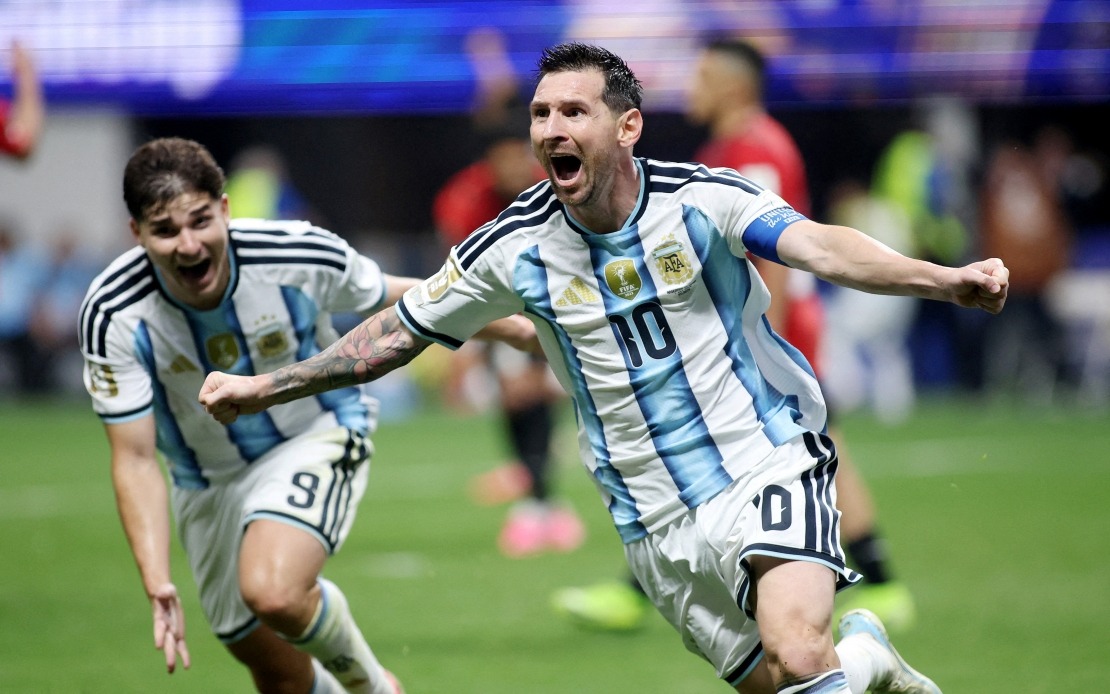
Lionel Messi returns to World Cup glory in what appears to be his twilight years, leading Argentina against England in Atlanta with a record-breaking campaign that has defied expectations about athletic longevity and competitive hunger. At 39 years old, the Argentine forward has accumulated eight goals in this tournament, matching France's Kylian Mbappé in the race for the Golden Boot and demonstrating that his appetite for the sport's grandest stage remains undiminished nearly two years after lifting the trophy in Qatar.
Messi's 2022 World Cup triumph represented something approaching a storybook ending to his international career. He orchestrated Argentina's passage to the final with extraordinary performances, ultimately scoring seven goals across the campaign, including two crucial strikes in the championship match against France. That victory seemed to fulfil a lifelong ambition for a player whose entire career had been shadowed by the absence of a World Cup medal, and many observers assumed the tournament would serve as his appropriate farewell. The collective desire within the Argentine squad to secure the title before Messi's retirement appeared to crystallise their focus and unity throughout that competition in the Middle East.
Yet here he stands again, not merely participating but leading from the front with a hunger that suggests his competitive fire has not diminished with age. The interval between tournaments—some four years—would typically signal the end of any footballer's international career, particularly one who had already achieved the sport's most coveted prize. Instead, Messi has returned to demonstrate that exceptional athletes operate by different rules, and that motivation and conditioning can extend playing careers well beyond conventional expectations. His presence continues to elevate Argentina's prospects and provides a focal point for their attacking philosophy.
The statistics accumulated across this tournament reveal a player operating at a level that contradicts his age and experience. Mbappé, his closest challenger, holds a marginal advantage through secondary metrics including assists and minutes played efficiency, but the pair have decisively moved ahead of the traditional scoring hierarchy. Together, they have obliterated Miroslav Klose's previous all-time World Cup record of 16 goals, with Messi now standing at 21 total career World Cup goals and Mbappé menacingly positioned at 20. England's Harry Kane, another experienced campaigner, has also accelerated up the historical scoring list with 14 goals, though he falls considerably behind the leading pair.
Beyond raw goal-scoring tallies, Messi and Ronaldo have become the first male players to participate in six World Cup tournaments, fundamentally reshaping expectations about career longevity at the international level. This shared milestone carries particular resonance given the decades-long rivalry between the Argentine and Portuguese legends, who have pushed each other toward ever-greater achievements throughout their careers. Messi is now positioned to eclipse Ronaldo's appearance record, with his 33rd World Cup match on Wednesday setting him six clear of his Portuguese counterpart in terms of total outings. This progression from their shared record-setting in tournament appearances to individual distinction underscores the competitive intensity that continues to drive both players.
Messi's World Cup journey, spanning from his debut in 2006 to the current tournament, illustrates the ebbs and flows of even exceptional careers. His initial tournament appearance saw him contribute a single goal before a goal-less campaign in South Africa in 2010, suggesting that early uncertainties about whether he could replicate his phenomenal club form at international level. However, his four-goal performance at Brazil 2014—when Argentina reached the final—signalled his emergence as a tournament focal point, and he added a single goal to that tally in 2018. The remarkable breakthrough came with age, when at 35 he outperformed his previous four World Cup campaigns combined, a paradoxical reality that challenges conventional wisdom about athletic decline.
The 2022 Qatar tournament that delivered his cherished World Cup medal revealed important nuances about his scoring method. Four of his seven goals emerged from the penalty spot, highlighting both his composure in high-pressure situations and the strategic advantage of converting set-pieces. However, his penalty record across all World Cup tournaments presents a more complicated picture. He has converted only four of eight penalty attempts throughout his World Cup career, excluding shootout scenarios, suggesting vulnerability in this specific domain despite his general reputation for reliability. This summer alone, he dispatched a spot-kick wide against Austria during the group stage and saw another attempt saved by Egypt goalkeeper Mostafa Shobeir in the round of 16, demonstrating that even elite performers face occasional mechanical failures.
Conversely, Messi's performance in World Cup penalty shootouts presents an unblemished record of absolute composure. He has succeeded in all three shootout situations he has encountered, converting crucial penalties against the Netherlands in 2014, against the same opponents again in the 2022 final, and in that championship match against France. These moments encapsulate his mentality in the highest-pressure scenarios, suggesting that while regular penalty-taking has proven inconsistent, the specific psychological demands of shootout situations bring out his best instincts. This distinction matters significantly for Argentina's prospects in the knockout stages, where such scenarios frequently determine advancement.
The Golden Boot award represents one of the few prestigious accolades absent from Messi's trophy collection, making this tournament particularly significant. In 2022, he finished as a runner-up in that category when Mbappé scored a hat-trick in the final despite ending on the losing side, a result that seemed to underscore the prize's somewhat arbitrary nature. This time, the same two players are locked in competition, with Mbappé holding marginal advantages in secondary metrics that would determine the award if they finish level. The trajectory of their scoring suggests both remain capable of adding to their tallies, meaning the Golden Boot remains genuinely contested rather than predetermined.
For Malaysian and Southeast Asian observers, Messi's continued prominence in global football provides important context about the sport's enduring appeal to older demographics and the international audience's sustained interest in veteran performers. His presence transcends typical sports narratives about decline and retirement, instead offering a template for how excellence can be sustained across decades through dedication and meticulous physical management. The Argentina-England matchup carries its own historical resonance, though Messi's personal quest for a second World Cup title and records that may never be matched constitutes the more compelling subplot for casual and dedicated followers alike.
As Messi prepares for his encounter with England, the broader question about his international future persists. Whether this tournament represents a genuine farewell or merely another chapter in an already extraordinary narrative remains uncertain. What seems clear is that his competitive hunger remains unabated, his technical execution remains formidable, and his presence continues to elevate not merely Argentina's prospects but the entire tournament's narrative significance. The records he has already established—his 33rd appearance, his position as a six-time World Cup participant, his mounting goal total—represent accomplishments that future generations will struggle to approach, let alone surpass.

