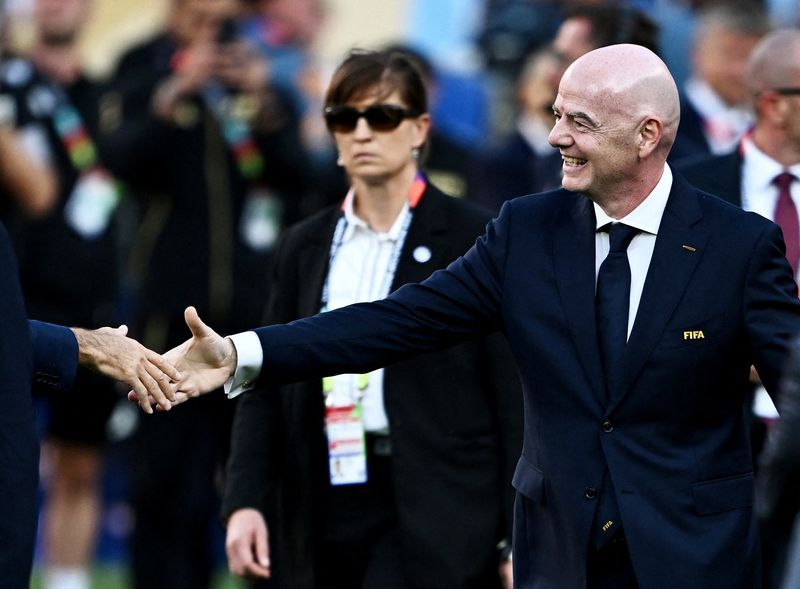
FIFA President Gianni Infantino faces a deepening institutional crisis as the world football body grapples with fallout from a controversial proposal to monetise World Cup commercial rights, with support fracturing unevenly across continental lines. Mexico and Argentina have now stepped forward to defend Infantino's leadership, marking a significant show of backing even as major regional confederations and individual national associations withdraw their endorsement or call for sweeping governance reforms.
The Mexican Football Federation, which recently co-hosted the World Cup, has taken the unusual step of breaking ranks with its own regional body CONCACAF, the confederation that oversees football in North and Central America and the Caribbean. CONCACAF had earlier demanded a "comprehensive reckoning" with Infantino's presidency, signalling deeper unease within the confederation. Mexico's stance suggests that divisions within continental blocks may prove as consequential as the broader criticism levelled at the FIFA president as his re-election campaign accelerates toward next March's Congress in Morocco.
Infantino's regional support base remains patchy and inconsistent. Africa's confederation threw its full weight behind the FIFA president on Thursday, with the Confederation of African Football unanimously endorsing his leadership. However, this backing from the world's largest continental bloc contrasts sharply with Europe's position. UEFA, the European confederation, has maintained its commitment to boycotting the World Cup and other FIFA competitions, a stance that carries considerable symbolic weight given Europe's historical influence within world football governance.
Asia's confederation has similarly aligned with the boycott movement, stating it "stood in solidarity" with both UEFA and CONCACAF, effectively positioning itself against Infantino. The confederation's decision reflects broader Asian concerns about FIFA's governance trajectory and the handling of the commercial rights controversy. South America's CONMEBOL, meanwhile, has adopted a more measured but pointed approach, issuing a statement that rejects any attempt to remove Infantino that bypasses a full vote of all 211 FIFA member associations—a procedural firewall that effectively protects the Swiss administrator from extrajudicial removal.
Mexico's federation echoed CONMEBOL's institutional protectionism, declaring that it would "neither recognise nor approve any process convened outside of that institutional framework." The FMF explicitly endorsed Infantino's efforts to develop football while emphasising institutional strengthening. Argentina's football association adopted a more diplomatic posture, acknowledging in a letter to Infantino that the commercial rights proposal had generated "far more uncertainties than certainties" and that errors had been committed. Nonetheless, the AFA affirmed FIFA's governance model as "clear, stable, and transparent," providing crucial diplomatic cover for the FIFA president.
The World Cup commercial rights proposal itself has become a lightning rod for broader governance anxieties within global football. FIFA publicly apologised for mistakes surrounding the initiative following a meeting in Rabat earlier this week, while pledging to review the decision-making processes that produced the controversy. The organisation has maintained that all actions complied with its regulations, attributing problems to process and communication failures rather than substantive breaches of governance rules. This technical defence has done little to assuage critics who view the episode as symptomatic of presidential overreach.
Croatia's football federation joined England and Albania in withdrawing support for Infantino, citing a "thorough reassessment" prompted by recent developments. The Croatian announcement underscores erosion among European national associations, traditionally significant voting blocs within FIFA's Congress. Players' union FIFPRO went further, characterising Infantino's actions as a "profound abuse of presidential power" rather than merely a governance failure, suggesting that labour movements within world football view the controversy through a lens of institutional accountability and democratic participation.
Infantino's path to re-election for a fourth term, which appeared inevitable merely two months ago, now carries genuine uncertainty. No clear rival candidate has emerged to challenge him at the March Congress, a gap that partly reflects the fragmentation of opposition. Some regional bodies favour institutional reform rather than leadership change, while others remain protective of procedural norms that safeguard sitting leadership. This procedural conservatism paradoxically strengthens Infantino's position even as his credibility suffers reputational damage.
The controversy illuminates deeper structural tensions within FIFA between centralised presidential power and more distributed regional accountability. CONMEBOL's emphasis on institutional reforms introduced over a decade ago to promote transparency suggests that even allies worry about governance drift. The split between CONCACAF's aggressive stance and Mexico's institutional deference indicates that confederations themselves lack unified positions on how aggressively to challenge Infantino, making coordinated opposition difficult to mobilise.
For Malaysian and Southeast Asian football stakeholders, the Infantino controversy carries implications for how FIFA governance decisions cascade through continental confederations and ultimately affect development funding, tournament scheduling, and regulatory frameworks. Asia's alignment with UEFA's boycott position signals that regional confederations view this moment as consequential for establishing limits on presidential authority. The unfolding drama through to March's Congress will likely influence how FIFA's leadership addresses criticisms regarding transparency, consultation, and the distribution of commercial benefits among member associations.

