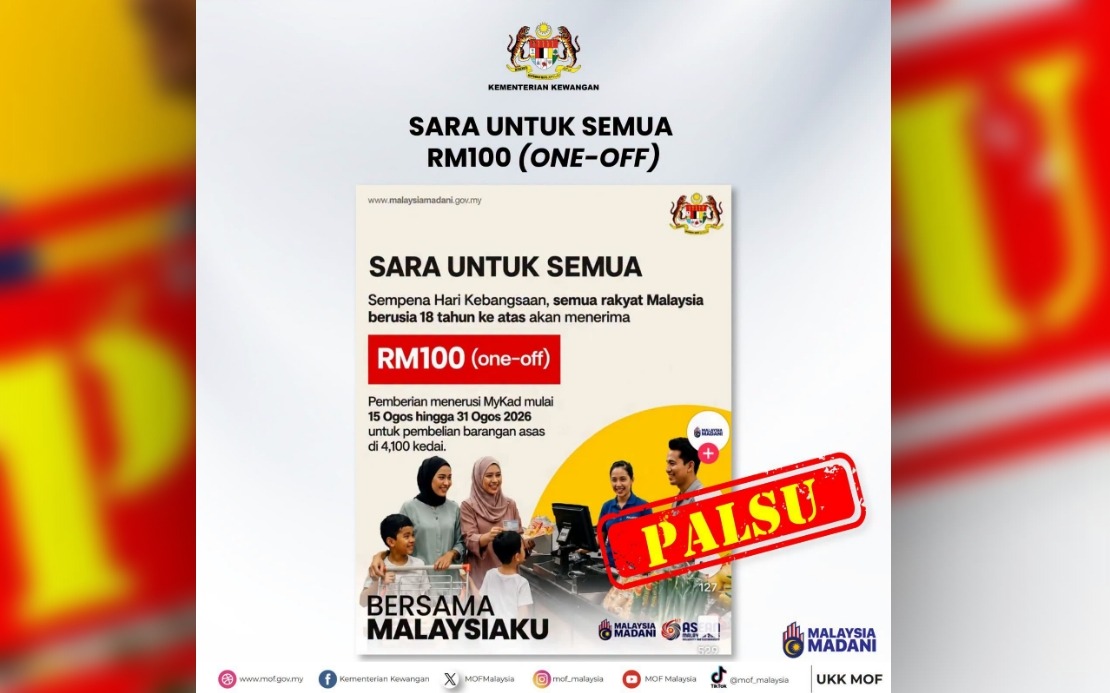
The Ministry of Finance has firmly rejected a false claim circulating on social media suggesting that all eligible Malaysians will receive a one-time RM100 payment under the Sumbangan Asas Rahmah (SARA) initiative in conjunction with the nation's National Day celebrations. Through an official statement posted on its social media platforms, the ministry categorically stated that the poster making this assertion is fraudulent and warned the public against believing or amplifying such misinformation.
This denial comes amid growing concerns about the spread of misleading financial information, particularly during festive seasons when Malaysians are more receptive to announcements about government assistance. The timing of such false claims can be particularly damaging, as citizens may alter their financial expectations or behaviour based on unverified promises of additional income. The ministry's swift intervention underscores the importance of distinguishing between authentic government announcements and fabricated claims that exploit public goodwill and festive sentiment.
In its official statement, the Ministry of Finance emphasised that no formal announcement pertaining to any special SARA payment has been made in connection with National Day. The statement highlighted a critical procedural point: genuine government financial assistance schemes are communicated through official ministry channels with proper documentation and verification procedures. Citizens receiving claims about government payments through unverified social media posts should immediately recognise such messages as suspect, particularly when they cannot be confirmed through authentic government sources.
The ministry's advisory extends beyond a simple denial, encouraging the public to adopt more discerning information consumption habits. The statement explicitly urged Malaysians to verify all claims regarding government assistance by consulting the Ministry of Finance's official platforms before sharing or believing such posts. This guidance reflects broader efforts across government agencies to combat the rapid dissemination of false information through social networks, where misinformation can spread exponentially within hours.
The incident illustrates the vulnerability of the Malaysian public to fabricated claims, particularly those involving financial benefits. Scammers and misinformation spreaders often exploit national holidays and festive occasions to lend credibility to false claims, banking on the assumption that people are more inclined to believe positive news during celebratory periods. The RM100 amount mentioned in the viral poster appears designed to be modest enough to seem plausible while remaining substantial enough to generate excitement and widespread sharing.
Such episodes underscore the persistent challenge facing authorities in combating digital misinformation. Despite previous public awareness campaigns, false claims about government payments continue to proliferate online, often gaining traction before official denials can effectively counter them. The psychological mechanism behind such claims—offering free money to all citizens—proves particularly effective at driving viral spread, as people naturally want to share good news with family and friends.
Malaysians should remain vigilant about claims involving government assistance, subsidies, or payments, especially those with no visible official documentation or announcement. The Sumbangan Asas Rahmah programme itself is a real government initiative providing direct cash assistance to eligible low-income households, which may explain why scammers chose to use this established scheme's name to lend false credibility to their claims. This confusion between genuine programmes and fabricated extensions of those programmes represents another layer of complexity in the misinformation problem.
For those genuinely concerned about their eligibility for government assistance programmes, the Ministry of Finance recommends consulting official government portals, visiting government offices in person, or contacting relevant agencies directly. Official announcements regarding changes to existing assistance programmes or new initiatives would invariably be accompanied by detailed eligibility criteria, application procedures, and timeline information, none of which appeared in the viral poster that prompted this denial.
The ministry's response also serves as a reminder that during election years or periods of heightened political activity, false claims about government payments may proliferate with even greater frequency. Political actors sometimes exploit public anxiety about economic conditions by circulating unverified claims about new assistance measures, hoping to influence public sentiment. Malaysians should develop robust critical thinking habits when evaluating such claims, particularly during sensitive political periods.
Going forward, cybersecurity experts and government communications teams suggest that public agencies should strengthen their proactive communication strategies to stay ahead of misinformation rather than merely responding reactively. This might include regular updates about the status of existing assistance programmes, clearer public education about the authentication process for official government announcements, and enhanced coordination between agencies to identify and counteract false claims more rapidly. The present case demonstrates the necessity of such systematic approaches to protecting the public from increasingly sophisticated misinformation campaigns.

