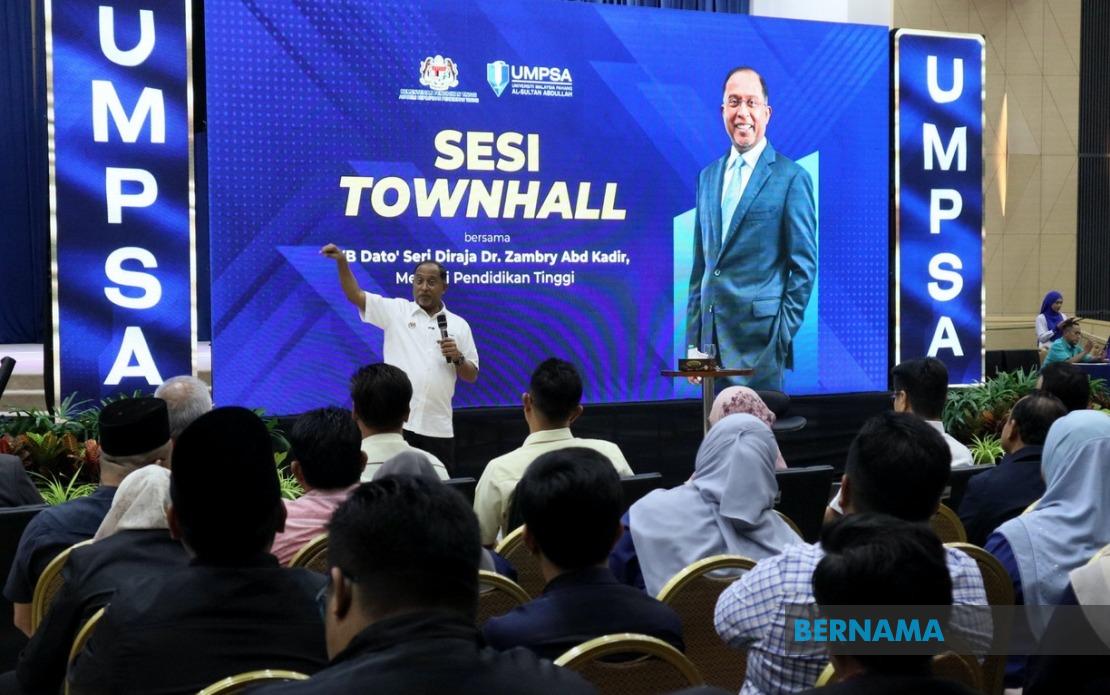
The Ministry of Higher Education has begun implementing a significant policy shift following Prime Minister Datuk Seri Anwar Ibrahim's recent instruction on how universities should handle student disciplinary cases. Speaking at Universiti Malaysia Pahang Al-Sultan Abdullah's convocation ceremony, Minister Datuk Seri Dr. Zambry Abd Kadir confirmed that the ministry is undertaking necessary procedural steps to align institutional practices with the government's new direction on student affairs, which reflects a broader commitment to balancing academic freedoms with institutional governance.
The directive carries particular weight given that it builds on Anwar's recent announcement regarding the repeal of the Universities and University Colleges Act 1971, a foundational law that has long governed student conduct and rights at Malaysian tertiary institutions. The Prime Minister has specifically instructed that students previously subjected to disciplinary action merely for criticising him or the government should be exonerated of those charges, marking a philosophical departure from past practices that critics argued chilled free expression on campuses. This approach signals recognition that student activism and critical engagement, particularly directed at leadership, should be protected rather than penalised through institutional mechanisms.
Dr. Zambry emphasised that the implementation encompasses multiple layers of regulation and decision-making, stretching from individual Student Affairs Departments at each institution to the legislative framework governing university autonomy. The minister noted that any misconduct identified through formal student affairs channels must be processed according to established protocols, but within a framework that now prioritises student freedom alongside institutional order. This dual mandate requires sensitivity from university administrators who must distinguish between genuine misconduct requiring discipline and legitimate political or social expression that should remain protected.
A crucial coordination mechanism emerged when the minister revealed that all vice-chancellors have engaged in collective discussions with the director-general of higher education to develop a unified approach. The announcement of a forthcoming joint statement from these discussions suggests that Malaysian universities are preparing coordinated guidance rather than allowing ad hoc interpretations to develop across different institutions. This centralised approach may prevent inconsistent application of the new policy and reduce confusion about what constitutes legitimate disciplinary grounds versus protected expression.
The question of private higher educational institutions presents a complex implementation challenge, one that Dr. Zambry acknowledged requires careful examination. Private universities operate under different legal frameworks, particularly the Private Higher Educational Institutions Act 1996, which grants them greater regulatory autonomy than their public counterparts. While the minister expressed hope that private institutions, especially state-owned or state-related educational establishments, would voluntarily align with the new approach, he stopped short of mandating compliance, reflecting the constitutional and operational distinctions between public and private tertiary sectors in Malaysia.
The timing of this policy shift intersects with Malaysia's broader governance narrative under the Malaysia Madani framework, which emphasises democratic values and stakeholder inclusion. The Intellectual Forum Series where Anwar outlined these principles attracted considerable attention precisely because student freedoms and institutional accountability have become touchstone issues in regional higher education debates. For Malaysian institutions competing internationally for talent and standing, clarifying their position on student expression carries consequences for reputation and recruitment.
Crucially, the Prime Minister specified that exoneration from university disciplinary charges would not extend to matters prosecuted under Royal Malaysia Police criminal law. This distinction preserves the separation between institutional discipline, which the government is reframing to protect expression, and criminal liability, which remains within the justice system's purview. The clarification prevents misinterpretation that might suggest blanket immunity for students facing legal consequences for conduct crossing into genuine criminality, though it leaves open important questions about where institutional misconduct ends and criminal conduct begins.
The expected lengthier timeline for formal amendments to the AUKU justifies the expedited administrative approach via presidential directive. Rather than wait for legislative processes that might require parliamentary debate and extended consultation, the Prime Minister has accelerated relief for currently affected students through executive action on university disciplinary records. This pragmatic sequencing acknowledges that legislative reform, however necessary, cannot address the immediate injustice experienced by students already penalised under the old regime.
For the broader Southeast Asian context, Malaysia's policy recalibration on student discipline reflects regional movements toward greater academic autonomy and student voice. Countries including Thailand, Indonesia and the Philippines have grappled with similar tensions between institutional order and student freedoms. Malaysia's explicit linking of this change to democratic governance under Malaysia Madani positions the nation within currents of democratic consolidation that regional observers are watching closely.
The gathering of 500 young university lecturers and administrators aged forty and below at the convocation, participating in the Kembara KARISMA Pemimpin Muda MADANI programme, provided Dr. Zambry an opportunity to communicate the policy directly to implementation cohorts representing Pahang, Terengganu and Kelantan institutions. These mid-career academic professionals will likely bear responsibility for translating ministerial direction into daily practice, suggesting the government recognises that successful policy change requires buy-in from institution-level leaders rather than merely top-down imposition.
The policy development also reflects evolving international standards on academic freedom and student rights that major tertiary accreditation bodies now emphasise. Malaysian universities seeking continued regional and global standing have incentive to demonstrate that their institutional environments protect rather than suppress legitimate student expression and civic engagement. By positioning Malaysia ahead of this curve, the government may strengthen the competitive positioning of local universities in attracting international students and faculty.
Looking forward, the success of this initiative depends substantially on how university administrators interpret the boundary between protected expression and genuine misconduct requiring discipline. Without clear guidelines, implementation risks becoming inconsistent or, conversely, so permissive that institutional order suffers. The promised statement from vice-chancellors and higher education leadership will be scrutinised for whether it provides sufficient operational clarity to guide difficult marginal cases that will inevitably arise on campuses.

