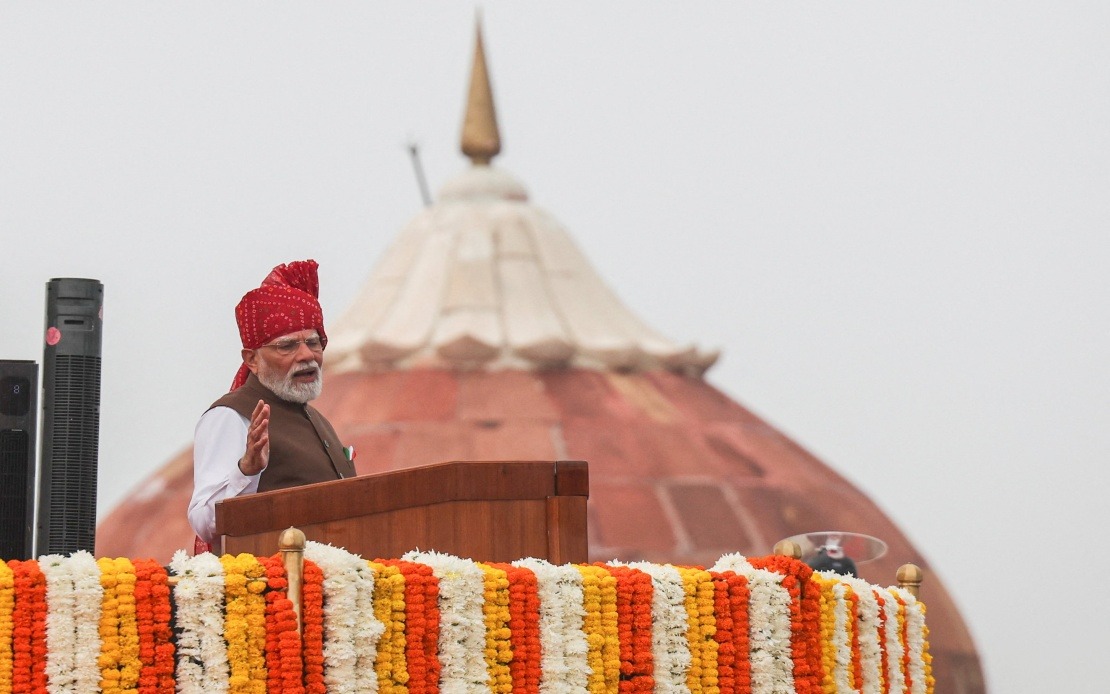
Indian Prime Minister Narendra Modi has laid out an expansive vision for his nation's economic and technological independence, framing self-sufficiency across critical industries as the cornerstone of India's transformation into a developed economy by 2047. Speaking from the Red Fort in New Delhi during Independence Day celebrations on August 15, Modi articulated a strategic pivot away from import dependence and towards building indigenous capabilities that will support India's long-term prosperity and global competitiveness.
The semiconductor sector represents a particularly significant dimension of this self-reliance agenda. Modi announced that three semiconductor manufacturing plants have already commenced operations, with expectations that a further five to eight facilities will become operational within the next seven to eight years. For Southeast Asian economies watching India's industrial trajectory, this expansion carries important implications. As semiconductor demand surges across Asia, India's manufacturing ambitions could reshape regional supply chains and potentially reduce the continent's collective reliance on external suppliers. The investment signals India's determination to capture a meaningful share of this high-value industry, though manufacturers will be closely monitoring whether domestic production can achieve the cost-competitiveness and technological sophistication necessary to compete globally.
Energy security formed another pillar of Modi's address, with nuclear power positioned as essential to India's long-term resource independence. The government has committed to commissioning five new nuclear reactors during the present decade and aspires to reach 100 gigawatts of nuclear capacity by 2047. More significantly, Modi highlighted India's recent breakthrough in mastering fast-breeder nuclear technology, a capability that addresses traditional concerns about uranium sourcing and positions the nation to achieve fuel self-sufficiency. This technological achievement carries broader regional relevance, as energy security remains a perennial challenge across South and Southeast Asia, and India's progress in this domain may establish precedents or pathways that other developing economies could potentially emulate.
Simultaneously, Modi emphasised the remarkable expansion of India's renewable energy infrastructure. Over the past twelve years, solar energy capacity has expanded from two gigawatts to 160 gigawatts—a transformation that reflects India's commitment to meeting growing electricity demand through low-carbon sources. This renewable expansion demonstrates that self-reliance need not rely solely on conventional fuels; rather, it can encompass the transition to cleaner energy systems. For regional policymakers grappling with climate commitments and energy needs, India's experience offers both lessons and cautionary tales about the pace and sustainability of such transitions.
Hydrocarbon exploration represents yet another frontier in Modi's self-reliance programme. The government has allocated 850 billion rupees, equivalent to approximately US$8.9 billion, for oil and gas exploration in areas that Modi characterised as previously unexploited, described as 99 per cent no-go zones. This investment strategy reflects India's acknowledgment that energy independence requires sustained exploration and extraction capabilities across multiple fuel types. The initiative may have environmental and geopolitical dimensions that merit careful examination, particularly as India seeks to balance energy security with climate and conservation objectives.
Defence and military manufacturing occupy a distinctive position within Modi's vision. The Prime Minister specifically highlighted the importance of developing domestic capabilities in drone technology, counter-drone systems, and hypersonic defence technologies. This emphasis on military innovation serves multiple purposes: it reduces India's reliance on foreign defence suppliers, generates high-skilled employment, and enhances national security positioning. For the broader region, India's advancement in these defence technologies carries strategic implications, potentially altering the balance of military capabilities in South Asia and influencing the calculations of other regional powers regarding their own defence investments and partnerships.
Underlying all these sectoral initiatives is a philosophy that Modi articulated with particular emphasis: the imperative to favour domestically produced goods over imported alternatives, even when foreign products offer apparent advantages in price or speed of availability. Modi argued that purchasing foreign goods may satisfy immediate commercial needs but fails to build internal technological capacity, test national capabilities, or develop the institutional knowledge necessary for sustained advancement. This consumption philosophy, if embraced widely, would represent a significant reorientation of Indian consumer and corporate behaviour, with potential ramifications for trade patterns throughout Asia and implications for multinational companies operating in the region.
The 2047 timeline, marking India's centenary of independence, serves as both a symbolic aspiration and a practical planning horizon. This twenty-plus year trajectory provides sufficient duration for major infrastructure projects, technological breakthroughs, and institutional reforms to mature and yield measurable results. Unlike shorter-term targets, a 2047 vision permits strategic patience and long-cycle investment in sectors like nuclear energy and semiconductor manufacturing, where returns accrue over extended periods. For Malaysia and other Southeast Asian nations, India's development trajectory and the success or setbacks of these initiatives merit careful observation, as India's progress could reshape regional economic dynamics, technology transfer patterns, and competitive positioning in global markets.
The coherence of Modi's self-reliance narrative—spanning energy, manufacturing, defence, and consumption patterns—suggests a comprehensive reimagining of India's economic model. Rather than viewing self-reliance as economic isolation or protectionism, Modi frames it as a path to building world-class capabilities that will enable India to compete effectively on the global stage. This distinction carries importance for understanding how India may engage with regional trade arrangements, technology partnerships, and supply chain integration with Southeast Asia in the coming years. The success of this agenda will significantly influence India's role as an economic and technological power within Asia and its capacity to serve as a counterweight to other major powers reshaping the region's strategic landscape.

