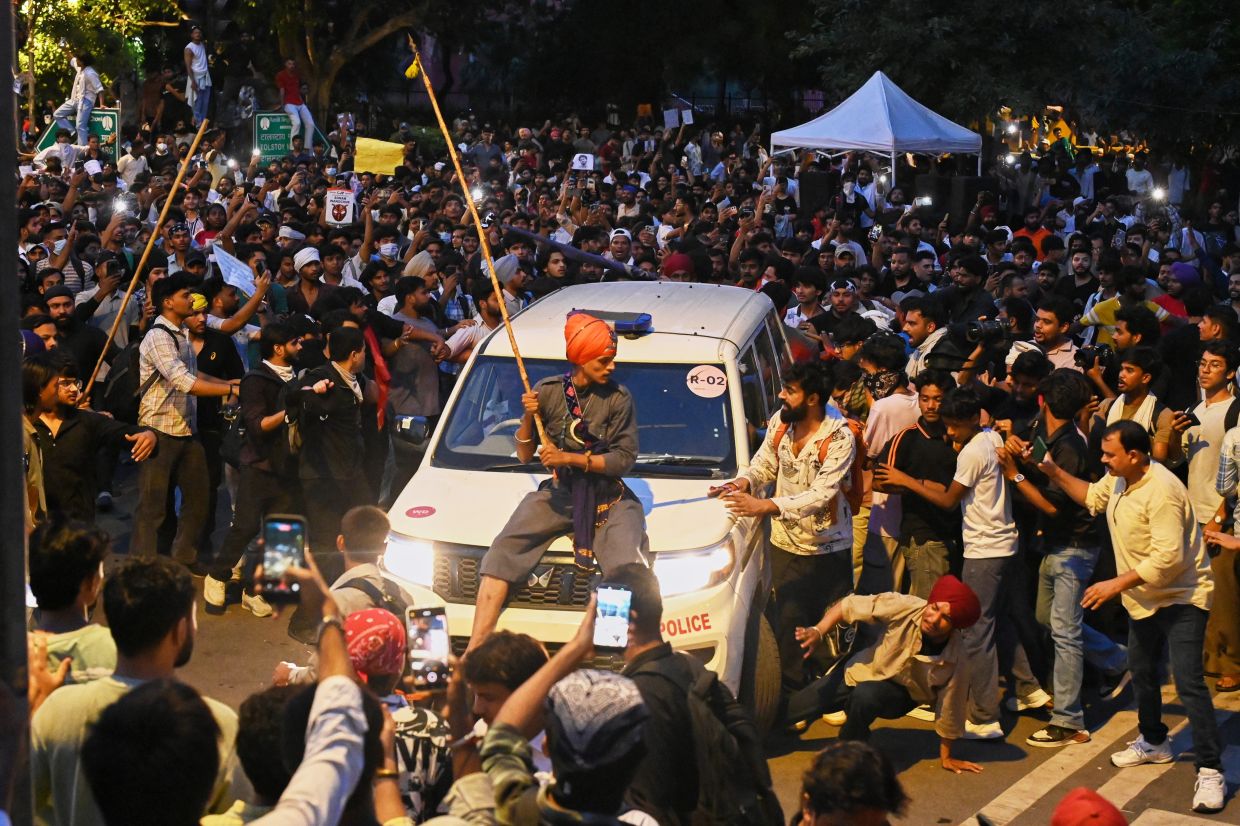
Prime Minister Narendra Modi has pledged severe consequences for those responsible for examination irregularities, marking his first substantive response to widespread student demonstrations that have shaken New Delhi. Speaking on Thursday, July 23, Modi emphasised that youth welfare represents the government's paramount concern, while announcing plans to establish expedited courts to address those implicated in question paper leaks. His statement represented an acknowledgment of mounting pressure from a movement that has evolved from online satire into the capital's most significant street mobilisation in roughly half a decade.
The protests intensified dramatically on Monday when security forces deployed tear gas and used batons against tens of thousands of demonstrators attempting to march towards parliament on the opening day of the monsoon legislative session. The ensuing confrontation saw protesters respond with stone-throwing, resulting in injuries to at least 178 people including police personnel. The escalation reflects the deep frustration among India's youth over repeated failures within the examination system, which forms the gateway to higher education and professional advancement across the country.
At the heart of this movement lies the Cockroach Janta Party, a social media-driven collective that originated in May as a satirical commentary after Chief Justice Surya Kant allegedly characterised young people as "cockroaches" and "parasites" during court proceedings. Since its inception, the movement has matured significantly, incorporating broader grievances about joblessness, limited economic opportunities, and what participants perceive as increasingly authoritarian governance under Modi's administration. The organisation now commands millions of followers across digital platforms, enabling rapid mobilisation and coordination among younger Indians seeking systemic change.
Examination irregularities have repeatedly undermined public confidence in India's testing mechanisms, with particular damage caused by the leak of a medical entrance examination that ultimately required over two million candidates to sit the test again. Additional controversies surrounding online marking practices affecting nearly two million secondary school students have further intensified public anger. These cascading failures have created a credibility crisis within India's educational infrastructure, prompting questions about institutional competence and accountability at the highest levels.
On Wednesday evening, renewed clashes erupted at the Jantar Mantar protest site as crowds extended demonstrations beyond designated areas. Police responded with what movement representatives characterised as disproportionate force, while authorities claimed protesters attacked officers with stones and plastic bottles, inflicting serious injuries. The encounter resulted in internet shutdowns, a measure that many observers view as an attempt to limit protest coordination and reduce visibility of government actions. Such incidents have become increasingly common during major demonstrations across Indian cities, raising concerns among civil liberties advocates about restrictions on communication freedoms.
The movement's expansion beyond the capital demonstrates its resonance with younger Indians nationwide. Wednesday saw smaller demonstrations emerge in major metropolitan centres including Mumbai, Bengaluru, and Patna, suggesting that education system frustrations transcend regional boundaries. Opposition parties have strategically leveraged the protests, disrupting parliamentary business and demanding that Modi apologise for the police response on Monday. Congress Party leader Rahul Gandhi directly challenged Modi on social media, arguing that the government's education policies have fundamentally compromised institutional integrity and that officials responsible for system failures have escaped accountability.
The timing and scale of these protests represent a significant political challenge for Modi, who secured election to an unprecedented third consecutive term in 2024. The demonstrations suggest that his political dominance may face constraints when addressing grievances affecting India's substantial youth population, who comprise a demographic cohort increasingly willing to mobilise against perceived governmental failures. The movement's reliance on digital organising and its cross-regional coordination capacity indicate that future protests may prove similarly difficult to contain or dismiss.
International dimensions have also emerged, with student movements in neighbouring Bangladesh expressing solidarity with Delhi protesters. Bangladesh's own youth-driven demonstrations in 2024 successfully culminated in the ouster of Prime Minister Sheikh Hasina, providing a cautionary reference point for regional governments regarding the political consequences of mismanaging public anger among young populations. This regional context underscores how education system failures and perceived democratic deficits can translate into governance crises with far-reaching consequences.
For Malaysian observers, these developments offer instructive parallels regarding youth mobilisation and the political salience of education quality. India's examination system difficulties, though operating at a vastly larger scale, reflect challenges that educational systems across Southeast Asia periodically confront—questions of examination integrity, fairness in merit-based advancement, and the psychological stakes involved when educational access determines socioeconomic mobility. Modi's measured response, combining acknowledgment of legitimate grievances with promises of institutional remedies, represents a pragmatic approach to managing dissent while attempting to preserve governmental legitimacy.
The longer-term implications remain uncertain, as the sustainability of these protests depends on whether tangible reforms materialise and whether educational system improvements restore public confidence. Modi's establishment of fast-track courts may address immediate accountability concerns but risks appearing performative unless accompanied by systemic reforms addressing root causes of examination fraud and institutional corruption. The government faces pressure to demonstrate concrete progress within a compressed timeframe, as sustained joblessness and limited opportunity will continue fuelling discontent among India's massive population of unemployed or underemployed graduates.

