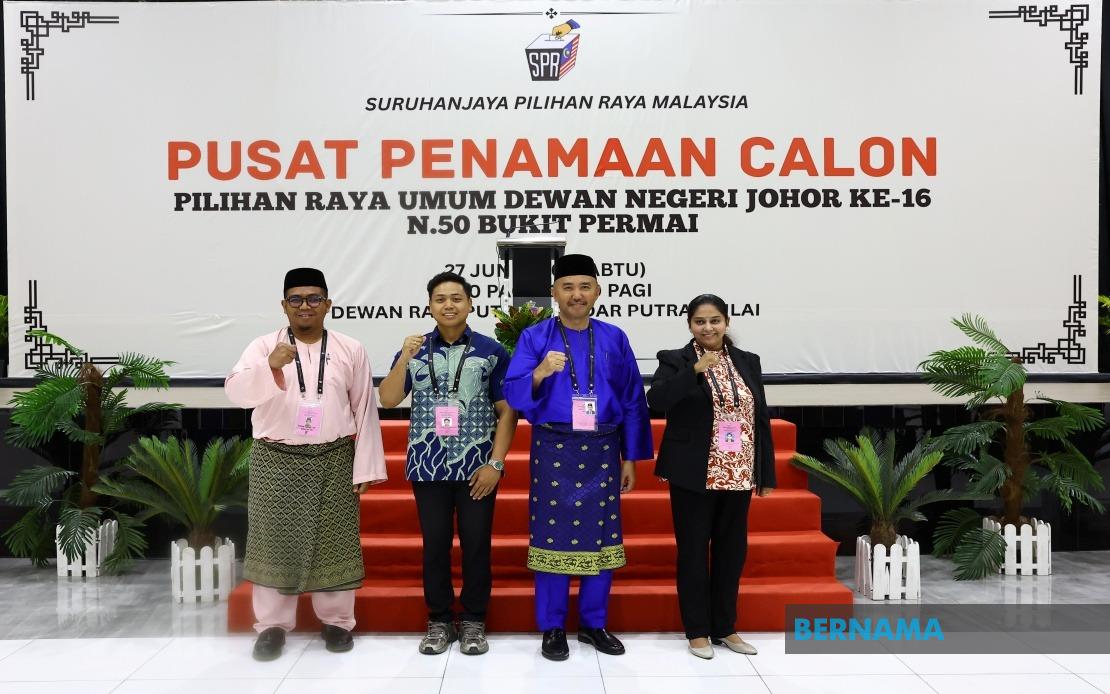
The race for Bukit Permai in the 16th Johor state election has taken shape as a closely watched four-cornered contest, with incumbent Datuk Mohd Jafni Md Shukor of Barisan Nasional seeking to retain his position against a fractured opposition. Nominations closed on June 27 at the Dewan Raya Putra nomination centre in Bandar Putra, Batu Pahat, with returning officer Afzan Azhari confirming that Mohd Jafni will face three challengers in what observers view as a competitive race with potential ramifications across Johor's political landscape.
The field of candidates reflects the complex multi-party competition now defining Malaysian state politics. Pakatan Harapan has fielded Mohamad Shafwan Ani, while Perikatan Nasional has selected M. Lina Manoh to challenge the incumbent. Completing the slate is Muhammad Aidil Riduan Mohd Yusof, representing the newcomer Parti Bersama Malaysia, signalling the growing fragmentation of Malaysia's political terrain as newer parties attempt to carve out electoral space. The presence of four competitive candidates suggests that traditional two-way contests have become increasingly uncommon in contemporary Johor politics, complicating the path to victory for all participants.
Mohd Jafni's candidacy carries the weight of an incumbency advantage earned in 2022, when he secured the seat with a commanding majority of 4,755 votes in an equally fractious four-way race. His ability to consolidate support despite a divided field suggests considerable local organisation and voter loyalty within the constituency. However, the fact that he required such a margin in 2022 indicates the seat remains genuinely competitive rather than a safe BN stronghold. His decision to run again underscores the stability Barisan Nasional seeks in an era of political volatility, though the return of a four-cornered contest means he cannot assume automatic victory.
The presence of Johor DAP chairman Teo Nie Ching at the nomination centre to accompany Mohamad Shafwan signals that Pakatan Harapan views this seat as within striking distance. Teo's personal involvement, arriving at 8.26 am to support the candidate, suggests the coalition is investing political capital in Bukit Permai as part of a broader effort to rebuild strength in Johor after difficult performances in recent electoral cycles. For Pakatan, the constituency represents an opportunity to demonstrate relevance in a state where Barisan Nasional traditionally commands substantial influence, though the four-way split complicates any clear narrative of opposition consolidation.
Perikatan Nasional's selection of M. Lina Manoh adds a gender dimension to the contest while reflecting PN's strategy of contesting seats across diverse constituencies to build its profile as an alternative force in Malaysian politics. As a newer entrant to the national coalition landscape, PN views state elections as crucial platforms for expanding its grassroots presence and credential-building ahead of potential future general elections. Bukit Permai represents one of several constituencies where PN is testing its electoral machinery across Johor, offering insights into whether the coalition can translate its national presence into consistent local performance.
Paiti Bersama Malaysia's inclusion of Muhammad Aidil Riduan Mohd Yusof completes a diverse candidate slate that reflects Malaysia's increasingly pluralised political marketplace. As a party still establishing itself in the consciousness of many voters, Bersama's participation may well function as a spoiler force capable of fragmenting vote shares even further. The four-candidate structure creates mathematical complexity around vote thresholds, potentially allowing candidates with lower absolute numbers to prevail if the opposition splits inefficiently. This dynamic has become a defining feature of Malaysian electoral mathematics, with successful candidates often winning with considerably less than 50 per cent of total votes cast.
The electoral timeline established by the Election Commission provides clear reference points for campaign intensity. Early voting has been scheduled for July 7, offering opportunities for those unable to vote on the main polling day, while the principal election will occur on July 11. This compressed campaign period compresses candidate visibility and voter messaging into a concentrated window, potentially advantaging incumbents with established machinery and name recognition. For challengers, the condensed timeframe demands rapid mobilisation and efficient resource allocation to reach sufficient voters before ballots are cast.
Bukit Permai's status as a four-cornered contest positions it as a microcosm of broader Johor political dynamics. The state has become increasingly fragmented since the 2022 elections, with no single coalition commanding overwhelming dominance across all constituencies. How voters in Bukit Permai distribute their preferences will offer important signals about BN's consolidation capacity in its traditional stronghold, opposition viability in challenging Johor, and emerging parties' ability to capture meaningful shares of electoral support. The constituency will warrant close monitoring throughout the campaign period as a bellwether for the overall state election trajectory.
The 4,755-vote majority from 2022 provides a baseline for assessing Mohd Jafni's potential performance, though changed political circumstances could alter voter behaviour substantially. Malaysians have demonstrated increasing willingness to shift allegiances between elections based on issue salience, leadership perceptions, and coalition performance in national politics. The three-year interval since 2022 has witnessed significant developments in national governance and economic conditions that may have reshaped voter calculations. For all candidates, understanding how local issues intersect with national political narratives will prove crucial to effective campaign messaging.
The four-candidate format ultimately creates a more unpredictable electoral landscape than the bipolar contests of earlier decades. Vote-splitting becomes both peril and opportunity depending on how supporters of various coalitions distribute their support. Barisan Nasional's challenge lies in consolidating its base and attracting sufficient swing voters to overcome potential splits in the non-BN vote. Conversely, opposition candidates benefit if anti-BN sentiment runs sufficiently strong to overcome their mutual competition. The outcome of this Bukit Permai race will illuminate not only the local political preferences but also the viability of Malaysia's evolving multi-party competition system at the state level.

