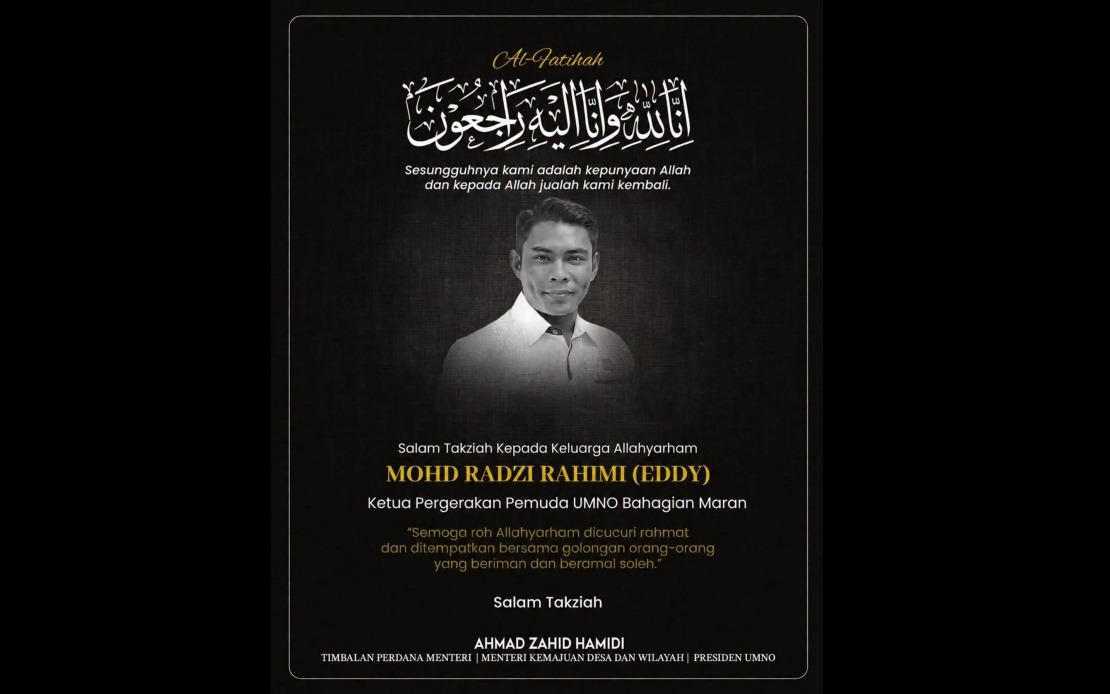
The Malaysian political establishment mourned a significant loss on August 3 as UMNO president Datuk Seri Dr Ahmad Zahid Hamidi expressed profound condolences following the death of Maran UMNO Youth chief Mohd Radzi Rahimi in a tragic accident in Bentong. The 40-year-old politician was killed along with his wife and brother-in-law when a tree fell and crushed their vehicle, a calamity that has shaken both the party and his immediate community.
Ahmad Zahid's public statement underscored the significance of Radzi's role within UMNO's organizational structure. In his Facebook post, the party president described Radzi's passing as an irreplaceable loss not merely to the Maran branch but extending to the broader UMNO Youth movement and the wider Pahang state organization. This characterization reflects the deep network of relationships and responsibilities that such political positions entail within Malaysia's largest Malay-Muslim political party.
The tragedy claimed four lives in total, with a five-year-old child also perishing in the accident. A second child, believed to be the twin of the deceased youngster, sustained injuries and was transported to Bentong Hospital for medical care. The incident highlights the unpredictable nature of such accidents and the cascading impact on families beyond the immediate victim. For the Pahang community, particularly those connected to UMNO structures, this tragedy represents a profound disruption to family units and organizational continuity.
In his formal response, Ahmad Zahid extended his sympathies to Radzi's extended family, acknowledging the immeasurable pain they face during this period. The UMNO president's words—"No words can describe what they are going through"—reflect the inadequacy of conventional expressions of sympathy when confronted with multiple fatalities in a single incident. Such accidents underscore the fragility of life and the sudden manner in which loss can visit families, irrespective of their social standing or prominence.
The incorporation of Islamic sentiment in Ahmad Zahid's statement, invoking Allah's strength for the bereaved family, aligns with cultural and religious norms prevalent in Malaysian society. This public invocation of faith serves both as a spiritual offering and as a signal to the broader Muslim community that grief is being addressed within the framework of Islamic values. For UMNO, an organization deeply rooted in Malay-Muslim identity, such expressions reinforce the party's connection to its grassroots constituency.
Mohd Radzi's role as Maran UMNO Youth chief positioned him as a significant figure in youth mobilization and political engagement within his constituency. UMNO Youth, known as Pemuda UMNO, functions as a critical recruitment and organizational arm for the parent party, particularly in engaging younger demographics in political processes. The loss of a committed youth leader disrupts not only individual branch operations but also broader party initiatives aimed at maintaining relevance among Malaysia's younger population.
The incident in Bentong occurred during a period when Malaysian political parties are engaged in ongoing organizational consolidation and regional representation building. The Pahang division remains strategically important for UMNO, and the loss of active, engaged leaders at the branch level inevitably creates gaps in local political machinery. Replacing individuals like Radzi, who bring experience and community connections, requires time and internal political negotiations that can sometimes prove contentious.
Tree-related accidents, particularly those involving falling branches or entire trees during storms or unfavorable weather conditions, represent a recurring hazard on Malaysian roads. Such incidents raise questions about road safety infrastructure, vegetation management along major thoroughfares, and emergency response protocols. Bentong, a town in Pahang's interior, has witnessed such tragedies before, pointing to potential systemic issues requiring ongoing attention from local and state authorities.
For UMNO specifically, this tragedy arrives amid the party's continued efforts to strengthen organizational structures following recent political transitions. The loss of engaged mid-level leaders like Radzi, who bridge grassroots constituencies with higher party machinery, creates challenges in maintaining internal coherence and community engagement. The party will likely need to consider succession planning and the consolidation of Radzi's responsibilities among remaining leadership.
The emotional dimension of such losses extends beyond formal condolences and political statements. Radzi's colleagues, constituents, and family members now face the complex process of grieving while navigating the practical demands of organizational continuity and family management. For UMNO Youth networks in Pahang, the absence of an engaged, experienced leader creates both an immediate operational gap and longer-term implications for leadership development and succession.
Ahmad Zahid's public response signals the party's recognition of Radzi's contributions and demonstrates institutional acknowledgment of the tragedy. Such official statements serve multiple functions: they validate the deceased's worth within party structures, express solidarity with grieving families, and reaffirm organizational values during moments of crisis. For the broader Malaysian public, particularly those connected to UMNO circles, such statements provide frameworks for understanding collective loss.
The incident serves as a sobering reminder of life's uncertainties and the unpredictable manner in which tragedy can intersect with ordinary moments. For Malaysian road safety authorities and state governments, such incidents demand renewed attention to environmental hazard mitigation and emergency response infrastructure. The loss of Mohd Radzi Rahimi, his family members, and the young child represents both a personal tragedy and a disruption to established social and political networks that had depended on his continued participation and leadership within UMNO structures.

