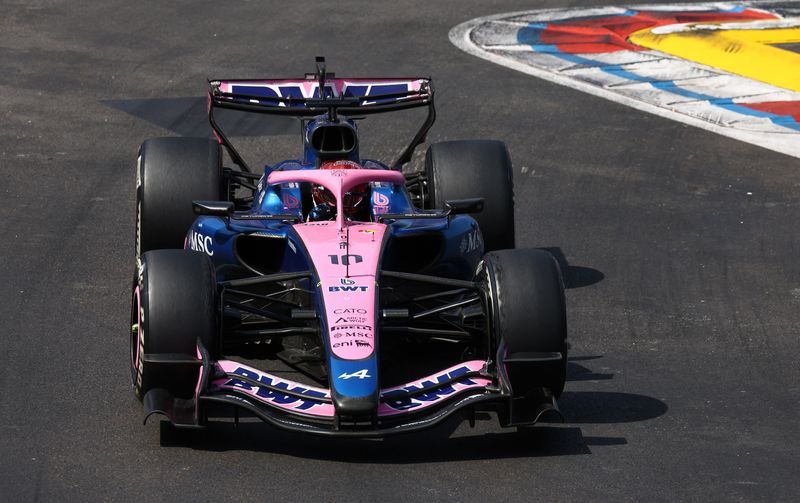
The international court of appeal for Formula One sat in closed session in Paris on Tuesday to hear arguments about one of the sport's most contentious recent decisions, with judges indicating they would need between two and three weeks to render their final judgment on the June Monaco Grand Prix. At stake is the third-place finish, currently credited to Red Bull driver Isack Hadjar after a complex sequence of penalties and reversals that has exposed fundamental questions about fairness and consistency in how the sport's stewards apply regulations.
Pierre Gasly of Alpine originally crossed the line in third place at the Monaco circuit on June 7, but was subsequently stripped of that position and demoted to seventh following the application of two five-second penalties for exceeding the speed limit in the pit lane. This demotion automatically elevated Hadjar to the podium, where the Red Bull driver celebrated with the traditional champagne spray. However, that sequence was itself overturned just five days later on June 12 when stewards accepted Alpine's evidence demonstrating that a timekeeping error had occurred, leading them to restore Gasly to third place and require Hadjar to return his trophy. The uncertainty did not end there, as both Red Bull and McLaren lodged appeals on June 16, setting in motion the hearing that concluded this week.
The broader implications of this decision extend well beyond the personal fortune of individual drivers. The reversal of Gasly's penalties has had cascading effects through the points classification, with McLaren's Oscar Piastri sliding from fourth to fifth position, Liam Lawson dropping to sixth, and Arvid Lindblad pushed to seventh. The race itself was won by Mercedes driver Kimi Antonelli, with Ferrari's Lewis Hamilton finishing second. These position changes carry material consequences for the constructors' championship battle, a consideration that has motivated McLaren's aggressive pursuit of the appeal despite the race occurring two months earlier.
The core issue driving this dispute centres on a fundamental procedural question that has revealed inconsistencies in how stewards enforce regulations. Gasly served his penalties post-race after they had already been applied, whereas Oscar Piastri, who was penalised for the identical speeding violation during the same Grand Prix, served his penalties in real time during the race itself. This distinction proved crucial because Gasly's subsequent overturning of his penalties could theoretically be revisited, while Piastri's served penalties could not be undone even though both drivers committed the same infraction under identical circumstances. Mercedes' George Russell similarly received a drive-through penalty for pit-lane speeding but was unable to have it converted to a post-race penalty despite requesting this adjustment from stewards, leaving him without points from the race.
McLaren's team principal Andrea Stella articulated the team's frustration in the aftermath of the Monaco Grand Prix decision, expressing concern about the fairness implications of allowing Gasly's penalties to be overturned while other drivers' identical penalties remained in place. Stella noted that McLaren's appeal was motivated by two distinct considerations: a general interest in protecting the integrity of Formula One as a sport, and a material interest in how the classification affects the ongoing constructors' championship competition. The situation presented stewards with a regulatory quandary they had themselves acknowledged in their written reasoning, noting that no rule existed empowering stewards to reverse penalties that had already been served, and that attempting to apply such power retroactively would be administratively impossible.
The complexity of this appeal reflects broader tensions within Formula One regarding consistency and discretion in penalty administration. Stewards operate within a framework designed to ensure driver safety and enforce sporting regulations, yet their authority exists in a grey zone between objective rule application and subjective judgment about fairness and proportionality. The Monaco situation has exposed the risks of this approach, where a timekeeping error by officials created a cascade of decisions that ultimately affected multiple teams and drivers who had complied with steward instructions at the time. For Malaysian and Southeast Asian motorsports enthusiasts, the case illustrates how Formula One's governance structures struggle with complexity, particularly when administrative errors compound into sporting inequities.
The timing of this appeal adds urgency to the proceedings, as Formula One races continue throughout the European summer and autumn schedule. The championship battle remains intensely competitive, and the potential reclassification of points from a race two months past could meaningfully affect the final standings and the distribution of prize money between teams. The circuit will next host racing at Monza for the Italian Grand Prix on September 6, followed by the highly anticipated debut of Madrid's new street circuit on September 13. The appeals court's decision is expected to land sometime during this busy racing calendar, potentially influencing team strategy and morale during crucial weeks of the season.
Formula One's governing body, the FIA, has maintained appropriate distance from the appeal process, allowing the independent court to hear evidence and render judgment without interference. The confidential nature of Tuesday's hearing means the public knows virtually nothing about the arguments presented or the judges' apparent receptiveness to either party's position. This opacity is standard for such proceedings but has generated considerable speculation within the paddock about the likely outcome. Some observers believe the court will ultimately support the timekeeping error explanation and leave Gasly's result intact, while others contend that the inconsistent treatment of identically penalised drivers provides sufficient grounds for reversal.
The regulatory uncertainty has also focused attention on potential reforms to how stewards handle penalties and their authority to modify or reverse decisions after the fact. Several voices within Formula One, including within the driver community, have called for clearer guidelines that would prevent the situation that emerged in Monaco from recurring. The prospect of a penalty being applied, then reversed, then re-applied depending on which appeal is successful creates an inherently unfair situation for drivers who must navigate rule changes in real time. Any reforms would likely involve establishing whether certain penalties can be assessed post-race and under what circumstances they might be subject to review, balancing the need for flexibility with the requirement for predictability and consistency that competitors deserve.

