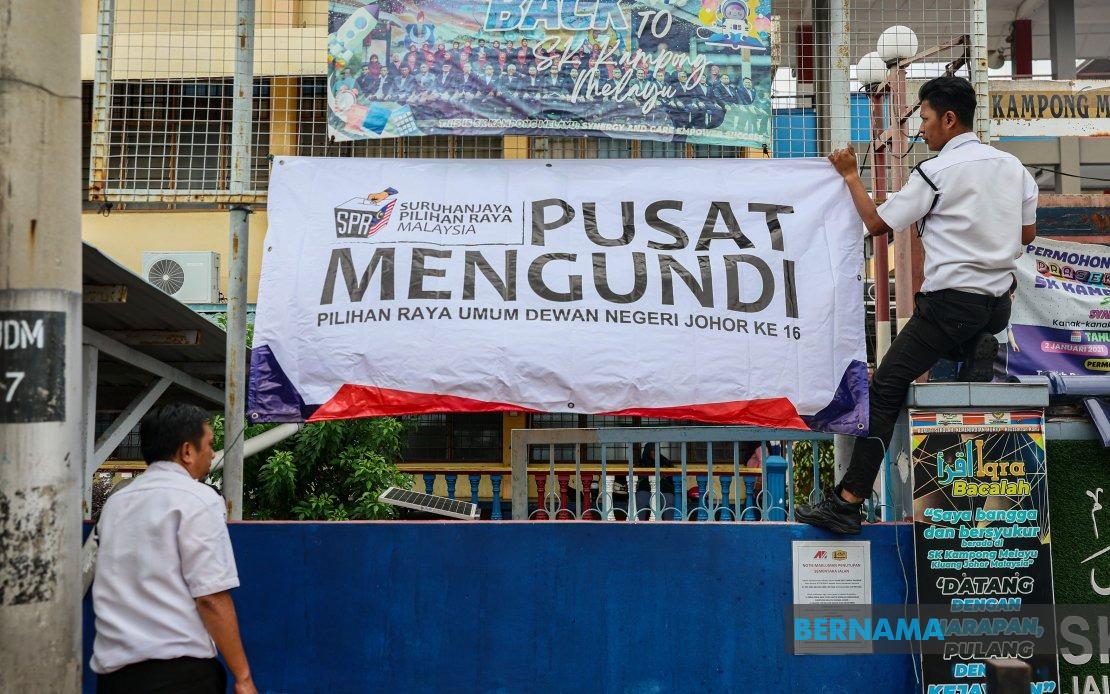
Johor Bahru is the focal point of Malaysian politics today as voters across the southern state participate in the 16th state election, with more than 2.7 million people eligible to cast their votes. The exercise represents a significant democratic event for the nation's most economically developed state, where residents will determine the composition of the 56-seat State Legislative Assembly and choose representatives to govern one of Malaysia's most critical jurisdictions.
Election officials have mobilised extensively to facilitate the voting process, with 1,076 polling centres and 4,889 voting streams stationed throughout Johor to manage the anticipated volume of participants. The Election Commission (EC) commenced polling at 8 am with a coordinated opening across all locations, ensuring that eligible voters from urban centres in Johor Bahru to remote island communities receive equal opportunity to participate in the democratic process. This organisational effort reflects the scale of the undertaking, requiring substantial logistics and coordination across the sprawling southern state.
The election marks the conclusion of an intensive campaign period that lasted 14 days, during which candidates from various political coalitions and independent hopefuls competed vigorously for voter support. The conclusion of the campaign at midnight yesterday signalled the formal end of the competitive phase, with candidates and parties transitioning to monitoring the voting process. This structured timeline, governed by established electoral protocols, provides clarity and ensures fair competition among contenders.
The EC has positioned itself to conclude counting operations expeditiously, with full results anticipated by 10 pm. Polling stations will close in staggered intervals between 11 am and 6 pm depending on their locations, allowing the commission to begin tabulating votes systematically. Remote island polling centres, including those on Pulau Besar, Pulau Aur and Pulau Pemanggil, will close earlier to accommodate travel logistics, with Pulau Besar closing as early as 11 am. Meanwhile, postal ballots numbering 24,677 must be returned by the 6 pm deadline, adding another administrative layer to the election management process.
The EC has deployed 43,036 election workers statewide to oversee smooth operations and maintain electoral integrity throughout voting day. These officials are responsible for managing polling streams, verifying voter eligibility, recording ballots and assisting with accessibility arrangements for voters with special needs. The substantial workforce reflects the commission's commitment to conducting a professional and inclusive electoral exercise that accommodates all eligible participants.
Election officials are aiming for approximately 70 per cent voter turnout, representing an improvement over the 2022 state election when participation reached 54.92 per cent. This target reflects growing expectations for enhanced civic engagement and represents a significant benchmark for assessing voter enthusiasm in this particular contest. Achieving higher turnout is considered important by political observers who view participation levels as indicators of democratic health and public confidence in electoral processes.
Early voting took place on Tuesday when 20,607 members of the police, armed forces and their respective spouses exercised their franchise in advance of the main election day. This arrangement, standard in Malaysian elections, accommodates security personnel who may be on duty during regular polling hours and ensures their democratic participation is not compromised by professional obligations. The early voting results provide the first tangible indication of electoral participation rates.
Weather conditions may influence voter movement and turnout patterns across different districts. The Malaysian Meteorological Department forecasted morning rain affecting Johor Bahru, Batu Pahat, Kulai, Muar, Pontian and Tangkak, with conditions expected to improve by afternoon and evening hours. Separate thunderstorm warnings were issued for Kluang, Kota Tinggi, Segamat and Mersing, potentially affecting accessibility to certain polling stations. Employers have been reminded to grant reasonable time off to workers fulfilling their civic responsibilities, ensuring weather conditions do not impede participation.
The election features a diverse candidate field with 172 individuals contesting the 56 seats. Pakatan Harapan and Barisan Nasional each fielded 56 candidates respectively, indicating both coalitions are fielding complete slates in every constituency. Perikatan Nasional presented 33 candidates, while Parti Bersama Malaysia nominated 15. Smaller entities including MUDA, Parti Orang Asli Malaysia and Parti Sosialis Malaysia fielded four, one and one candidates respectively, alongside six independent candidates. This configuration reflects the competitive multiparty landscape characterising contemporary Malaysian politics.
The previous State Legislative Assembly, dissolved on 1 June, saw Barisan Nasional holding a commanding majority with 40 seats. Pakatan Harapan occupied 12 seats, Perikatan Nasional controlled three and MUDA held one seat. This distribution provides context for understanding potential power dynamics and coalition possibilities that may emerge from today's voting, with the outcome likely to reshape Johor's political trajectory for the coming term. The balance between the major coalitions will determine whether BN retains its dominant position or whether alternative arrangements may emerge from the electoral result.

