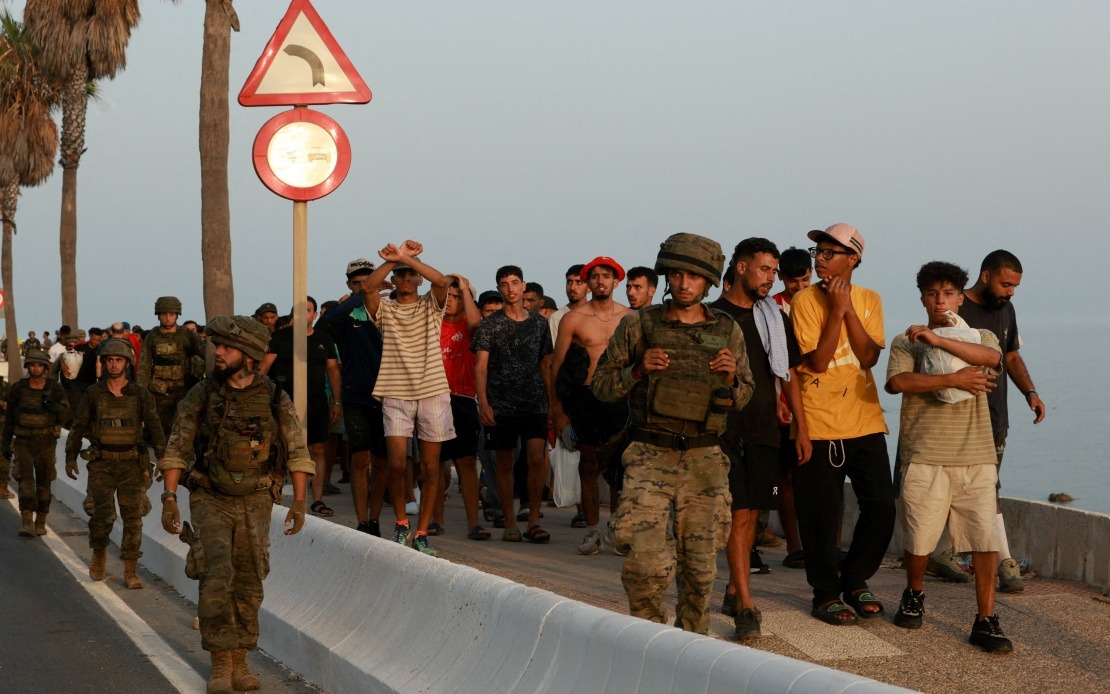
Morocco's government has pinpointed social media falsehoods and organized human trafficking as the primary drivers behind the unprecedented influx of migrants attempting to reach the Spanish enclave of Ceuta in recent days. According to the Moroccan Interior Ministry, the crossings were precipitated by widespread misinformation circulating on digital platforms, combined with the activities of professional smuggling networks that exploited confusion surrounding a Spanish court decision to convince migrants they could enter Europe without immediate deportation.
The scale of the movement has been staggering. Western estimates place the total number of arrivals in Ceuta between 50,000 and 60,000 people—a figure that dwarfs the territory's resident population of approximately 85,000. The influx occurred over just a few days, straining local resources and prompting urgent diplomatic coordination between Rabat and Madrid. Morocco's own accounting suggests a somewhat lower figure of roughly 40,000 successful crossings into Ceuta, with an additional 1,135 migrants attempting to reach Melilla, another Spanish territory on the Moroccan coast.
The role of misinformation in catalyzing this movement deserves careful examination. In an era of rapid digital communication, false claims about European entry procedures can spread instantaneously across borders, reaching vulnerable populations in transit camps and impoverished communities. Moroccan authorities contend that migrants, particularly from Sub-Saharan Africa and beyond, were led to believe that a particular court judgment had effectively opened pathways for entry into Spanish territory that would not result in automatic return. This misinterpretation, whether deliberately amplified by traffickers or organically distorted through social media sharing, created a false sense of opportunity that motivated people to undertake dangerous maritime crossings.
Human trafficking networks have long exploited migration corridors across North Africa and the Mediterranean. These organized groups profit immensely from each migrant guided toward European shores, regardless of success rates or personal outcomes. By seizing upon legal confusion and amplifying social media rumors, traffickers positioned themselves as guides offering a unique window of opportunity, demanding substantial payments for passage. The combination of false hope and professional coordination creates a particularly lethal scenario, as desperate individuals accept dangerous routes and conditions they might otherwise avoid.
A significant discrepancy has emerged regarding casualty figures, reflecting the broader tensions surrounding this crisis. Morocco reported 11 deaths during the crossing attempts, a figure that stands in stark contrast to Spanish authorities' assessment of at least 72 fatalities in Ceuta alone. This substantial gap raises troubling questions about the true human cost of the migration surge and suggests that comprehensive casualty data remains incomplete. The Moroccan government acknowledged the need for ongoing coordination with Spain to verify additional death reports and to identify the victims involved—a process complicated by the sheer scale of arrivals and limited resources for managing such a crisis.
The incident highlights recurring vulnerabilities within migration management frameworks across the Mediterranean and North Africa. Despite years of international cooperation and enforcement efforts, smuggling networks continue to adapt and exploit both technological platforms and legal gray areas. The ability of misinformation to trigger mass movements also underscores how digital ecosystems can amplify migration pressures in ways that traditional border management tools struggle to address. For Malaysia and other Southeast Asian nations watching Mediterranean dynamics, the Ceuta episode offers cautionary insights into how rapidly crises can escalate when multiple factors—legal ambiguity, trafficking infrastructure, digital misinformation, and desperation—converge.
Morocco's attribution of blame to social media and traffickers, while containing factual elements, also warrants nuanced analysis. The authorities' emphasis on misinformation and external actors may deflect attention from underlying structural factors driving migration: poverty, conflict, and lack of opportunity in origin countries, alongside Morocco's own role as a transit nation. Nevertheless, the government's willingness to coordinate with Spain on verification and victim identification suggests recognition of the humanitarian dimensions requiring immediate diplomatic response.
The broader implications for European border security and Mediterranean migration policy are substantial. This incident demonstrates that even improved enforcement capabilities can be overwhelmed by sudden, coordinated population movements. It also illustrates the complex interplay between legal systems, media environments, and human smuggling operations. For countries throughout Southeast Asia managing their own migration challenges, the Ceuta case provides evidence that comprehensive solutions must address not only enforcement and infrastructure, but also information ecosystems and the root causes motivating people to undertake dangerous journeys.
Looking forward, addressing such crises requires sustained attention to multiple fronts simultaneously: disrupting trafficking networks, combating misinformation through media literacy and factual public communication, clarifying legal frameworks to prevent exploitation of ambiguity, and—most fundamentally—addressing the conditions that make migration appear as a viable or necessary option for hundreds of thousands of people. Morocco and Spain's ongoing coordination to identify victims and verify circumstances offers a model of bilateral crisis management, yet underscores how international cooperation remains essential when migration pressures exceed the capacity of any single nation to manage them effectively.

