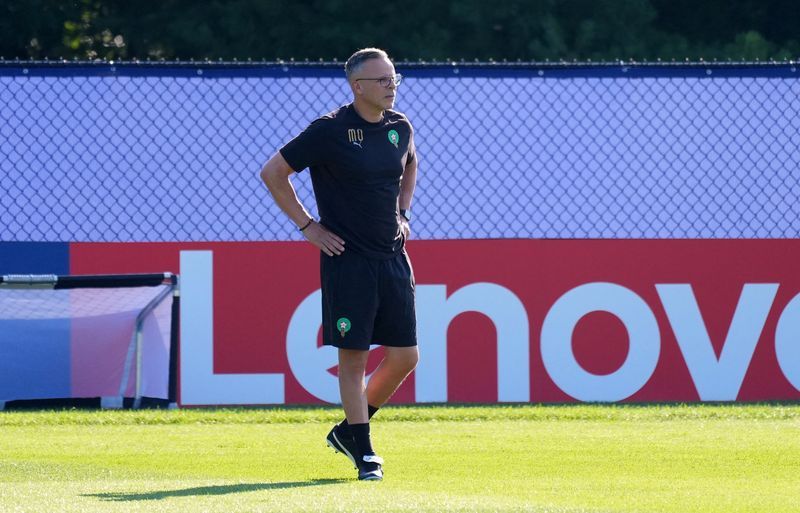
Morocco's coach Mohamed Ouahbi has adopted an uncompromising stance ahead of his team's quarter-final encounter with France, refusing to entertain any celebration of the North African nation's impressive journey through the tournament so far. Speaking at a press conference in Foxborough, Massachusetts on Wednesday, Ouahbi made clear that his squad will resist the temptation to bask in their accomplishments until the World Cup competition has concluded, with his sights firmly fixed on the ultimate prize.
The matchup between Morocco and France represents a rematch of their 2022 World Cup semi-final in Qatar, where the French eliminated the Moroccans in an encounter that had seemed to mark the end of an unexpected fairy tale for the North African side. However, the context this time around has transformed dramatically. Morocco arrives not as plucky outsiders exceeding expectations, but as a formidable and confident outfit that genuinely believes it can win the tournament. The psychological and competitive dynamic has shifted substantially in the intervening months, with Morocco now operating from a position of genuine strength rather than as underdogs looking to improve their standing.
Ouahbi's philosophy reflects a meticulous focus on process and ambition that extends beyond merely reaching successive rounds. He explicitly rejected the notion that the team should view their advancement as a bonus achievement, emphasising instead that only capturing the World Cup itself would constitute success in his estimation. This mindset represents a significant departure from the satisfied acknowledgment of progress that sometimes characterises tournament runs, instead establishing an unrelenting standard for what constitutes acceptable performance. The coach's language was deliberately emphatic, insisting that his players maintain a singular focus on victory rather than allowing themselves to be seduced by external validation of their efforts to date.
France enters the quarter-final as heavy favourites, bringing exceptional pedigree to the encounter. The French team triumphed in 2018 and reached the final in 2022, establishing themselves as one of the tournament's elite contenders. Their progression through the knockout stages has not been entirely convincing, however, with France scraping past Paraguay in the round of 16 through a narrow 1-0 victory secured by Kylian Mbappe's penalty conversion. Despite this somewhat laboured victory, France possesses arguably the most potent attacking arsenal assembled at this World Cup, with Mbappe complemented by the creative talents of Ousmane Dembele, the rising star Michael Olise, and Bradley Barcola forming a strike force of extraordinary depth and quality.
Mbappe's individual contribution to France's campaign has been substantial, with the captain accumulating seven goals in the tournament. This tally places him second in the golden boot race behind Argentina's Lionel Messi, who has netted eight times, underlining France's attacking prowess and their reliance on Mbappe's clinical finishing to advance through the competition. The technical quality and finishing ability concentrated within the French forward line represents a formidable obstacle for any defensive unit, and Morocco will need to demonstrate exceptional organisation and discipline to contain the threat posed by these players.
Morocco's journey through the tournament has demonstrated genuine substance beyond lucky victories. The team progressed smoothly through their group stage before engineering elimination of the Netherlands and Canada in successive knockout rounds. These victories against established football nations have confirmed Morocco's credentials as serious World Cup contenders rather than flash-in-the-pan performers. Their progression has been earned through competent performances and tactical nous, establishing a foundation of genuine accomplishment that distinguishes their campaign from mere chance or circumstance.
Ouahbi's rejection of complacency stems from a clear understanding that Morocco must elevate their performance substantially to overcome France's superior resources and experience. The coach emphasised that comparison of assets between the two sides is ultimately irrelevant, instead focusing on the execution and intensity that will be demanded during the ninety minutes of football. He stressed that both teams are evolving throughout the tournament, and that the crucial variable determining the outcome will be the psychological approach and commitment demonstrated on the pitch rather than objective measurements of squad quality or reputation.
The coach's insistence that his team must play at an almost superhuman standard reflects the realistic assessment that Morocco faces a tremendous challenge. Yet this demanding internal standard also reflects the genuine belief permeating the squad that they possess the capability to prevail. Ouahbi's rejection of satisfaction with past achievements, combined with his articulation of a vision where only winning the World Cup constitutes success, establishes a framework that potentially liberates his players from defensive caution and encourages the aggressive, attacking approach that may be necessary to trouble France.
For Malaysian and Southeast Asian observers, Morocco's campaign represents a compelling narrative of ambition and self-belief from a regional outsider challenging established European powerhouses. The North African nation's evolution from surprising quarter-finalists in Qatar to genuine title contenders illustrates how sustained investment in player development and tactical sophistication can yield remarkable returns on the world's greatest sporting stage. Ouahbi's emphatic rejection of premature celebration, coupled with his demanding standards for what constitutes acceptable performance, provides insight into the mentality required to compete at the highest level of international football.

