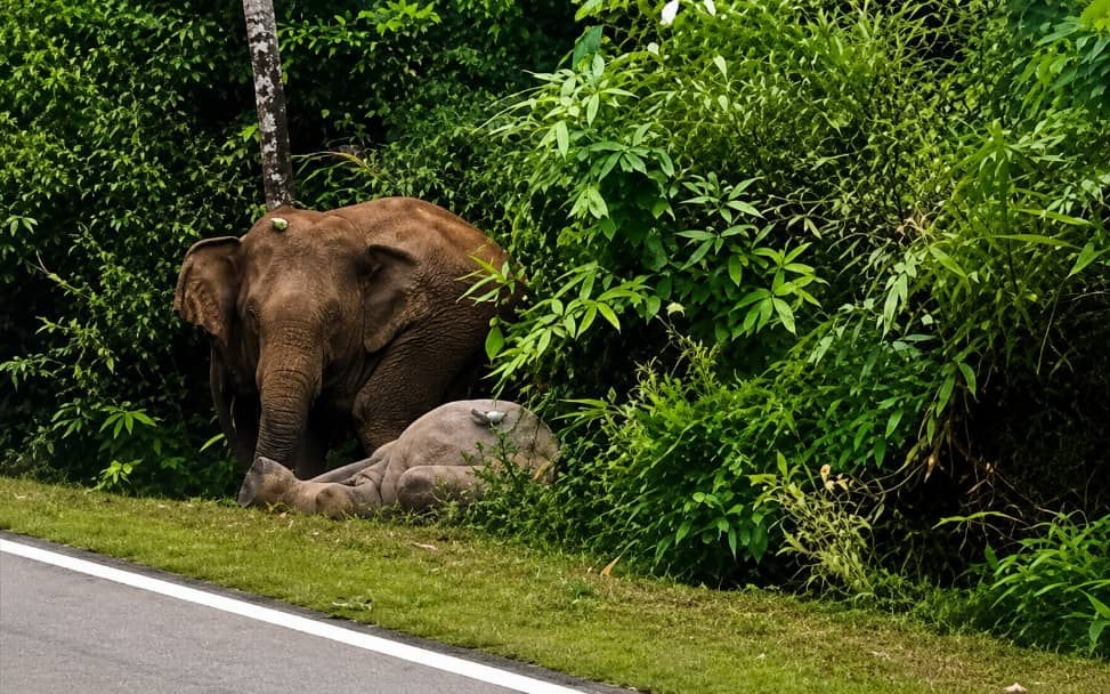
A heart-wrenching incident unfolded on the roads of Johor early Monday morning when a young elephant lost its life to a vehicle collision, prompting its mother to maintain a vigil over the carcass for seven consecutive hours. The tragedy, which occurred along Jalan Felda Nitar in Mersing at 2.28 am, struck a national chord particularly among those who recall the emotionally charged Gerik incident that gripped Malaysia on Mother's Day the previous year.
Video footage that rapidly circulated across social media platforms captured the devastating scene of the adult female elephant steadfastly remaining beside her offspring's lifeless body, unable to abandon what appeared to be an expression of maternal grief and confusion. The Johor Department of Wildlife and National Parks (Perhilitan) received formal notification of the tragedy around 8.30 am, several hours after the initial impact, and immediately mobilised four officers to investigate the circumstances surrounding the death.
Wildlife officials determined that the fatality involved a five-year-old female elephant calf, a member of the Jamaluang-Mersing identification group that roams this particular region of Johor. The animal measured approximately 150 centimetres in length and bore specific physical identifiers that would allow for ongoing research into the herd's movements and welfare. The vehicle involved in the collision was a Perodua Bezza, an increasingly common sight on Malaysian roads, underscoring the growing frequency of encounters between expanding human infrastructure and elephant habitats.
The human toll of the incident extended beyond the animal kingdom when a 31-year-old male driver found himself in grave danger following the impact. The force of the collision sent his vehicle careening off the roadway and plummeting into a five-metre-deep ravine, trapping him inside the wreckage with serious lower-body injuries that required emergency intervention. The Fire and Rescue Department responded to extricate the injured motorist, adding another layer of complexity to what had begun as a simple journey through the darkness.
Responding to the distressed mother elephant's continued presence at the site, the Elephant Capture Unit from the Johor Elephant Sanctuary employed gentle herding techniques to encourage the grieving animal back into the relative safety of the forest environment. Only after successful relocation of the mother elephant did wildlife authorities proceed with the burial of the calf's remains in a location near the incident site, attempting to provide some measure of dignity to the deceased animal.
Concerned about potential complications in the hours following the immediate resolution, Perhilitan announced plans for continuous surveillance throughout the evening and subsequent day to monitor the mother elephant's condition and deter any possible return to the dangerous roadway. The department recognised that traumatised animals sometimes attempt to retrace their steps to accident sites, behaviour that could place them in renewed peril from oncoming traffic.
Authorities noted that warning signage specifically alerting motorists to elephant crossings had been previously installed throughout the problematic corridor, yet such measures have repeatedly proven insufficient to prevent tragic encounters. This systemic limitation reflects a broader challenge confronting Malaysian wildlife management: the difficulty of effectively protecting megafauna within densely utilised transportation networks where visibility is compromised by darkness and driver vigilance may be diminished during night hours.
The Mersing incident inevitably invokes memories of the Gerik tragedy that unfolded on May 11 the previous year, an event that captured national attention and generated widespread emotional response. In that incident, a young elephant became pinned beneath a commercial container lorry after sustaining impact injuries, while observers documented what appeared to be a desperate maternal response as the adult elephant seemingly attempted to manipulate the heavy vehicle in hopes of liberating her offspring. The Gerik case transcended ordinary news coverage to become a symbol of the escalating human-wildlife conflict threatening Malaysia's irreplaceable elephant populations.
These successive incidents underscore the precarious position occupied by Johor's elephant populations, which share their ancestral territories with modern infrastructure and increasingly intensive human activity. The Jamaluang-Mersing herd, like other elephant communities throughout the peninsula, faces narrowing options as agricultural expansion, highway development, and residential growth compress available habitat into ever-smaller fragments. Night-time journeys through forested corridors, once routine survival activities, have become deadly gambles against the probability of encountering vehicles on roads cutting through traditional movement routes.
The repetition of such tragedies within a relatively short timeframe raises urgent questions about the adequacy of current protective measures and enforcement mechanisms designed to reduce human-elephant fatalities. While warning signs serve an important awareness function, evidence suggests that enhanced intervention strategies may be necessary, potentially including temporal restrictions on traffic movement during peak elephant activity hours, improved road design that incorporates wildlife crossing provisions, or expanded habitat connectivity that reduces the necessity for elephants to traverse major transportation corridors.
Public health and safety considerations also demand attention, as demonstrated by the injuries sustained by the vehicle operator in Monday's incident. The collision that killed the young elephant also endangered human life, creating a dual imperative for Malaysian authorities to address the underlying conditions generating these preventable tragedies. Motorists traversing Mersing and other regions known for elephant presence require not merely warning signs but also practical guidance on appropriate behaviour should they encounter wildlife on roadways during low-visibility conditions.
Looking forward, the Mersing incident offers an opportunity for renewed assessment of Malaysia's commitment to coexisting peacefully with its remaining elephant populations. The emotional resonance of the grieving mother elephant captured in viral video footage speaks to something fundamental in human consciousness about the bonds connecting members of the animal kingdom. Translating such public sentiment into concrete policy changes and enforcement improvements remains the central challenge facing wildlife managers tasked with ensuring that future generations of both humans and elephants can safely share Malaysian territory.

