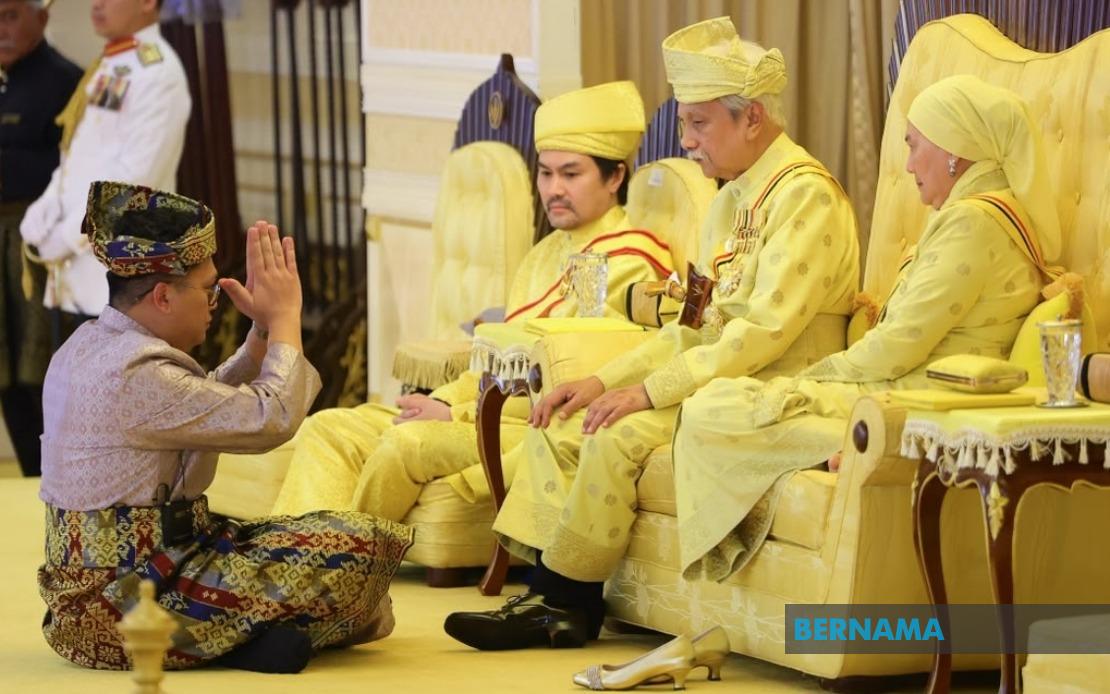
Negeri Sembilan's Yang Dipertuan Besar, Tuanku Muhriz Tuanku Munawir, presided over the formal installation of Muhammad Faris Johari as the 11th Undang of Luak Sungei Ujong during a ceremonial gathering held at Istana Besar Seri Menanti in Kuala Pilah. The occasion represented a significant moment in the state's customary governance structure, where traditional protocols were meticulously observed to legitimise the succession of this important regional chieftain position within Negeri Sembilan's unique administrative framework.
The installation ceremony adhered to longstanding constitutional customs integral to Negeri Sembilan's governance model. The proceedings commenced when the Orang Empat Istana, custodians of palace protocol, formally sought the Yang Dipertuan Besar's permission to proceed. Following this preliminary step, the newly appointed Undang made his solemn pledge of allegiance to the monarch, reaffirming the hierarchical bond between local chieftains and the sovereign authority of the state ruler.
Tuanku Muhriz subsequently proclaimed Muhammad Faris's elevation to the position, granting him the honorific title Datuk Klana Petra alongside his appointment as Undang. This dual bestowal of title and office underscores the ceremonial significance attached to custodial roles within Negeri Sembilan's traditional administrative apparatus, where such designations carry historical weight and community recognition.
In his address during the ceremony, the Yang Dipertuan Besar articulated expectations regarding the discharge of customary responsibilities. He emphasised the necessity of honouring pledges with utmost sincerity, professional integrity, and substantial personal accountability. The ruler's remarks directed at the Orang Kaya community stressed the imperative of maintaining unwavering loyalty to the institution of the Yang Dipertuan Besar and fostering respectful engagement with both the monarch and the palace establishment.
Tuanku Muhriz contextualised his remarks within broader constitutional governance. He underscored that relationships grounded in reciprocal respect, institutional trust, and consensual decision-making prove indispensable for preserving Malaysia's constitutional monarchy framework. Beyond national constitutional concerns, the ruler emphasised that such principles equally sustain customary traditions and contribute to Negeri Sembilan's sustained prosperity and social cohesion.
The ruler additionally addressed the assembled populace through the customary leadership, encouraging community members to collaborate actively with these traditional officials in fulfilling civic responsibilities. Simultaneously, he called for continued reverence and preservation of Adat Perpatih, the distinctive customary legal system practised in Negeri Sembilan and transmitted through successive generations. This dual emphasis—contemporary collaboration alongside ancestral tradition—reflects the balance Negeri Sembilan seeks between modern governance requirements and cultural continuity.
The ceremony drew attendance from prominent state figures, including Tunku Ampuan Besar Tuanku Aishah Rohani Tengku Besar Mahmud, Tunku Besar Seri Menanti Tunku Ali Redhauddin Tuanku Muhriz, and Tunku Panglima Besar Tunku Zain Al-'Abidin. Menteri Besar Datuk Seri Aminuddin Harun and senior government department heads also participated, demonstrating the ceremonial significance attributed to this installation and the integration of customary procedures within state governance structures.
Muhammad Faris brings contemporary professional credentials to his customary position. The 28-year-old, born on October 30, 1997, completed undergraduate studies in accountancy at Universiti Teknologi MARA and subsequently obtained professional accounting certification through the Association of Chartered Certified Accountants programme in 2022. His background reflects an emerging pattern whereby younger Malaysians assume traditional chieftain roles whilst maintaining modern professional qualifications, potentially enhancing governance effectiveness at community levels.
The appointee is married to Sharifah Amirah Syed Ismail Ash-Shahab, establishing family connections that likely strengthen social networks within his administrative jurisdiction. Such matrimonial alliances have historically held significance in Malaysian customary governance contexts, facilitating communication and consensus-building across established community hierarchies.
For Malaysian political observers, Muhammad Faris's installation represents succession continuity within Negeri Sembilan's distinctive constitutional arrangements. Unlike peninsular states lacking comparable customary frameworks, Negeri Sembilan maintains formalised roles for territorial chieftains—the Undangs—whose authority derives from Adat Perpatih traditions rather than purely administrative designation. This system, whilst ceremonially elaborate, continues serving as institutional mechanism through which traditional authority structures interface with modern state administration.
The timing of this installation assumes particular relevance given contemporary discussions regarding institutional modernisation across Malaysian governance systems. Negeri Sembilan's persistent commitment to ceremonial validation of customary appointments demonstrates sustained respect for historical constitutional frameworks amongst Malaysia's leadership, suggesting resistance to radical institutional reformulation in favour of gradual evolutionary adaptation.
Immediate proceedings included scheduling an additional royal audience to formalise installation of the 22nd Undang of Luak Rembau, indicating the palace's completion of succession procedures across multiple administrative divisions. These coordinated ceremonial activities underscore Negeri Sembilan's systematic approach to maintaining continuity within its customary governance institutions, ensuring that territorial chieftain positions remain appropriately occupied and legitimised through formal royal sanction.
For Southeast Asian governance studies, Negeri Sembilan's institutional arrangements offer comparative interest, representing rare instances where post-colonial states retain functioning traditional governance hierarchies integrated within constitutional frameworks. Muhammad Faris's installation, therefore, exemplifies how Malaysian federalism accommodates distinctive state-level constitutional arrangements whilst preserving broader national institutional coherence.

