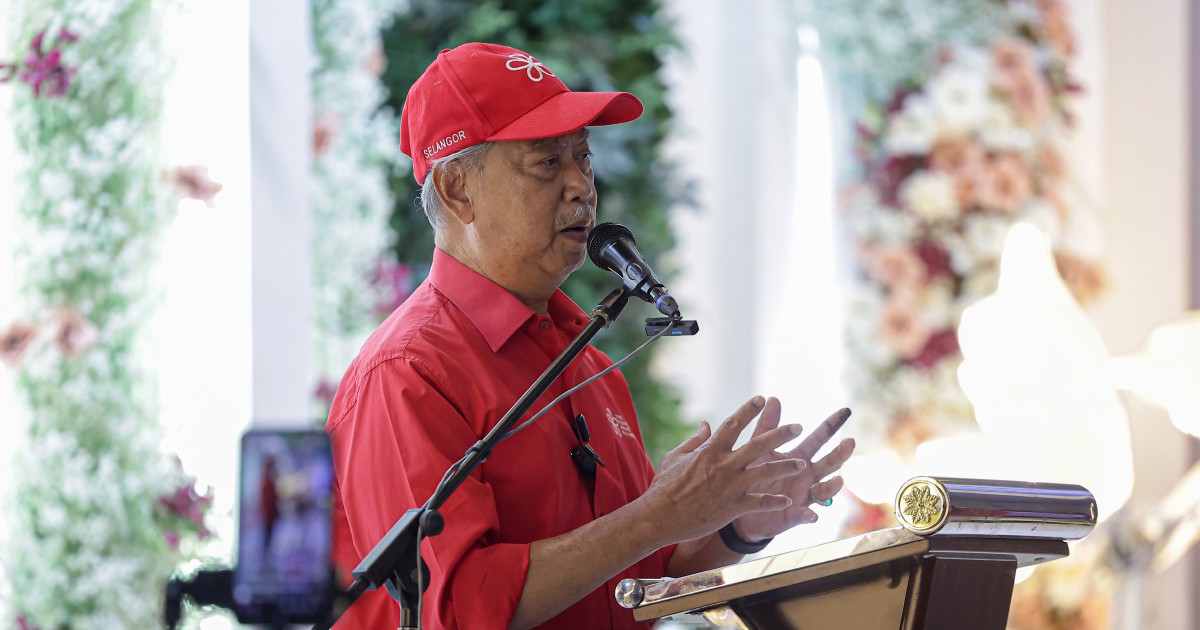
Bersatu president Tan Sri Muhyiddin Yassin has firmly rejected characterisations of his party as a political spoiler, responding with undisguised irritation to recent remarks by Umno vice-president Datuk Seri Mohamed Khaled Nordin regarding the party's participation in the Negri Sembilan state election. The sharp exchange underscores simmering tensions within Malaysia's political coalition landscape, revealing the fragile nature of alliances that have governed the country in recent years.
Muhyiddin's rebuke comes as Bersatu, despite its dwindling parliamentary representation, continues to assert its relevance within the broader political framework. The accusation of playing spoiler—a term typically reserved for minor parties whose participation fragments opposition votes or complicates electoral mathematics—strikes at the legitimacy question that has dogged Bersatu since its dramatic split from Umno in 2020. For Muhyiddin, the characterisation threatens to diminish his party's standing just as it attempts to maintain political influence in the states, where grassroots presence often matters more than national polling numbers.
The dispute reflects a deeper tension between Bersatu and its erstwhile coalition partners. While both parties have participated in the Perikatan Nasional and various state-level arrangements, the relationship remains competitive and occasionally adversarial. Mohamed Khaled's spoiler comment appears calculated to discourage Bersatu from fielding candidates who might split the Malay-Muslim vote in marginal constituencies, a concern that intensified as state elections approached. For Umno, which has sought to rebuild its dominance in states like Negri Sembilan, additional competitors in three-cornered fights pose a genuine strategic threat.
The timing of this exchange carries particular significance for Malaysian politics. State elections in Negri Sembilan represent a crucial test of coalition cohesion and voting patterns, especially given recent shifts in voter preferences. Umno has invested substantially in recovering ground lost during its period outside federal power, and any division of the Malay-Muslim electorate could compromise those ambitions. Bersatu's insistence on participating, meanwhile, signals its determination to maintain a visible political presence and prevent itself from becoming entirely sidelined by larger coalition partners.
Muhyiddin's defence of Bersatu's electoral participation rests on the party's constitutional right to contest elections as a registered political entity. This legalistic argument, while straightforward, masks a more complex political reality. In Malaysian politics, the distinction between legitimate political competition and spoiler tactics often depends on which coalition perspective one adopts. What Umno sees as problematic vote fragmentation, Bersatu characterises as democratic participation and voter choice.
The language deployed in such disputes carries implications beyond immediate electoral calculations. Describing a party as a spoiler carries pejorative weight, suggesting that the party's involvement in elections undermines broader political objectives or coalition stability. For Bersatu, which has struggled with questions about its ideological coherence and political purpose, such characterisations compound existing vulnerabilities. The party's relatively recent formation and its origins as a breakaway faction have left it perpetually vulnerable to accusations of unprincipled opportunism.
From a Southeast Asian perspective, this intra-coalition tension reflects broader patterns observable across the region's democracies. Coalition politics in Malaysia, Indonesia, and Thailand frequently involve similar disputes about which parties legitimately belong in electoral contests and which should defer to larger alliance partners. These disagreements often mask deeper questions about power distribution, ideological alignment, and the future direction of political movements. Bersatu's insistence on participating in Negri Sembilan elections suggests the party has chosen not to accept a subordinate role within coalition arrangements.
For Malaysian voters in Negri Sembilan, the spat between coalition partners introduces additional complexity into state electoral calculations. Rather than presenting a unified front, the squabbling signals underlying fractures within the governing coalition. This visibility of internal disagreement, when disputes become public, can affect voter confidence in the coalition's capacity to govern effectively. Conversely, it offers voters in marginal constituencies additional choice, which some may welcome as a healthy expression of political pluralism.
The broader context includes Bersatu's persistent struggle to maintain political relevance after its relatively poor showing in the 2023 federal election. State elections offer opportunities for the party to demonstrate continuing support and justify its continued existence as a significant political force. Without victories in state contests, Bersatu risks further marginalisation, particularly as discussions about future coalition arrangements gather momentum. Participation in Negri Sembilan thus carries both symbolic and practical importance for the party's trajectory.
Muhyiddin's counter-attack also serves an important internal function for Bersatu, signalling to party members and supporters that the leadership will not accept dismissive treatment from larger coalition partners. By responding publicly and forcefully to Mohamed Khaled's remarks, Muhyiddin demonstrates that Bersatu will defend its interests actively. This posturing matters for maintaining internal party cohesion and preventing further defections to larger political entities.
The dispute underscores how Malaysian coalition politics operates according to unwritten rules and implicit understandings that occasionally break down into public recriminations. When such breakdowns occur, they reveal the transactional nature of many inter-party relationships and the ongoing competition for influence despite formal alliance arrangements. The Negri Sembilan election will provide one measure of whether Bersatu's insistence on participation strengthens or damages its political position in the months ahead.

