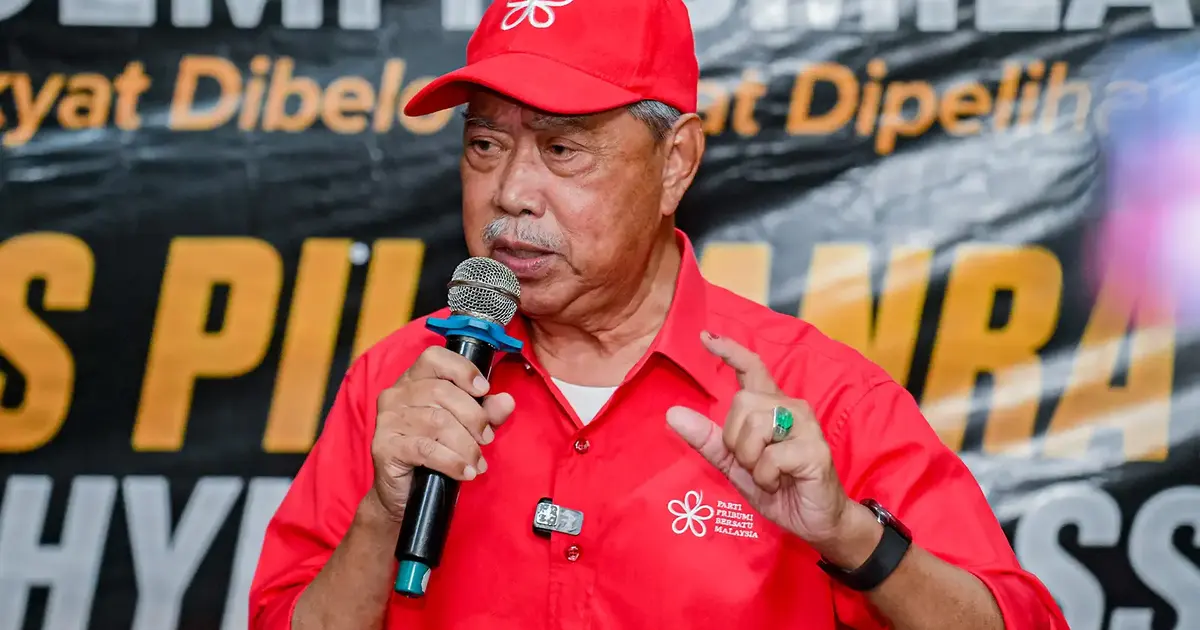
Bersatu president Muhyiddin Yassin has forecast an imminent collision between Umno and PAS in Malaysia's northern states, casting doubt on the long-term viability of the broader Barisan Nasional and Perikatan Nasional alliance that currently governs the country. The prediction underscores deepening fissures within the ruling coalition and raises fresh questions about political stability in the peninsula's northern tier, where both major Islamic-leaning parties harbour overlapping territorial and electoral ambitions.
Muhyiddin's remarks represent a significant escalation in public commentary about coalition tensions, moving beyond the private grumbling that has characterised recent months. His assessment appears rooted in the structural incompatibility of having two parties with similar ideological positioning and voter bases—Umno and PAS—operating under the same umbrella in regions where they have historically competed fiercely for control and legitimacy. The northern states, including Kedah, Perlis, Kelantan, and Terengganu, have long been battlegrounds for supremacy between these two forces, and the current arrangement merely postpones rather than resolves these underlying rivalries.
The Barisan Nasional-Perikatan Nasional coalition was forged in the aftermath of the 2022 general election as a pragmatic compromise to secure legislative majorities and form government. However, the marriage of convenience has always carried the seeds of discord, particularly given that both alliances contain parties with divergent—and sometimes contradictory—policy preferences on economic management, religious governance, and resource allocation. For PAS, a primary motivation for joining the broader federal coalition was securing influence over states it controls or contests; for Umno, the arrangement provides numerical strength while simultaneously requiring it to accommodate a rival with competing claims to lead the Malay-Muslim electorate.
Northern states represent a critical testing ground for this uneasy coexistence. Kedah and Perlis remain Umno strongholds where the party expects to maintain dominance, yet PAS has cultivated significant grassroots presence and views these territories as potentially reclaimable. Kelantan and Terengganu present different dynamics: PAS holds Kelantan outright and maintains substantial leverage in Terengganu, creating scenarios where Umno might seek to dislodge the Islamic party or at minimum constrain its expansion. The current coalition framework obscures but does not eliminate these competitive impulses, and as the next general election approaches—potentially within the next two to three years—both parties will intensify their positioning within their respective fiefdoms.
Muhyiddin's prediction carries particular weight given his position as Bersatu leader and his detailed knowledge of coalition mechanics from his time as prime minister. Bersatu itself occupies an awkward middle position, allied with Perikatan Nasional while maintaining relationships across the broader federal coalition. This vantage point affords him credibility in assessing fault lines that may not yet be visible to casual observers. His willingness to articulate these concerns publicly also signals that Bersatu may be positioning itself as a potential kingmaker or mediator should the coalition fracture, a calculation not lost on other political players.
The implications for Malaysian governance are considerable. A breakdown in the Barisan Nasional-Perikatan Nasional arrangement would not necessarily topple the federal government, given mathematical realities, but it would trigger a fundamental reconfiguration of state-level politics across northern Malaysia. Such realignment could reshape public policy priorities in these regions, affecting everything from religious affairs administration to economic development initiatives. Additionally, a visible rupture between Umno and PAS would force other coalition partners to choose sides or engineer new power-sharing arrangements, cascading effects that could destabilise seemingly settled political calculations elsewhere.
For Malaysian voters, particularly in northern states, Muhyiddin's remarks serve as a reminder that the apparent stability of current governance arrangements masks deeper tensions awaiting resolution. Political parties are already laying groundwork for potential repositioning, conducting quiet negotiations, and assessing fallback options. The coming months will likely see escalating rhetoric and tactical positioning as parties prepare for the possibility that the current coalition structure proves unsustainable. Umno and PAS, despite occupying the same coalition space, continue pursuing incompatible political objectives in these regions, and the trajectory suggests accommodation rather than reconciliation.
Regional observers and neighbouring Southeast Asian governments watching Malaysian political developments will also note that coalition instability at the federal level invariably ripples through state politics and vice versa. Any significant rupture in the Barisan Nasional-Perikatan Nasional arrangement could create openings for alternative coalitions to emerge, potentially fundamentally altering the character of Malaysian governance. The northern states, where demographic patterns and religious demographics create distinct political dynamics, may become the laboratories where this process first becomes visibly apparent to the broader public and international community.

