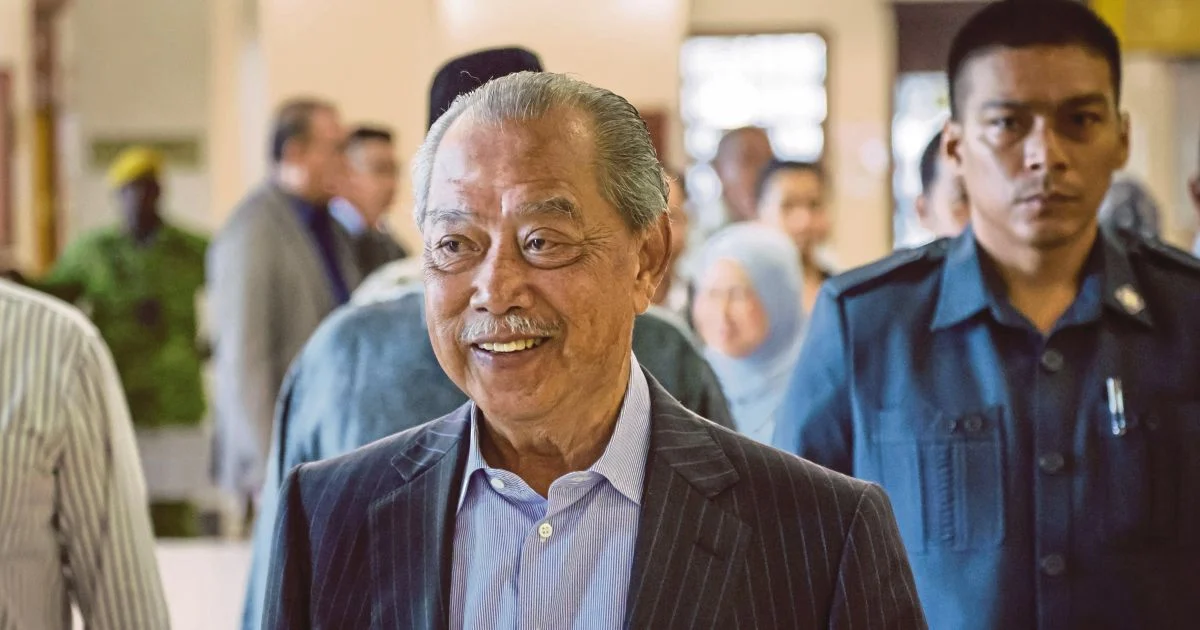
Perikatan Nasional retains realistic prospects of capturing control of Johor's state assembly following the coming election, according to Bersatu president Tan Sri Muhyiddin Yassin, even though the opposition pact is contesting only 33 of the chamber's 56 seats. Speaking at his party's headquarters in Pagoh, Muhyiddin projected optimism about PN's electoral positioning, suggesting that the coalition's focused approach to seat selection reflects strategic calculation rather than weakness.
The decision to field candidates in roughly 59 percent of available contests represents a deliberate narrowing of PN's target perimeter compared to past electoral contests. Rather than spreading resources across every constituency, the coalition has apparently concentrated its efforts on seats deemed winnable or strategically significant. This methodology, Muhyiddin implied, does not diminish PN's ultimate objective of assembling a majority in the 56-member legislature, where 29 seats would be required to govern.
Johor represents particularly significant political terrain for Perikatan Nasional, which has sought to rebuild its influence in peninsula Malaysia's heartland since the 2022 general election. The state has historically oscillated between major coalitions, and control of its government would constitute a meaningful restoration of the opposition's capacity to govern a significant state economy and population base. For Muhyiddin personally, Johor holds symbolic weight as his home state and longstanding political foundation.
The mathematics of the upcoming election remain genuinely fluid. While PN's decision to contest fewer than two-thirds of seats might appear to handicap its prospects, such calculations often rest on sophisticated internal polling and constituency-level analysis. Coalitions routinely withdraw from seats where polling data indicates minimal advantage, preferring to concentrate campaign machinery and financial resources where marginal gains can prove decisive. In tight electoral contests, such concentration frequently yields superior results than broader dispersion of effort.
Beyond PN's own positioning, the Johor outcome will significantly depend on how fractionalised the ruling coalition's vote becomes in contested constituencies. Should Pakatan Harapan and Barisan Nasional fail to maintain unified candidacy in specific areas, vote-splitting could amplify PN's opportunities across the state. Conversely, disciplined opposition coordination would substantially improve incumbent chances. The three-cornered structure of contemporary Malaysian politics increasingly produces outcomes where plurality voting advantages the coalition with superior ground organisation and targeted campaign focus.
Muhyiddin's confidence projection also reflects broader PN strategy to demonstrate viability and momentum ahead of the Johor contest. Political psychology matters considerably in Malaysian elections; voter perception that a coalition possesses genuine prospects of victory frequently becomes self-fulfilling as undecided electors gravitate toward perceived winners. By publicly articulating confidence rather than defensive caution, PN leadership attempts to establish narrative momentum and discourage last-minute defections to incumbents.
The Bersatu leader's remarks come amid sustained restructuring within PN itself, which has struggled to maintain internal cohesion following the 2022 general election aftermath. Perikatan's constituent components—principally Bersatu, PAS, and smaller partners—have occasionally pursued conflicting agendas in state-level politics. Johor, however, has remained a focus for PN consolidation efforts, and unified candidacy across the coalition's members should strengthen competitive positioning.
For Malaysian political observers, Johor's coming election carries implications extending well beyond the state's boundaries. A PN victory would demonstrate that the opposition retains capacity to govern substantial state administrations and could reshape parliamentary calculations affecting federal stability. Conversely, if incumbents retain control despite PN's concentrated challenge, it would reinforce perceptions that Pakatan Harapan and Barisan Nasional maintain consolidated advantages in Malaysia's most populous and economically significant territories.
The state election also functions as preliminary indicator of electoral sentiment before any future general election becomes constitutionally necessary. Both the ruling coalition and opposition will scrutinise results to gauge voter sentiment and refine campaigning approaches. For investors and businesses with operations concentrated in Johor, the election's outcome carries material implications for regulatory policy, infrastructure investment, and state-level economic direction.
Muhyiddin's optimistic framing reflects Bersatu's broader strategic positioning within PN, where the party has sought to reestablish itself as kingmaker in coalition dynamics. By projecting confidence in Johor specifically, Muhyiddin simultaneously positions himself as effective strategist and vindication of PN's continued relevance within Malaysian politics. The coming weeks will demonstrate whether such confidence rests on solid electoral foundation or represents merely aspirational political rhetoric.

