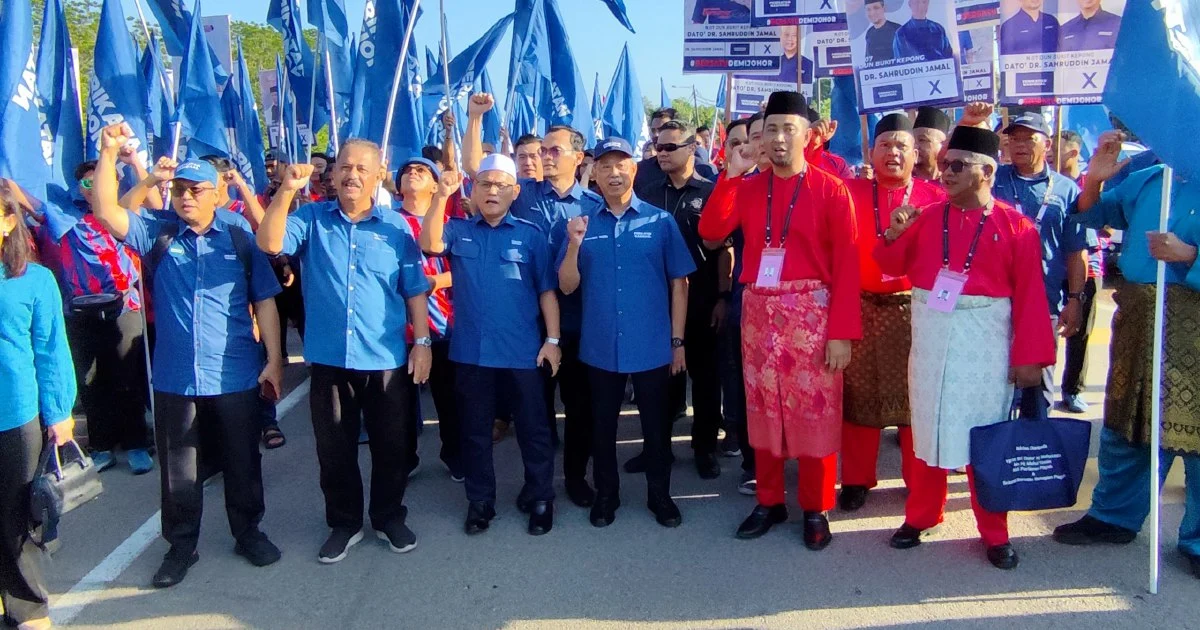
Bersatu president Tan Sri Muhyiddin Yassin made a public show of party unity by arriving at the nomination centre in Pagoh early this morning, accompanying candidate Sahruddin through the formal registration process. His appearance at the Pagoh Sports Complex Hall at 8.45 am carries symbolic weight in the broader context of Johor's electoral dynamics, where the federal government's coalition partners are seeking to consolidate their foothold ahead of potential state-level contests.
The timing of Muhyiddin's presence reflects a deliberate strategy by Bersatu to position itself prominently in Johor politics. As the party's president, Muhyiddin has consistently sought to maintain Bersatu's relevance within the federal administration while competing for support within the state's electorate. His participation in the nomination proceedings underscores the importance that Bersatu attaches to the Bukit Kepong contest, which represents one of the party's targeted seats in the region.
Johor remains a significant political battleground in Malaysian politics, both as a source of federal parliamentary representation and as a potential arena for state-level political competition. The state's electoral dynamics have shifted considerably in recent years, with various coalitions jockeying for influence. Bersatu's efforts to maintain momentum in Johor must be understood within the broader complexities of coalition politics and the competing interests of different parties within government.
Sahruddin's nomination in Bukit Kepong marks another step in what appears to be a coordinated electoral campaign by Bersatu. The party has been working to strengthen its grassroots presence across several constituencies, particularly in states where it can compete as part of the ruling coalition. The presence of senior party leadership at nomination events serves both to legitimise individual candidates and to send messages about party priorities to both supporters and potential voters.
Muhyiddin's involvement in Johor electoral activities reflects ongoing negotiations about political positioning between various components of Malaysia's federal government. Bersatu, which emerged as a significant political force in recent years, has sought to establish itself as an essential coalition partner rather than a junior or peripheral entity. Electoral contests provide opportunities for parties to demonstrate organisational capacity and voter appeal, metrics that influence their bargaining position within government.
The Pagoh nomination process itself represents a formal administrative requirement for all candidates contesting electoral seats. Nomination days typically draw attention from media and political observers, who scrutinise candidate fields, party strategies, and the broader competitive landscape. The presence of high-ranking party officials at these events is a calculated move to generate publicity and reinforce party messaging to the voting public.
Bukit Kepong's electoral significance extends beyond its immediate constituency boundaries. As part of Johor, the seat contributes to the state's overall political composition and influences the state's representation within the federal parliament. Electoral outcomes in Johor constituencies have historically carried implications for broader national political alignments, making contests like that in Bukit Kepong worthy of close attention from both politicians and political analysts across Malaysia.
The optics of party leadership supporting individual candidates cannot be overstated in Malaysian electoral culture. Voters often interpret the level of attention and resources directed towards a candidate as indicative of a party's confidence in that candidate's prospects and the party's commitment to winning that particular seat. Muhyiddin's early morning appearance signalled that Bersatu is treating the Bukit Kepong race as a priority engagement rather than a peripheral contest.
For Malaysian observers monitoring coalition dynamics, such public displays of party unity hold particular significance. Coalition governments depend on maintaining cohesion among partner parties, and visible endorsements of individual candidates by senior leadership help reinforce messages about stability and shared commitment to common goals. Muhyiddin's support for Sahruddin contributes to the narrative that Bersatu remains actively engaged in the electoral process and committed to advancing its representatives into elected office.
The nomination centre setting, though administrative in nature, provides an ideal backdrop for political messaging. Photographers and journalists typically cover nomination day proceedings, creating opportunities for parties to generate news coverage and shape narratives about their electoral strategies. Muhyiddin's participation ensured that Bersatu's campaign in Bukit Kepong received media attention at a critical moment in the nomination process.
Looking ahead, the intensity with which Bersatu is engaging in Johor contests may indicate the party's assessment of the state's political trajectory. Should Johor move towards state elections in the near term, contests like Bukit Kepong will acquire additional significance as indicators of each party's preparedness and voter support levels. The pattern of leadership involvement in nomination proceedings often correlates with parties' broader electoral strategies and their expectations about competitive intensity in specific constituencies.

