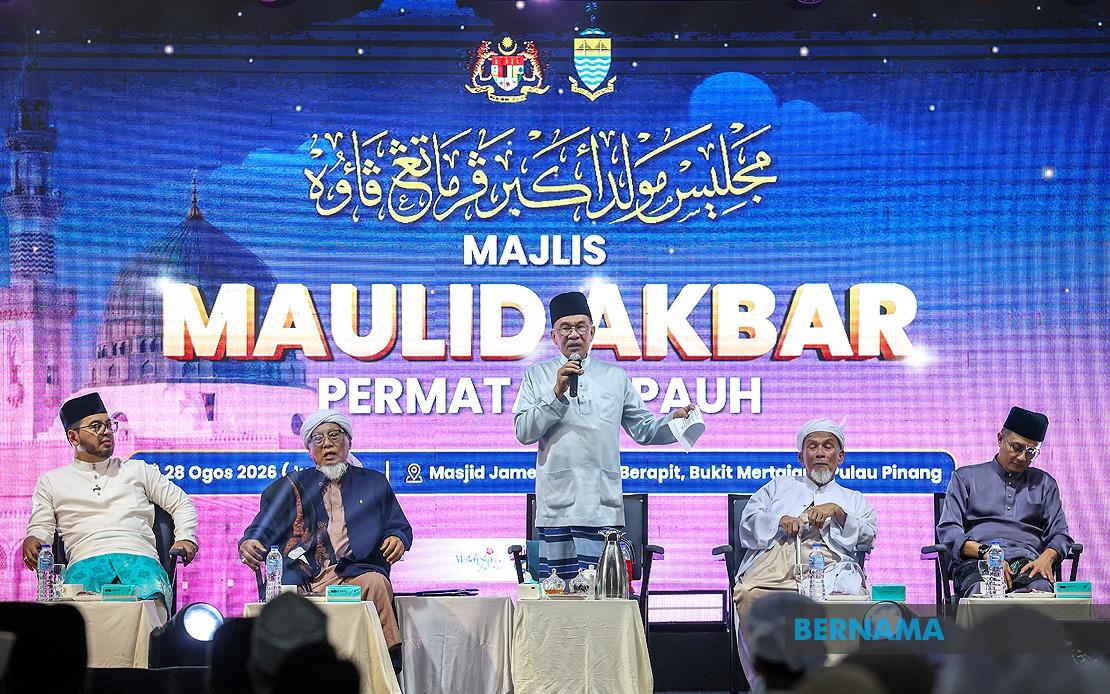
Prime Minister Datuk Seri Anwar Ibrahim has called on Muslims across Malaysia to become moral exemplars for society, arguing that respect and admiration must be earned through consistent demonstration of integrity, hard work and principled conduct rather than expected by virtue of religious identity alone. Speaking at a Maulid Akbar ceremony held in conjunction with National Day at Masjid Tengah in Bukit Mertajam, Anwar underscored that positive character and ethical behaviour constitute the true foundation upon which the standing of Islam and Muslims in society is built.
The Prime Minister outlined a vision in which public trust in Muslim leadership and institutions flows directly from observable actions in daily life. He emphasised that when citizens witness Muslims working diligently, honouring commitments, maintaining honesty in transactions and refraining from theft or embezzlement, they naturally extend respect and confidence to the broader Muslim community. This framing positions individual ethical conduct as both a personal obligation and a collective responsibility that influences how Islam itself is perceived within Malaysia's multi-religious democracy.
Anwar's remarks carry particular weight given Malaysia's ongoing efforts to rebuild institutional credibility following previous governance challenges. His emphasis on rejecting corruption and wrongdoing reflects a broader policy agenda that seeks to anchor national development in moral principles rather than technocratic measures alone. The inclusion of Minister in the Prime Minister's Department (Religious Affairs) Dr Zulkifli Hasan at the ceremony underscored the government's intention to align religious messaging with anti-corruption and good governance initiatives.
Central to the Prime Minister's philosophy is the proposition that Islam fundamentally embodies compassion and universal goodness. From this premise, he argued that Muslims bear a responsibility to extend welfare considerations across all segments of Malaysian society regardless of racial or religious background. This inclusive framing addresses potential concerns about sectarian division and reinforces the constitutional commitment to religious pluralism while maintaining that Islamic values themselves demand such tolerance and care for the broader community.
Anwar articulated a holistic conception of human development that resists the compartmentalisation of material progress from spiritual and moral growth. He stressed the importance of cultivating knowledge, faith, morality, and both spiritual and physical development alongside economic advancement. This integrated approach reflects Islamic scholarly tradition while responding to contemporary anxieties about technological disruption and rapid modernisation potentially displacing ethical foundations.
The Prime Minister's metaphor of reaching for the sky while remaining rooted in the earth encapsulates his vision for Malaysia MADANI, the government's development framework. He positioned faith, morality and character as essential anchoring principles that prevent national ambition from becoming untethered from value systems. Without such grounding, technological prowess and economic metrics become hollow measures disconnected from human flourishing and social cohesion.
Anwar contended that Malaysia MADANI cannot rely solely on policy implementation, economic indicators or technological mastery to achieve sustainable development. Rather, these conventional metrics of progress must be pursued in deliberate conjunction with the cultivation of moral consciousness and character at both individual and institutional levels. This argument implicitly challenges development paradigms that prioritise GDP growth and digital transformation above all other considerations.
The Prime Minister underlined the continued relevance of Islamic scholarship and scholarly authority in modern governance. He called for Muslims to actively seek knowledge from Islamic scholars and for strengthening institutional relationships between religious scholars and political leaders through frank exchange of views and constructive counsel. This appeal for intellectual engagement between religious and secular authorities suggests an openness to diverse perspectives while maintaining Islam's role in public discourse.
Anwar's insistence that Malaysia MADANI must simultaneously drive economic expansion and technological innovation while preserving moral and spiritual values positions his administration as attempting to navigate the challenging middle ground between traditionalism and modernisation. Rather than accepting these as opposing forces, his framework proposes their complementary integration. This balancing act will likely remain a central tension in Malaysian governance as the country pursues both material development and cultural cohesion amid globalisation pressures.
The implications for Southeast Asian readers extend beyond Malaysia's borders, as questions about how Muslim-majority and multi-religious nations can pursue development while anchoring policy in ethical foundations remain salient across the region. Anwar's emphasis on individual moral responsibility as a prerequisite for collective standing offers a model that diverges from purely institutional or regulatory approaches to governance reform. Whether such appeals to personal integrity can meaningfully influence systemic behaviour remains an open question that will test the government's broader anti-corruption agenda.

