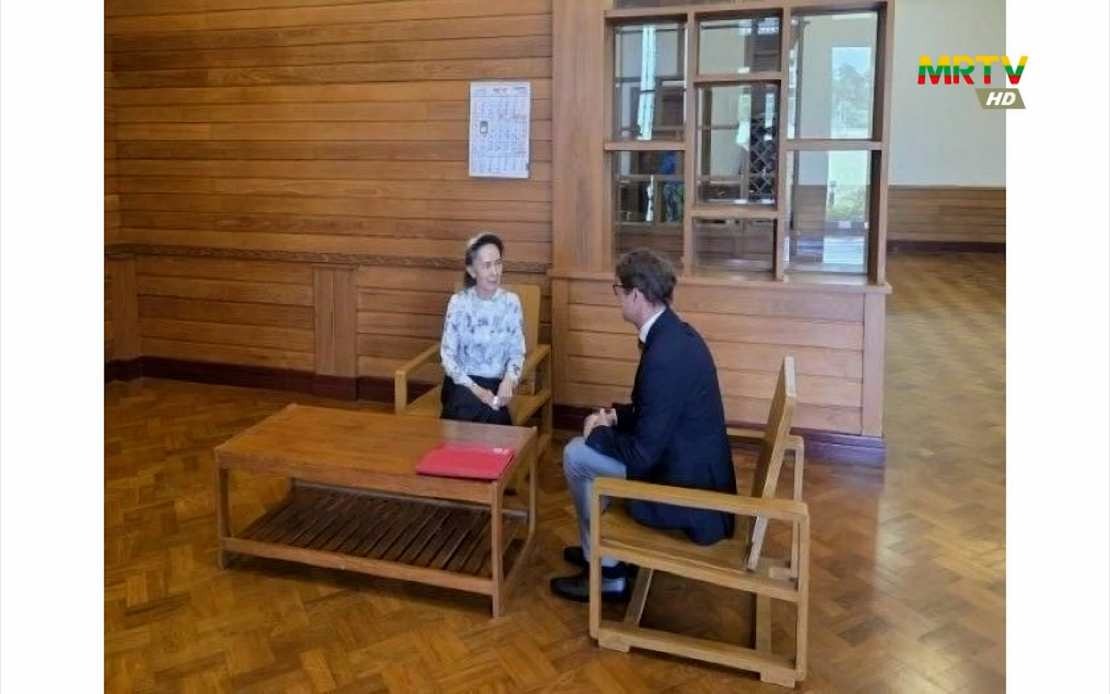
Myanmar's military-backed administration confirmed on Monday that detained former civilian leader Aung San Suu Kyi had received a visit from an International Committee of the Red Cross representative, marking a rare glimpse of the 81-year-old Nobel Peace Prize laureate since her imprisonment following the February 2021 coup. Government spokeswoman Khine Khine Soe announced that Suu Kyi met with Arnaud de Baecque, the ICRC's Resident Representative to Myanmar, in the capital Naypyitaw, in what appears to be a calculated response to mounting diplomatic pressure from neighbouring ASEAN nations demanding transparent access to the imprisoned leader.
The controlled nature of the encounter underscores the military administration's carefully managed approach to managing international scrutiny of Suu Kyi's detention. Photographs released by the government showed Suu Kyi, dressed in traditional Burmese clothing, seated across from de Baecque in a minimalist wooden-paneled room containing only basic furniture. A fourth image purported to show Suu Kyi cutting a birthday cake inscribed with her name and the date "19.6.2026," though Reuters could not independently verify when or where the photographs were actually taken, nor were earlier versions of the images discoverable online before the announcement.
Suu Kyi's imprisonment represents a dramatic reversal of fortune for Myanmar's most iconic political figure. The military's dawn coup in February 2021 dismantled an elected civilian government that she led, displacing decades of carefully cultivated democratic progress and throwing the Southeast Asian nation into profound instability. Her imprisonment has cast a long shadow over Myanmar's regional standing and its relationship with neighbouring countries, particularly those within ASEAN, which has repeatedly called for her release and verification of her current condition.
The charges levelled against her have been substantial and broadly construed. Following a series of secret trials, military courts convicted her of corruption, election fraud, and violations of state secrecy laws, imposing an initial sentence of 33 years. That sentence was subsequently reduced to 27 years, then further trimmed by one sixth in April, leaving her with approximately 18 years still remaining, according to members of her legal team. Her supporters and international observers have consistently characterised these convictions as politically motivated instruments designed to permanently neutralise her influence within Myanmar's political landscape.
The opacity surrounding Suu Kyi's actual health and living conditions has become an increasingly contentious international issue. Her son, Kim Aris, disclosed to Reuters in December that he has received virtually no direct communication from his mother in years, obtaining only fragmentary secondhand accounts of alleged health complications affecting her heart, bones, and gums. This profound informational vacuum has fuelled significant international concern about her welfare, particularly given her advanced age and the strain of prolonged detention.
The military administration has consistently dismissed these concerns, repeatedly issuing blanket assurances that Suu Kyi remains in "good health," despite providing no credible independent verification. Following the April military-engineered elections that enabled former junta leader Min Aung Hlaing to assume the presidency, authorities claimed that Suu Kyi had been transferred to house arrest, yet this status change has not translated into meaningful access for international observers or family members.
Regional diplomatic efforts to secure transparent access have intensified but yielded limited concrete results. Following ASEAN ministerial meetings in Bangkok last month, Thailand's Foreign Minister Sihasak Phuangketkeow explicitly called for international access to Suu Kyi "so that we can be able to verify the claims" of her good health. The Philippines similarly submitted a formal request for an ASEAN special envoy to meet with the detained leader in May. However, Myanmar's military-backed administration has remained notably reluctant to accommodate these requests, suggesting that the Red Cross meeting may represent the outer limit of permissible international contact.
The historical resonance of Suu Kyi's detention cannot be overlooked. She is the daughter of General Aung San, Myanmar's independence hero, and carries enormous symbolic weight within the nation. During previous periods of military rule, she endured 15 years of intermittent house arrest at her family residence overlooking Yangon's Inya Lake, where she delivered celebrated speeches to devoted supporters gathered beyond the property's gates. That history of struggle had earned her the Nobel Peace Prize in 1991 and transformed her into a global symbol of democratic resistance. Her current situation represents not merely a personal tragedy but a profound setback for democratic aspirations across Southeast Asia.
For Malaysian and regional observers, Suu Kyi's case carries urgent implications for regional stability and democratic governance. Myanmar's instability has generated refugee flows affecting neighbouring countries and created security vacuums that external actors have sought to exploit. The military's apparent intransigence on prisoner access raises troubling questions about whether diplomatic engagement and ASEAN's preferred consensus-based approach can effectively influence military regimes committed to consolidating authoritarian control. The limited Red Cross access, while technically a diplomatic concession, may ultimately signal the junta's confidence that managed international scrutiny poses minimal constraint on its political objectives.
The broader pattern of military governance across Myanmar since 2021 suggests deepening entrenchment rather than movement toward compromise. The electoral processes conducted under military supervision have systematically excluded pro-democracy forces and consolidated institutional power in military hands. Suu Kyi's continued imprisonment serves as a powerful symbol of this consolidation, effectively removing from political circulation the single figure capable of commanding genuine popular legitimacy. Her absence from any realistic political timeline underscores the junta's apparent determination to retain power indefinitely, regardless of international opinion or regional diplomatic pressure.
Looking forward, the trajectory of Suu Kyi's case will likely continue generating diplomatic friction within ASEAN and between Myanmar and its neighbours. The Red Cross meeting may have provided temporary diplomatic cover for the military administration while satisfying minimum international expectations for prisoner contact. However, without sustained, credible access for independent observers, regional suspicions regarding her actual condition will persist. For Malaysia and other ASEAN members, the challenge lies in determining whether engagement strategies can gradually shift Myanmar's military leadership toward greater openness, or whether alternative approaches are required to address the political crisis that Suu Kyi's detention symbolises.

