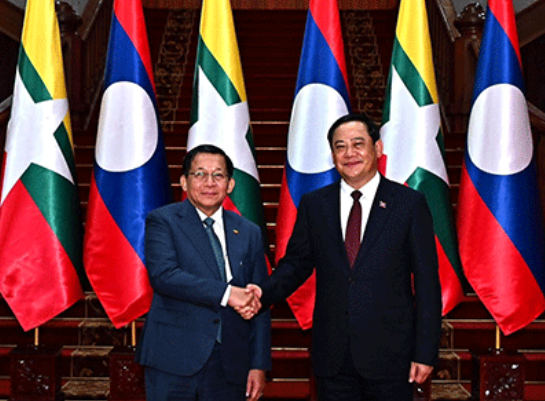
Myanmar President Min Aung Hlaing's three-day state visit to Vientiane from July 3-5 represents a significant consolidation of ties between two Southeast Asian neighbours bound by history, geography and increasingly aligned regional interests. The visit, undertaken at the invitation of Lao President Thongloun Sisoulith, carries symbolic weight as it coincides with the 70th anniversary of formal diplomatic relations between the two nations and marks President Min Aung Hlaing's first official foreign engagement to an Asean member state since assuming office.
The ceremonial dimensions of the visit underscored the importance both governments place on the relationship. A full state welcome ceremony at the Presidential Palace in Vientiane set a formal tone, with President Thongloun and his wife Naly Sisoulith extending official honours to the Myanmar delegation. Such protocol reflects not merely courtesy but a deliberate political signal that the two countries regard their partnership as a cornerstone of regional stability and cooperation.
During bilateral talks, the two presidents canvassed a remarkably broad agenda encompassing traditional state-to-state concerns and emerging transnational challenges. The discussions ranged from border security and defence coordination to the practical realities of trade flows, energy projects and labour migration patterns that link the two economies. This comprehensive approach suggests the two nations view their relationship not as confined to high-level diplomacy but as requiring institutional coordination across multiple government agencies and sectoral bodies.
President Thongloun's public congratulations to Myanmar on its general election and formation of a new government carried diplomatic weight in a regional context where Myanmar's political transitions have generated considerable international scrutiny. By welcoming Myanmar's electoral process and expressing confidence in President Min Aung Hlaing's leadership, Laos positioned itself as a steady partner committed to engagement regardless of the political currents swirling through other capitals. This stance reflects Laos's broader foreign policy orientation toward non-interference and pragmatic bilateral cooperation.
The formal agreements signed during the visit illuminate the practical dimensions of the renewed partnership. A Memorandum of Understanding on tourism cooperation between the two countries' culture and tourism ministries acknowledges the growing importance of regional travel flows and the potential for Laos and Myanmar to jointly develop tourism products that could benefit both economies. Simultaneously, the establishment of friendship city relations between Vientiane and Naypyidaw creates an institutional framework for cultural and people-to-people exchanges that can sustain goodwill beyond the diplomatic level.
The handover of snake antivenom serum to Laos's health ministry, though appearing marginal, illustrates how bilateral cooperation extends to practical healthcare collaboration. For a region where cross-border disease vectors and medical emergencies recognise no national boundaries, such exchanges represent meaningful cooperation on issues affecting ordinary citizens rather than political elites alone.
Critically, both leaders emphasised enhanced coordination within multilateral frameworks, specifically naming Asean, the United Nations and the Mekong-Lancang Cooperation mechanism. This multilayering of engagement suggests the two countries recognise that individual bilateral relationships gain force when aligned with broader regional institutions. For Malaysia and other Asean members, this emphasis on Mekong-Lancang cooperation signals how Laos and Myanmar are calibrating their ties within a complex regional architecture where Asean platforms intersect with other groupings.
The parliamentary dimension of the visit, marked by President Min Aung Hlaing's meeting with National Assembly President Xaysomphone Phomvihane, addresses an often-overlooked aspect of bilateral relations. Legislative bodies can either facilitate or obstruct the implementation of inter-governmental agreements, and the explicit commitment to strengthen parliamentary cooperation suggests both nations understand that agreements require institutional backing beyond executive chambers. This commitment to legislative support for bilateral memorandums demonstrates institutional depth in the relationship.
Lao Prime Minister Sonexay Siphandone's separate engagement with the Myanmar President enabled discussion of economic cooperation dimensions that presidential-level talks may not address in detail. The emphasis on trade, investment and transport links reflects the material interests binding the two economies. For Myanmar, access to Lao territory offers potential routes to Thai and wider Southeast Asian markets. For Laos, Myanmar represents a gateway to markets in South Asia and a source of complementary trade goods.
The agreement to strengthen cooperation on cross-border air pollution represents an understated but significant commitment to address environmental challenges that respect no borders. Air quality deterioration during burning seasons affects both nations, and institutional cooperation on this issue acknowledges shared vulnerability to transnational environmental pressures. This focus aligns with broader Asean environmental cooperation initiatives and positions Laos-Myanmar relations within a framework of sustainable development.
President Min Aung Hlaing's ceremonial tribute at the Unknown Soldier Monument and attendance at traditional Baci ceremonies served cultural and symbolic functions beyond protocol. These gestures demonstrated respect for Lao national memory and engagement with local customs, facilitating the people-to-people connections that sustain long-term diplomatic relationships. The scheduled extension to Luang Prabang, with visits to temples and Unesco World Heritage sites, further embeds the state visit within a broader cultural and historical narrative.
For Malaysia and other Asean members observing this visit, the deepening Laos-Myanmar partnership carries implications for regional balance and consensus-building within Asean. Both nations occupy strategic positions along key regional corridors and maintain particular geopolitical sensitivities. The emphasis on mutual trust and non-interference suggests both countries are committed to principles of sovereignty and autonomy that Malaysian policymakers generally respect. Simultaneously, the high-level attention both nations devote to their relationship reminds all Asean members of the importance of maintaining active engagement with often-overlooked bilateral partnerships that collectively constitute the fabric of regional order.
The timing of this state visit, following Myanmar's political transition and coinciding with anniversary commemorations, reflects intentional diplomatic strategy. By elevating bilateral relations through ceremonial and substantive engagement, Laos and Myanmar are signalling their commitment to stability, cooperation and the rules-based frameworks through which Asean conducts its affairs. For a region navigating complex geopolitical currents and economic interdependence, such reaffirmations of bilateral partnership contribute to the broader architecture of Southeast Asian stability.

