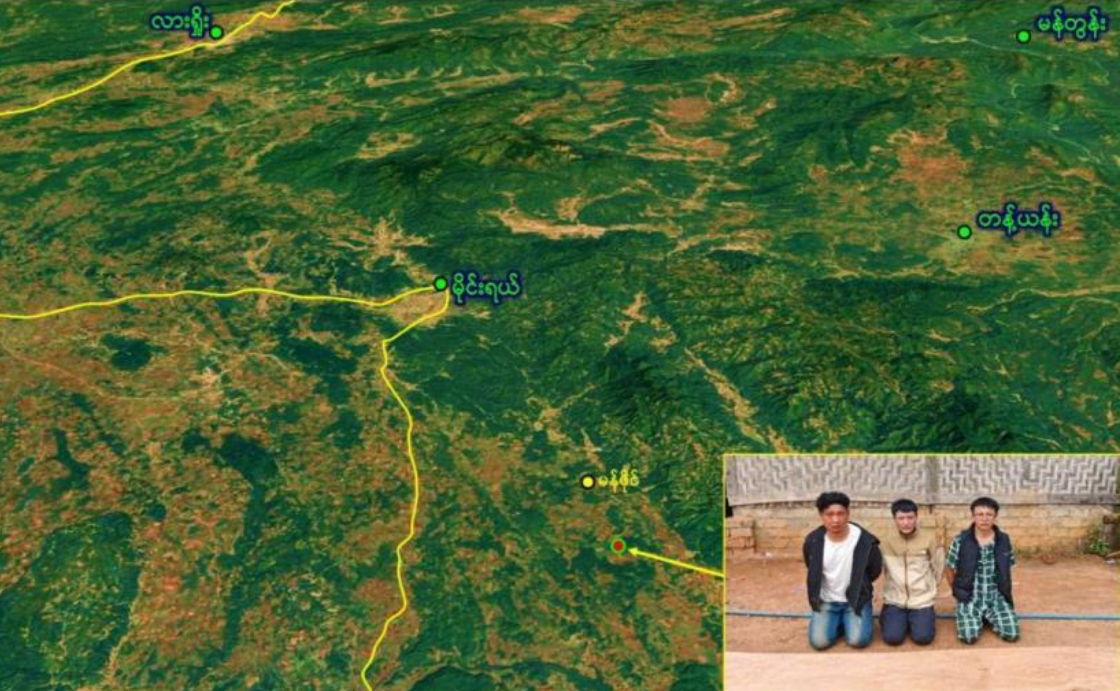
Myanmar's military has intensified its enforcement campaign against transnational online scam operations with the arrest of three Chinese nationals in Mongyai Township, Shan State. The suspects, who allegedly crossed the border illegally, were apprehended on August 26 along with an extensive array of telecommunications and computing equipment used to defraud victims across regional networks. The operation represents the latest in a sustained push by authorities to dismantle what has become a significant cross-border criminal enterprise spanning Southeast Asia.
The capture took place approximately 26 kilometres southeast of Mongyai town and five kilometres south of Manphai Village, following intelligence gathered from local residents who reported suspicious activities in the area. Residents had observed individuals setting up temporary shelters specifically designed for conducting online scam gambling operations, prompting security personnel to launch investigations that ultimately led to the raid. The location, situated in a remote section of Shan State near Myanmar's border region, highlights how sophisticated transnational crime networks exploit difficult terrain and limited state presence to establish clandestine operations far from urban scrutiny.
The haul of seized equipment reveals the technical sophistication required to operate these international scam networks. Authorities recovered twenty-five mobile phones, five all-in-one computers, two power stations, and notably a Starlink satellite internet device—indicating the operators' reliance on advanced connectivity solutions to maintain secure communications and conduct transactions across borders. Additionally, security forces seized ten communication radios and other operational equipment, suggesting a hierarchical structure with internal command-and-control systems. The scale and nature of the equipment underscores how these enterprises require significant capital investment and technical expertise to function effectively.
Physical infrastructure seized during the operation included one large corrugated iron-roofed structure measuring fifty by twenty feet with bamboo walls, along with five temporary tarpaulin shelters of varying sizes. The makeshift nature of these installations reflects a deliberate strategy by criminal networks to maintain operational flexibility and enable rapid relocation if security forces close in. The deliberate use of temporary structures rather than permanent facilities allows operators to minimize local engagement and reduce the risk of permanent detection, making enforcement particularly challenging for authorities monitoring border regions with limited resources.
Myanmar's intensified campaign against online scams represents a response to escalating regional concerns about transnational cybercrime. These operations typically target individuals across Southeast Asia and beyond, with perpetrators residing in border zones that straddle Myanmar, Thailand, Laos, and Cambodia—zones where state authority remains contested or fragmented. The involvement of Chinese nationals aligns with established patterns in which citizens from several nations participate in these networks, though the specific nationality composition varies depending on which crime hub is under discussion. Intelligence agencies across Southeast Asia have repeatedly highlighted how organised crime syndicates have industrialised online scamming, creating specialised roles and compartmentalised operations that resemble legitimate corporate structures.
The timing and location of this operation suggest Myanmar's security apparatus is prioritising border areas where these networks have previously established footholds. Northern Shan State has experienced particular pressure from various armed groups and criminal enterprises, creating an environment where online scam operations have found refuge alongside other illicit activities. The military's involvement in the raid reflects how serious the government considers this threat, moving beyond civilian law enforcement to deploy security personnel with greater operational capacity and fewer legal constraints.
Authorities have signalled that arrested suspects will face prosecution under Myanmar's existing legal framework once questioning and investigation conclude. The specific charges have not been detailed, but Myanmar maintains multiple statutes addressing telecommunications fraud, illegal border crossing, and unlicensed business operation. Sentencing for online scam operations in Southeast Asia typically ranges from several years to over a decade, depending on the scale of fraud and victimisation involved. The legal proceedings will likely reveal the sophistication of the conspiracy, including financial flows, victim targeting methodology, and the hierarchical structure connecting field operators to higher-level coordinators.
Beyond legal consequences for the three arrested individuals, Myanmar's authorities have committed to systematically destroying illegal shelters and operational bases throughout the region. This demolition strategy aims to eliminate the physical infrastructure that enables these networks to function, though critics observe that destroying temporary shelters proves less effective than dismantling the financial and technological systems sustaining the broader enterprise. Repeated enforcement operations have shown that criminal networks quickly relocate to alternative border zones, suggesting that sustainable solutions require regional cooperation, intelligence sharing, and simultaneous action across multiple countries.
For Malaysian readers and broader Southeast Asian observers, this operation underscores how porous borders and limited transnational law enforcement coordination enable sophisticated criminal operations to flourish. Malaysia has experienced significant victimisation from online scam networks, with local victims losing substantial sums to perpetrators operating from precisely these border regions. The arrest of these three individuals represents incremental progress in addressing the problem, yet the underlying conditions—poverty, weak governance in border areas, and technological accessibility—continue enabling recruitment and operation of these networks. Sustained regional cooperation, potentially through mechanisms like the ASEAN Regional Forum or enhanced bilateral agreements, remains essential for disrupting these enterprises at scale rather than apprehending individual operators who are readily replaced within the hierarchical structure of transnational organised crime syndicates.

