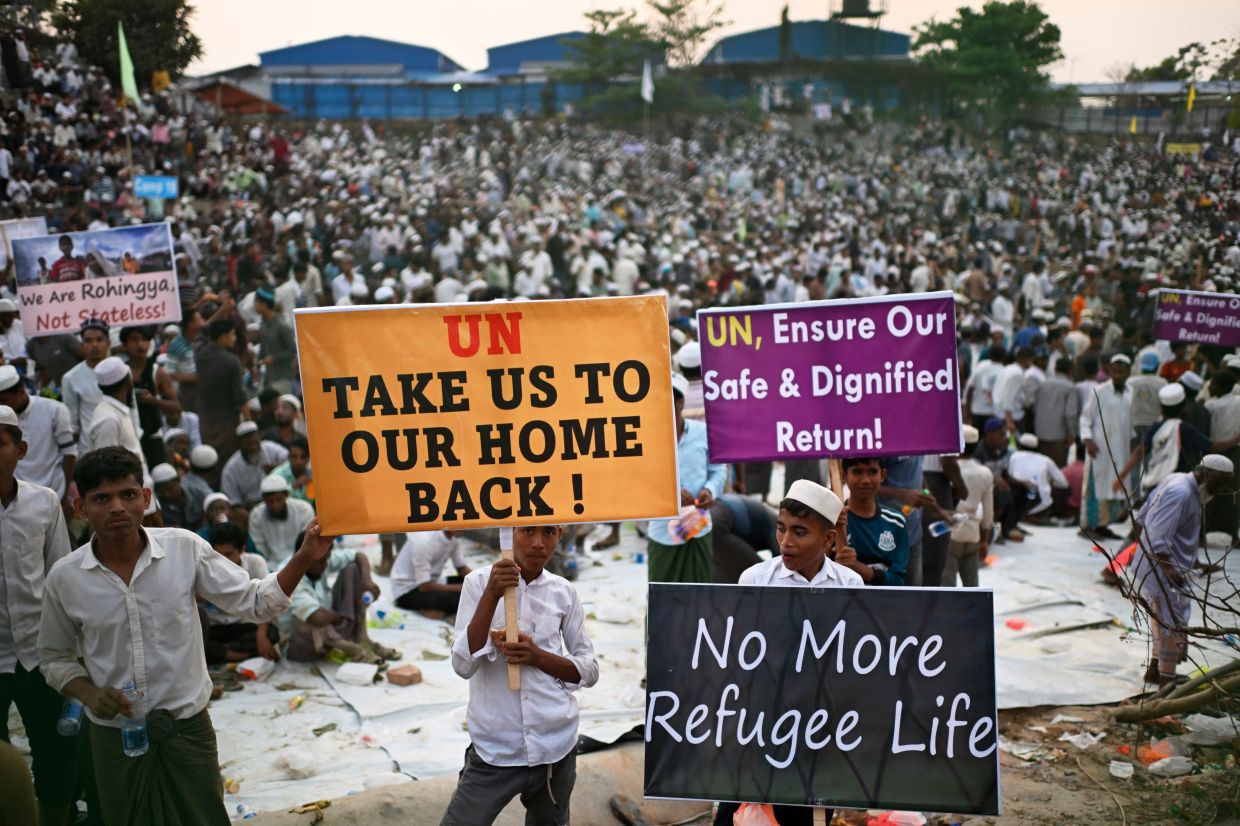
Myanmar's military government announced Saturday that it has verified over 300,000 Rohingya refugees currently sheltering in Bangladesh as former residents of Rakhine state, signalling willingness to accept their return once security conditions stabilize. The declaration arrives as the protracted humanitarian crisis, sparked by a military crackdown in August 2017, enters its ninth year with hundreds of thousands of people still confined to sprawling camps across the border. The Myanmar Ministry of Foreign Affairs statement represents an official position on a conflict that has fractured the region and created one of Southeast Asia's most intractable displacement challenges.
The origins of today's catastrophe trace to a military offensive launched after a Rohingya insurgent group attacked guard posts in Rakhine. The response was disproportionate and devastating. More than 700,000 Rohingya fled across the border into Bangladesh in 2017 alone, compounding an existing refugee population numbering in the hundreds of thousands who had accumulated over previous decades following intermittent episodes of violence perpetrated by Myanmar's security forces. International observers, including United Nations bodies, characterized the military operation as ethnic cleansing and potentially genocide—accusations that Myanmar's government has consistently rejected. The scale and systematic nature of the displacement fundamentally altered the region's demographics and created a humanitarian burden that Bangladesh, already struggling with poverty and overpopulation, has shouldered largely alone.
Myanmar's verification process, conducted against a roster supplied by Bangladesh, processed 426,545 of 828,824 registered refugees through July, concluding that 308,797 qualified as legitimate former Rakhine residents. The government identified 113,507 individuals it could not verify through its records and designated 4,241 as persons allegedly involved in terrorist activities. These figures underscore the contentious nature of determining identity and citizenship in a context where Myanmar refuses to recognize the Rohingya as an ethnic minority, instead employing the inflammatory term "Bengalis" to suggest they are Bangladeshi nationals illegally present in Myanmar. This linguistic strategy reflects Myanmar's broader refusal to acknowledge the community as indigenous to Rakhine, a position that complicates any sustainable resolution.
The practical pathway toward repatriation remains heavily obstructed by security deterioration across Rakhine. Myanmar and Bangladesh formalized a two-year repatriation framework in 2018, yet not a single refugee returned through that mechanism. The military coup in February 2021, which toppled the elected government of Aung San Suu Kyi, transformed Myanmar into a conflict zone where armed resistance movements contest military authority across multiple regions. The subsequent emergence of the Arakan Army as a dominant armed faction in Rakhine, after capturing substantial territory from government forces in 2023, has rendered the state increasingly volatile and unsafe for potential returnees. These escalating military confrontations create legitimate concerns that civilians, particularly a historically persecuted minority group, would face danger if repatriation proceeded.
The humanitarian conditions deteriorating within refugee camps have intensified pressure for resolution. Bangladeshi camps, swollen to accommodate nearly a million people across confined areas, suffer from inadequate healthcare, education, and employment prospects. Simultaneously, international donors have reduced financial assistance, straining resources and amplifying desperation among residents who perceive no meaningful timeline toward either permanent integration into Bangladesh or safe return home. This squeeze has catalyzed increasingly dangerous migration attempts, with growing numbers of Rohingya boarding unseaworthy vessels bound for Malaysia and Indonesia, undertaking perilous maritime journeys where human smugglers exploit their vulnerability and countless perish at sea.
Regional powers have begun engaging with repatriation proposals, though with notably divergent interpretations of commitment. Malaysian Prime Minister Anwar Ibrahim declared in late July that Myanmar had consented to accept 5,000 Rohingya currently residing in Malaysia as part of a repatriation initiative. However, Han Win Aung, an official from Myanmar's foreign ministry, subsequently told international media that the program applied exclusively to verified Myanmar nationals detained in Malaysian detention facilities, explicitly rejecting characterizations that the government would accommodate broader Rohingya populations. This contradiction illustrates the persistent ambiguity surrounding Myanmar's intentions and the difficulty in establishing credible commitments when the military government lacks international legitimacy and maintains positions that contradict humanitarian norms.
Myanmar's latest statement disputes international assessments regarding displacement numbers, contending that claims of over one million displaced persons from Rakhine are inflated. The government insists that approximately 540,000 departed for Bangladesh following the 2017 violence while over 200,000 remained in northern Rakhine. These figures substantially undercount the scale widely documented by humanitarian organizations, suggesting that Myanmar continues manipulating statistics to minimize accountability for displacement magnitude. Such revisionism undermines confidence in any numerical claims the government advances, including its verification of 308,797 eligible returnees.
The implications for Malaysia and Southeast Asian countries extend beyond humanitarian considerations into regional stability and bilateral relations. Malaysia, with its Muslim-majority population and historical role as a refuge for persecuted minorities, faces mounting internal pressures as Rohingya populations expand and resource competition intensifies. Indonesia similarly contends with irregular maritime arrivals. The absence of meaningful progress on repatriation means that Bangladesh's neighbours will absorb escalating displacement, creating incentives for alternative solutions that may prove destabilizing. Regional governments increasingly recognize that without Myanmar's substantive cooperation—demonstrated through genuine security sector reform and inclusive governance—the crisis will perpetuate, generating ongoing transnational challenges.
Looking forward, the credibility of Myanmar's repatriation claims depends on concrete changes that currently appear improbable. The military government would need to establish security in Rakhine sufficient to protect returnees, reverse its refusal to recognize Rohingya citizenship and rights, and demonstrate commitment through accepting verified returnees without preconditions or delays. None of these developments appears imminent given Myanmar's political trajectory and the Arakan Army's consolidation of territorial control. Instead, the ninth anniversary of this crisis likely signals the beginning of a prolonged phase where hundreds of thousands languish in camps, migration pressures escalate, and regional countries bear the consequences of Myanmar's failure to resolve internal conflict or address the fundamental grievances that generated the displacement. Unless Myanmar's situation transforms dramatically, the Rohingya refugee crisis will endure as a defining humanitarian challenge for Southeast Asia.

