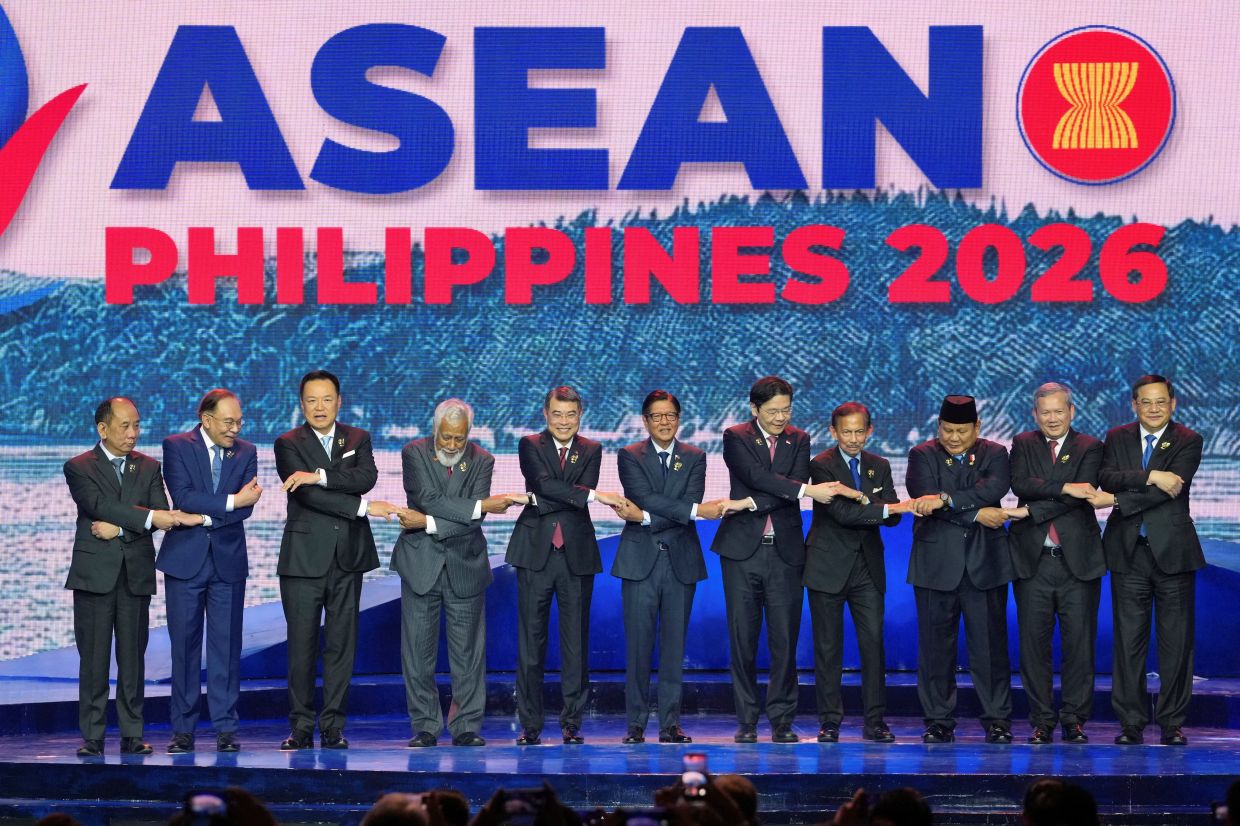
The Philippines will host a three-day gathering of Southeast Asia's top diplomats beginning Tuesday, bringing together representatives from across the region and beyond as geopolitical tensions ripple across multiple flashpoints affecting the bloc's interests. The annual ministerial talks, chaired this year by the Philippines, have taken on heightened significance with the arrival of high-level delegations from the United States, China, Russia, and the European Union, signalling the international dimensions of challenges confronting the 11-nation Association of Southeast Asian Nations. Among the notable attendees are U.S. Secretary of State Marco Rubio, Chinese Foreign Minister Wang Yi, and Russian Foreign Minister Sergey Lavrov, each representing powers with competing strategic interests in Asia and beyond.
The renewed outbreak of hostilities between the United States and Iran looms as an immediate concern for Southeast Asian policymakers. When ASEAN foreign ministers convene privately on Tuesday, they plan to deliberate on the Middle East conflict and its cascading regional implications, with a coordinated statement under consideration that would signal collective unease and call for diplomatic de-escalation. The conflict carries particular weight for the region given that approximately one-fifth of the world's oil supply passes through the Strait of Hormuz, a critical chokepoint vulnerable to disruption. For Southeast Asia, a region of more than 680 million people heavily dependent on Middle Eastern energy resources, the security of these supply lines directly translates into economic vulnerability.
The ramifications of Middle East instability extend beyond energy security to broader geopolitical concerns. Philippine President Ferdinand Marcos Jr. was compelled to declare a national energy emergency in March, a measure designed to safeguard fuel availability and prevent speculative pricing that could destabilise basic commodity markets. Such interventions underscore how conflicts thousands of kilometres away can rapidly cascade into domestic challenges for Southeast Asian governments tasked with maintaining price stability and public welfare. The region's exposure to global supply shocks, particularly those affecting oil and gas markets, places energy security firmly atop the diplomatic agenda alongside traditional security concerns.
Parallel to Middle Eastern developments, the apparent preoccupation of Washington with Iran has prompted anxiety among Southeast Asian allies regarding American strategic focus on the Indo-Pacific. The Trump administration's military commitments in the Middle East risk diluting attention from China's assertive posture in contested waters and against Taiwan, both matters critical to regional stability. Rubio's attendance at these talks represents an effort to reassure ASEAN partners of continued American engagement despite competing global commitments. State Department spokesperson Thomas Pigott framed the visit as advancing "a clear U.S. priority: a free and open Indo-Pacific," language designed to signal that Washington's strategic pivot toward Asia remains undeterred by Middle Eastern entanglements.
Preliminary signals suggest potential bilateral conversations between American and Chinese officials could occur during the Manila gathering, though neither side has confirmed concrete meeting schedules. Rubio indicated openness to engagement with Wang Yi, describing such high-level dialogue as essential between major powers despite inevitable areas of disagreement. His comments reflected a pragmatic recognition that sustained diplomatic channels, even amid tensions over election interference allegations and broader geopolitical rivalry, serve mutual interests. The possibility of an Xi Jinping visit to Washington in September, mentioned by Rubio, suggests tentative steps toward managing bilateral relations through conventional diplomatic means rather than confrontation alone.
On the sidelines of the ASEAN ministerial talks, Rubio is expected to convene with members of the Quad grouping, comprising the United States, India, Japan, and Australia. This four-nation coalition represents a central plank of American strategy to maintain regional balance amid Chinese ascendancy, though Beijing consistently denounces it as a containment mechanism. For Southeast Asian nations navigating between great power competition, the Quad's activities carry implications for regional alignment patterns and military-strategic positioning. The gathering thus becomes a venue where broader great power dynamics intersect with regional concerns.
The Myanmar civil war remains perhaps the most intractable challenge confronting ASEAN's collective diplomatic efforts. Since the 2021 military coup that overthrew Aung San Suu Kyi's democratically elected government, the conflict has claimed more than 8,100 lives according to the Assistance Association for Political Prisoners, while nearly 22,500 individuals languish in detention. Despite ASEAN's 2021 five-point peace consensus intended to facilitate reconciliation, the military junta's persistent non-compliance has rendered the framework largely ineffective. This failure prompted the bloc to exclude Myanmar's military-backed leadership from high-level meetings, a punitive measure reflecting ASEAN's frustration with the junta's intransigence.
Recent diplomatic developments have introduced complications into this established posture. Philippine Foreign Secretary Theresa Lazaro, acting as ASEAN's special envoy, met her Myanmar counterpart Tin Maung Swe in Bangkok for the first time in five years, a gesture that human rights organisations characterised as abandoning principled pressure on the junta. The meeting, followed by Lazaro and Thai Foreign Minister Sihasak Phuangketkeow's subsequent engagement with ethnic armed group representatives in Pattaya, signalled a pragmatic shift toward inclusive dialogue. Yet critics contend that meeting Myanmar's foreign minister without extracting meaningful concessions effectively rewards military leadership and undermines the credibility of ASEAN sanctions. Lazaro defended the approach as consistent with the consensus framework rather than its abandonment, arguing that "the path to peace can only be obtained through resolute diplomacy with all parties to the conflict."
The South China Sea territorial disputes represent another arena demanding ASEAN attention during the ministerial gathering. Chinese and Philippine maritime forces have experienced repeated confrontations in recent years, incidents that threaten to inflame tensions between Beijing and Manila. ASEAN foreign ministers will meet with Wang Yi to assess progress on a proposed "code of conduct" designed to establish guardrails preventing territorial disagreements from spiralling into open conflict. The code seeks to create procedural mechanisms and confidence-building measures among claimant states, including China, Taiwan, and ASEAN members Brunei, Malaysia, the Philippines, and Vietnam. Without agreed protocols and communication channels, the risk of accidental escalation remains elevated.
For Southeast Asian nations, navigating between great power interests while addressing internal regional conflicts demands sophisticated diplomatic choreography. The Manila meetings reflect this challenge as ministers must simultaneously address Washington's expectations regarding Chinese containment, Beijing's insistence on regional deference to its interests, Russia's broader geopolitical positioning, and internal ASEAN concerns over Myanmar and the South China Sea. The convergence of these issues at a single gathering reveals the interconnected nature of contemporary regional security challenges, where local disputes intersect with global power competition.
The stakes of these talks extend beyond diplomatic formalism to concrete outcomes affecting Southeast Asian stability and prosperity. An energy crisis sparked by Middle Eastern disruption could trigger economic contraction across the region. Unresolved Myanmar violence perpetuates humanitarian suffering and regional instability. Unmanaged South China Sea tensions risk military incidents with unpredictable consequences. The Philippines, as ASEAN chair, bears particular responsibility for channelling these disparate concerns toward constructive outcomes. Whether this week's ministerial gathering produces substantive progress on any of these fronts will reveal whether ASEAN can function as a coherent voice amid great power pressures or whether regional divisions will limit the bloc's capacity to shape its own destiny.

