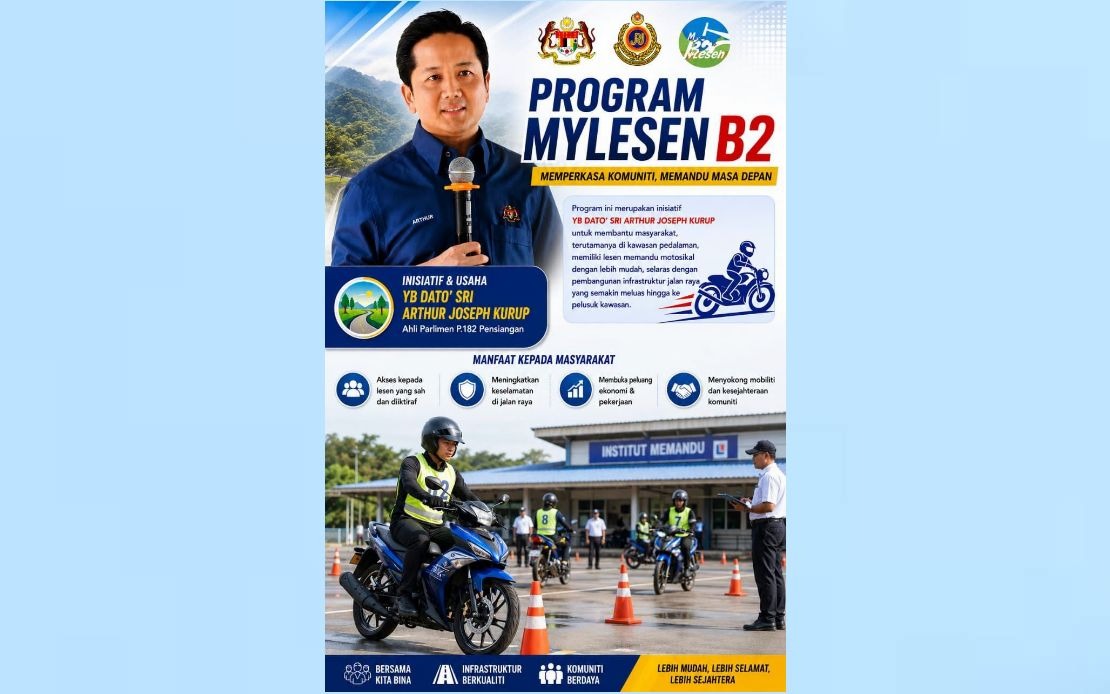
The MyLesen B2 programme has reestablished its presence in Pensiangan, Sabah, marking a significant step forward in extending essential government services to Malaysia's more remote regions. The initiative represents a deliberate effort to eliminate geographical barriers that have long prevented rural residents from obtaining valid motorcycle riding credentials, a necessity that rural communities have grappled with for years.
Pensiangan Member of Parliament Datuk Seri Arthur Joseph Kurup, who simultaneously serves as Natural Resources and Environmental Sustainability Minister, announced the programme's return with an emphasis on accessibility and practical support. His dual role underscores the government's commitment to integrating infrastructure development with environmental stewardship across Sabah's constituencies. By bringing licencing services directly to communities, the initiative acknowledges that rural residents often face prohibitive travel costs and time constraints when attempting to access driving schools concentrated in major towns and cities.
The programme's focus extends beyond mere administrative convenience. Participants must complete mandatory coursework and pass standardised assessments before receiving their licences, ensuring that road safety standards remain consistent throughout Malaysia's diverse landscape. This rigorous approach reflects growing national concern about motorcycle safety, as two-wheeled vehicles represent a substantial proportion of Malaysia's vehicle fleet and are disproportionately involved in fatal accidents. By coupling accessibility with mandatory education, the programme targets a critical gap in road safety compliance.
Young people constitute a particular focus of the MyLesen B2 initiative, recognising that employment opportunities in rural areas often depend on personal mobility. A valid motorcycle licence serves as a gateway to employment that may otherwise remain inaccessible to residents without motorised transport. For rural youth, obtaining such credentials has traditionally required substantial financial outlay and time away from family or existing work commitments. The localised approach directly addresses these structural barriers.
The age eligibility range of 16 to 63 years reflects inclusive policymaking designed to serve multiple demographic cohorts. Older residents who have never formalised their riding credentials now possess an accessible pathway to legal compliance, while young people can secure licences early in their working lives. This broad range acknowledges that rural communities comprise individuals across the lifespan whose circumstances may have previously prevented formal licencing.
The economic implications deserve careful consideration. A valid motorcycle licence unlocks employment possibilities that extend beyond local communities, enabling residents to pursue opportunities in regional centres while maintaining rural residence. For young women particularly, formal credentials represent tangible recognition of their capability and legal eligibility to participate in the formal economy. The programme thus functions as a modest but meaningful economic empowerment tool within communities where such formal qualifications can prove transformative.
The permanence of a valid licence—its lifelong utility subject to regulatory compliance—represents a significant advantage over temporary or restricted credentials. Recipients can invest confidence in their documentation knowing it will retain legal standing across their working lives. This stability encourages formal sector participation and reduces the prevalence of unlicenced riding that characterises regions where access barriers remain high.
The practical registration structure channels applications through the Pensiangan Parliamentary Service Centre and the Sook State Assemblyman's Service Centre, leveraging existing government infrastructure to minimise administrative friction. This approach recognises that rural residents often engage most readily with services delivered through locally familiar channels. By integrating the programme into established community touch-points, authorities reduce the psychological and logistical distance between potential participants and opportunity.
Road safety considerations underpin the entire initiative, though these merit examination beyond simple statistics. Rural roads in Sabah frequently present unique challenges—variable surface conditions, limited lighting, and sparse emergency services—that demand particular riding competence. Riders trained through the MyLesen B2 programme receive instruction specifically calibrated to local conditions, potentially generating safety benefits that extend beyond individual participants to entire communities dependent on shared road networks.
The programme's return to Pensiangan carries implications for broader rural development strategy across Sabah and comparable regions throughout Malaysia. Successful implementation could establish a replicable model for extending other essential services to underserved communities. The precedent of treating rural accessibility as a policy priority—rather than assuming residents must adapt to urban-centred systems—potentially influences thinking across multiple government portfolios.
Matrices measuring programme success will likely focus on participation numbers and licence issuance rates, yet deeper evaluation should examine employment transitions among recipients and accident rate changes in participating communities. Longitudinal tracking would illuminate whether improved formal credentialling correlates with increased formal sector employment or enhanced road safety outcomes. Such data would strengthen the case for similar initiatives across Malaysian regions where geographical dispersion compounds service access challenges.
The initiative's timing reflects political responsiveness to constituent needs in a state where rural voices have historically received inconsistent policy attention. By prioritising local solutions over requiring residents to bear travel burdens, Pensiangan's leadership demonstrates commitment to practical governance that respects the real constraints facing rural populations. The programme ultimately embodies recognition that equitable development requires bringing services to communities rather than expecting communities to organise themselves around distant institutions.

