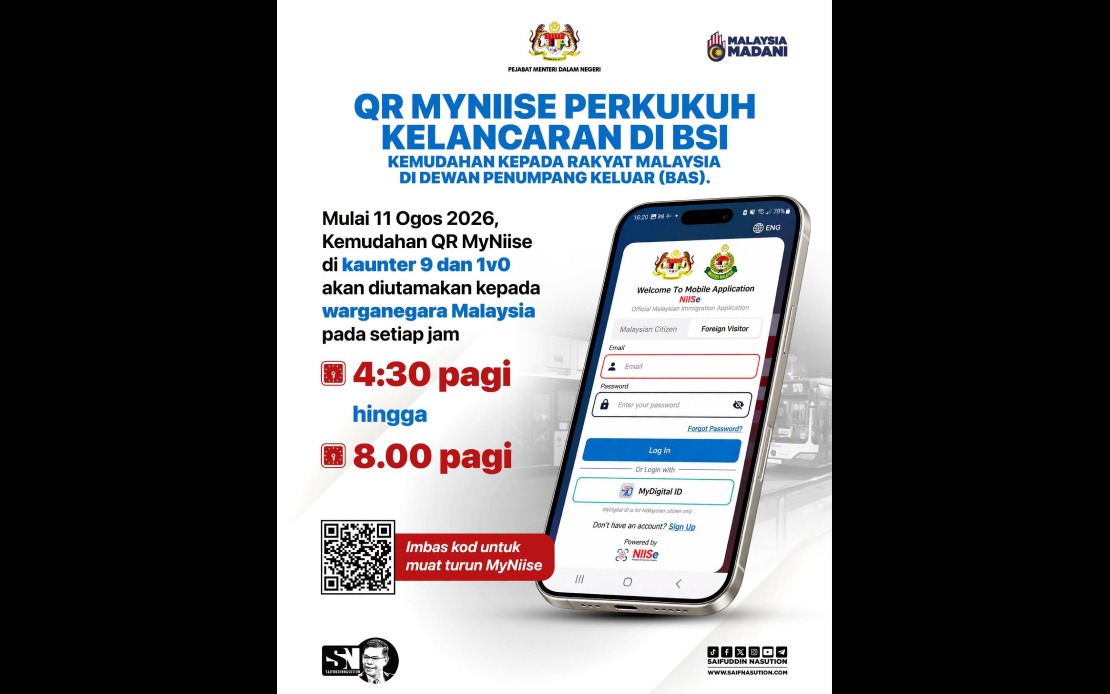
Malaysia's Home Minister Datuk Seri Saifuddin Nasution Ismail has announced a new priority immigration clearance system for cross-border commuters using the National Integrated Immigration System (MyNIISe) QR code at Bangunan Sultan Iskandar in Johor Bahru. The facility, which became operational from August 11, offers accelerated processing through dedicated counters during the busy morning period when thousands of Malaysians travel to Singapore for work. By designating counters 9 and 10 in the Bus Departure Hall specifically for MyNIISe users between 4.30 am and 8 am, authorities aim to address a persistent pain point for daily commuters who must navigate congested immigration facilities before dawn.
The morning rush at Bangunan Sultan Iskandar has long posed a significant operational challenge for the steady flow of workers crossing the Causeway. Many commuters depart extremely early to secure seats on packed express buses and arrive at their workplaces on time, creating bottlenecks at immigration counters during peak hours. This congestion not only affects individual travellers but also impacts traffic flow and bus operations, creating downstream effects on both the Malaysian and Singaporean sides of the border. The prioritisation initiative recognises that efficiency at this critical crossing point has broader implications for the regional economy and the daily lives of hundreds of thousands of cross-border workers.
MyNIISe represents a flagship digitalisation effort by the Malaysian government aimed at modernising the country's immigration infrastructure. The system allows travellers to complete pre-clearance procedures through a smartphone application, reducing processing time at physical counters. By streamlining document verification and passenger information collection before arrival at immigration desks, the QR code approach eliminates redundant data entry and manual checks. The Home Minister's emphasis on the system reflects the government's broader commitment to leveraging technology for citizen convenience and operational efficiency, positioning Malaysia as a regional leader in digital border management.
The application is available across multiple platforms including Apple App Store, Google Play Store, and Huawei App Gallery, ensuring accessibility for users with different smartphone ecosystems. This multi-platform availability is particularly relevant in Malaysia, where diverse phone models and operating systems are in common use across different demographic and economic groups. The inclusive approach to distribution removes technological barriers that might otherwise limit adoption, especially among older commuters or those with less familiarity with digital systems. By making the app accessible through various channels, authorities remove excuses for non-adoption and increase the likelihood of meaningful uptake.
The designation of specific counters exclusively for MyNIISe users creates a tangible incentive structure encouraging adoption of the digital system. Rather than simply offering the technology and hoping users would embrace it voluntarily, the priority clearance approach provides immediate, concrete benefits that accumulate over time. For a worker who saves even five to ten minutes per crossing across 250 working days annually, the time savings total 20 to 40 hours—a substantial benefit that justifies downloading and using the application. This behavioural economics approach, which offers preferential treatment rather than merely promoting optional convenience, has proven effective in driving technology adoption in other government services.
The timing of this announcement underscores recognition that cross-border commuting has become structurally integral to labour market integration across the Malaysia-Singapore border region. Tens of thousands of Malaysians work in Singapore, while Singaporeans also commute to Malaysian locations for employment. This bidirectional flow reflects decades of regional economic integration and the development of integrated labour markets where workers live in one country and work in another. Johor in particular has emerged as a major commuter source, with towns including Johor Bahru, Skudai, and surrounding areas serving as residential hubs for Singapore-bound workers. Optimising border crossing efficiency directly impacts productivity and economic competitiveness for both nations.
The focus on morning peak hours reflects data-driven targeting of the most critical congestion periods. Immigration officials can gauge precisely when the maximum number of people attempt to cross the border and concentrate resources accordingly. The 4.30 am to 8 am window captures early-morning commuters who depart before sunrise to secure transport and arrive for work starts. This temporal specificity demonstrates that the initiative is not a blanket policy but rather a carefully calibrated response to identifiable operational bottlenecks. Such precision in policymaking, informed by actual traffic patterns and congestion data, represents more sophisticated governance than one-size-fits-all approaches.
The MyNIISe initiative also provides valuable insights for other Southeast Asian countries managing high-volume border crossings. The region hosts numerous major international borders with significant daily foot traffic, from the Causeway and Second Causeway between Malaysia and Singapore to crossings between Thailand and Cambodia, and Indonesia and Timor-Leste. As countries throughout ASEAN increasingly recognise the economic value of frictionless labour mobility and regional integration, expedited clearance systems like MyNIISe offer proven technological solutions. Malaysia's implementation provides a working model and proof-of-concept that other nations can learn from and adapt to their own contexts.
Beyond operational efficiency, the MyNIISe system also generates valuable data about cross-border movement patterns, peak usage times, and user demographics. This information allows immigration and transport authorities to make evidence-based decisions about resource allocation, infrastructure expansion, and policy adjustments. Over time, such data accumulation creates an increasingly sophisticated understanding of cross-border dynamics, enabling more effective planning and intervention. The digital nature of the system means that every transaction contributes to this knowledge base, unlike traditional paper-based processes that leave minimal institutional memory.
The announcement reflects evolving government priorities regarding digital governance and citizen-facing services. During recent years, Malaysian authorities have invested substantially in digitalisation initiatives across multiple sectors, from taxation to healthcare to land registration. The immigration sector, given its strategic importance and high transaction volume, represents a natural focus for such modernisation efforts. However, as other nations have discovered, technology adoption requires more than simply building digital systems—it demands creating compelling incentives and demonstrating clear benefits to end users. The priority immigration clearance scheme succeeds precisely because it makes the benefit immediate and visible.

