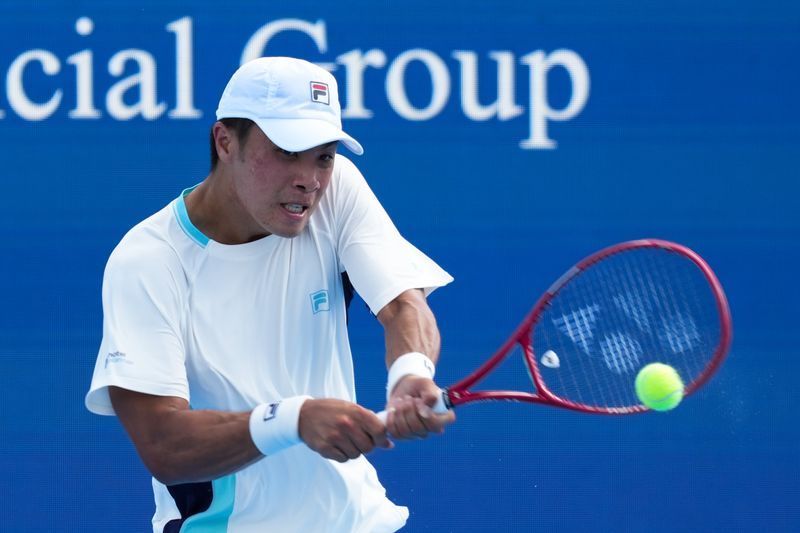
Brandon Nakashima has solidified his position among tennis's rising talents by staging a gritty comeback against sixth-seeded Taylor Fritz at the Cincinnati Open on Friday, securing a 7-6(9) 4-6 6-3 victory that propels the 25-year-old into the tournament's final four. The American's capacity to recover from adversity in the decisive set, particularly after conceding a break of serve, underscores the mental fortitude he has developed during what may prove to be a career-defining stretch on hard courts.
The significance of Nakashima's achievement extends beyond the Cincinnati result. Reaching consecutive Masters 1000 semifinals—having also advanced to the final four in Montreal the preceding week—marks a substantial leap in the trajectory of a player who has long been regarded as possessing considerable potential. These results suggest that Nakashima is finally translating that promise into consistent, high-level performances against established tour competitors, a transition that many observers have anticipated but that requires sustained execution across multiple weeks and opponents.
The match itself reflected the calibre of competition at this stage of major tournaments. Both players demonstrated formidable serving prowess throughout, with the opening set exemplifying the intensity of contemporary professional tennis. The first-set tiebreak was particularly instructive, featuring the kind of extended rally and point-conversion battle characteristic of matches between athletes of similar technical ability. After trading mini-breaks and momentum shifts, Nakashima ultimately prevailed when Fritz's serve deserted him at a critical juncture, with the sixth seed dispatching a ball long on the American's fifth set point.
Fritz responded to this setback with impressive resilience, employing aggressive return-of-serve tactics that immediately bore fruit. He broke Nakashima's service in the opening game of the second set and subsequently consolidated that advantage by closing the frame with an ace, forcing the match into a decider where the psychological advantage subtly shifted. In professional tennis, such momentum fluctuations often prove decisive, particularly when players of comparable ranking and experience face one another.
The third set demonstrated Nakashima's mental capacity to absorb pressure and recalibrate his approach. After Fritz had edged ahead 3-2 through capitalizing on unforced errors, Nakashima found himself facing a deficit that could have derailed his tournament run entirely. However, recovering from a 30-0 scoreline in the fourth game—a position that typically favours the player serving—Nakashima converted his second break point of the encounter to restore parity at 3-3. This recovery exemplifies the kind of clutch performance that separates players who merely reach meaningful tournaments from those who advance deep within them.
From that pivotal moment, the match's complexion altered dramatically in Nakashima's favour. He claimed the final three games as Fritz's error count escalated and the pressure of needing to recover from such a momentum shift began visibly affecting the sixth seed's decision-making and execution. The accumulation of unforced errors—often symptomatic of mental fatigue rather than technical deficiency—left Fritz unable to mount a comeback despite his superior seeding. This outcome illustrates that rankings, while generally predictive, do not preordain results on any given occasion, particularly when a lower-ranked player enters the match with superior confidence and tactical clarity.
Nakashima's achievement must be contextualized within his broader 2024 season. His record against Fritz prior to this encounter stood at 1-4, suggesting that Friday's victory represented a genuine upset rather than a natural progression within a dominant head-to-head rivalry. More significantly, his fourth top-10 victory of the season indicates that he is increasingly capable of prevailing against elite-ranked opposition, a prerequisite for breaking into tennis's upper tier. The 27th seed's performance on North American hard courts has been particularly noteworthy, suggesting that the fast, low-bouncing surfaces prevalent in the region suit his attacking tennis and serve-dominant approach.
The timing of Nakashima's resurgence carries considerable implications for the U.S. Open, which commences later in August. American tennis has long sought a male player capable of delivering a Grand Slam title, and while Nakashima likely remains several seasons away from contending seriously for major crowns, performances such as these demonstrate that he possesses the technical and mental attributes necessary for deep tournament runs. A quarterfinal or semifinal appearance at Flushing Meadows would represent genuine progress for an American contingent that has struggled at its home Grand Slam in recent years.
Looking ahead, Nakashima's path through the Cincinnati draw presents further opportunities to announce himself decisively among tennis's elite. His semifinal opponent will be either Italian 10th-seeded Lorenzo Musetti or American Frances Tiafoe, both accomplished players capable of providing stern examination. Musetti, in particular, has demonstrated significant improvement in recent seasons and possesses the versatility to trouble Nakashima's serving-based game. Conversely, should Tiafoe advance, the matchup would present an all-American semifinal between two players staking claims for leadership roles within the domestic contingent.
The narrative surrounding Nakashima's current trajectory extends beyond mere statistical accumulation. His ability to absorb the mental pressure of back-to-back Masters tournaments, to execute effectively at crucial junctures, and to recover from adversity speaks to maturation that typically precedes significant career breakthroughs. While predicting the precise timing of such developments remains inherently speculative, the Cincinnati semifinal berth, combined with his Montreal run, suggests that Nakashima has entered a phase where reaching Grand Slam quarterfinals and competing meaningfully at Masters events should become regular occurrences rather than occasional achievements.

