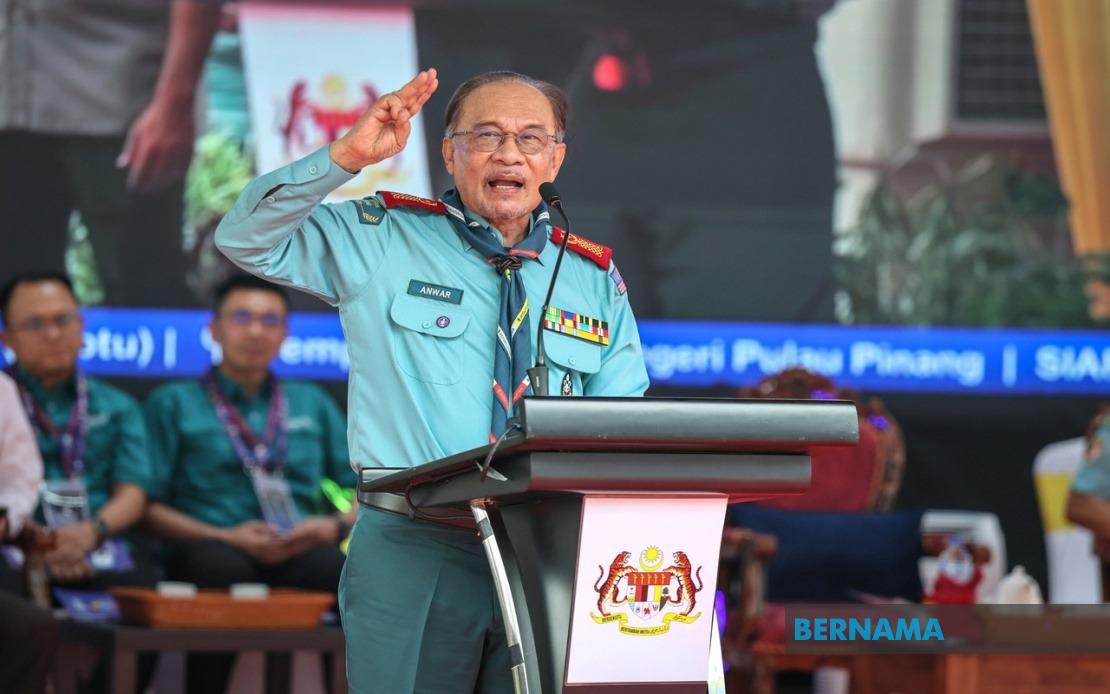
Prime Minister Datuk Seri Anwar Ibrahim has articulated a vision of national development that extends beyond the conventional metrics of economic output and technological innovation. Speaking at the 15th Malaysian Scouts Jamboree in Penang, he contended that Malaysia's true progress hinges on cultivating a generation equipped not merely with professional skills but with foundational moral character and a commitment to service. This perspective reflects an ongoing tension in developing economies across Southeast Asia between rapid modernisation and the preservation of social cohesion through shared values.
Anwar's remarks at the Penang State Stadium, where he officially opened the jamboree on August 29, centre on a philosophical premise that education systems must transcend knowledge transfer. The Prime Minister argued that educational institutions—from schools through universities—bear responsibility for shaping individuals who understand their obligations to family, community, and nation. This holistic conception of education diverges markedly from purely outcomes-focused approaches that prioritise measurable academic achievement or employability metrics, suggesting a deliberate effort to rebalance national priorities.
The timing of these comments coincides with Malaysia's broader digital transformation and integration into global knowledge economies. Yet Anwar's emphasis on spiritual and cultural grounding appears designed to address what he perceives as risks inherent in rapid technological change. The Prime Minister specifically flagged artificial intelligence and information technology advancement as domains where young Malaysians must remain vigilant about maintaining cultural roots and inherited values. This formulation suggests concern that connectivity and digital integration, while economically beneficial, might erode the social foundations upon which national stability depends.
Anwar drew explicit connections between youth development and national unity, a particularly salient concern in Malaysia's multi-ethnic context. He stressed the importance of fostering harmony across diversity, implying that a disciplined, values-oriented generation would be better equipped to navigate Malaysia's plural society. The emphasis on shared responsibility and collective purpose serves as a counterweight to the centrifugal forces that digital individualisation and consumer capitalism can unleash. This framing resonates with broader Southeast Asian anxieties about social fragmentation accompanying rapid modernisation.
The Prime Minister's reference to the upcoming 2026 National Day celebrations introduced a patriotic dimension to his address. He encouraged young people to sustain their commitment to nation-building and prepare for future challenges. This future-oriented language frames the current generation not as passive recipients of development benefits but as active custodians of Malaysia's trajectory. The invocation of patriotism, however, occurs within a context where younger cohorts increasingly question traditional authority structures and demand greater transparency and accountability from their leaders.
The 15th Malaysian Scouts Jamboree itself provides a concrete embodiment of the values Anwar articulated. Assembling over 5,450 scouts from Malaysia and abroad—including delegations from South Korea, Indonesia, Singapore, and Sri Lanka—the event creates an interactive space where young people from different backgrounds engage with shared principles of discipline, service, and outdoor competence. The international dimension of the jamboree illustrates how character-building through scouting transcends national boundaries, though Anwar's emphasis remained on distinctly Malaysian concerns.
Geographically, the jamboree's location carries historical significance. Penang's hosting of the event marks a 60-year return to the state, which previously held Malaysia's national jamboree in Teluk Bahang in 1966. This cyclical return suggests continuity with post-independence nation-building projects, when scouting served as an explicit mechanism for cultivating patriotic sentiment and social discipline among youth. The historical echo implicitly positions contemporary scouting as a lineal successor to these earlier efforts, even as the wider social context has transformed dramatically.
The presence of Chief Minister Chow Kon Yeow and Chief Scout Datuk Prof Dr Mohd Zin Bidin at the opening underscores institutional commitment to youth development frameworks. Such multi-level endorsement—federal Prime Minister, state Chief Minister, and dedicated scout leadership—signals alignment across governance hierarchies on this agenda. Yet it also raises questions about whether symbolic endorsement translates into substantive resource allocation and policy implementation. Malaysian youth development programmes frequently struggle with funding constraints and competing budgetary priorities.
Anwar's characterisation of knowledge acquisition as fundamentally purposeful—oriented toward service rather than individual advancement—introduces an ethical dimension often marginalised in Malaysian educational discourse. The assertion that learning should cultivate moral uprightness alongside intellectual capability suggests a particular vision of meritocracy, one in which personal achievement remains tethered to social responsibility. This formulation potentially challenges prevailing narratives emphasising competitive individualisation that dominate contemporary Malaysian schooling.
The challenges Anwar identified—navigating rapid technological change while maintaining cultural continuity—represent genuine dilemmas for Malaysia's policy architects. Southeast Asian societies generally confront comparable pressures as digital integration accelerates and traditional social structures face disruption. Malaysia's approach, articulated through the Prime Minister's emphasis on values-based development, offers one possible framework, though implementation challenges remain substantial. The gap between rhetorical commitment to character education and actual classroom practice often proves considerable.
Looking forward, Anwar's vision implies that Malaysia's competitive advantage in the region depends partly on social stability and shared purpose alongside conventional economic indicators. This reasoning reflects recognition that societies experiencing profound cultural dislocation often struggle with governance challenges, talent retention, and social cohesion despite material prosperity. The investment in scouting and youth formation programmes thus represents not merely character-building for its own sake but strategic national interest.
The international composition of MYJAM15 creates opportunities for peer learning and cross-cultural exchange that may subtly influence how Malaysian scouts conceptualise their own responsibilities. Exposure to peers from Indonesia, Singapore, and South Korea—nations with varying approaches to balancing modernisation and tradition—could enrichen younger Malaysians' understanding of possible pathways through these tensions. The jamboree becomes, in this sense, a subtle form of comparative civic education.
Ultimately, Anwar's insistence that development requires disciplined, values-conscious youth reflects a particular political philosophy emphasising social foundations over market mechanisms. Whether this vision can be operationalised through existing institutions and resource constraints remains an open question. The months ahead will indicate whether the Prime Minister's rhetoric translates into expanded programming, revised curricula, or sustained budgetary support for youth character development initiatives across Malaysia.

