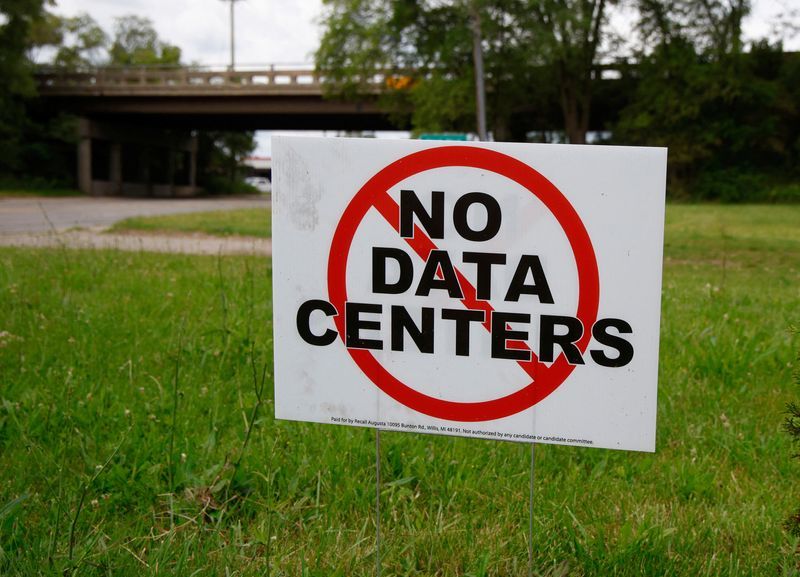
An unprecedented wave of public resistance to artificial intelligence infrastructure is sweeping across the United States, with grassroots organizers planning simultaneous demonstrations across more than 125 locations. The coordinated action represents the first major national pushback against what has become one of the most contentious infrastructure battles in American communities, fundamentally reshaping how politicians view the technology sector's rapid expansion into residential and agricultural areas.
The mobilization, orchestrated by HumansFirst—a grassroots advocacy organization founded by a former Tea Party leader—reflects a remarkable political phenomenon: data centers have become one of the rare policy areas where Americans demonstrate genuine consensus regardless of ideological affiliation. Amy Kremer, who co-founded the movement, explicitly drew parallels to the Tea Party uprising of 2009, positioning the anti-data-center campaign as a populist movement against what she characterized as corporate overreach and governmental indifference to community concerns. However, unlike previous partisan movements, this resistance cuts across traditional left-right boundaries with striking force.
The intensity of public disapproval emerging from national polling data underscores the magnitude of the shift. According to a June Reuters/Ipsos survey, merely one-third of American adults endorse the current pace of data center construction nationwide. Even more telling, only 14 percent of respondents would welcome such facilities in their own neighborhoods, regardless of which technology giant—Meta, Alphabet, Amazon, Microsoft, or xAI—would operate them. These figures reveal a profound disconnect between corporate expansion strategies and actual community sentiment, a gap that politicians from both parties can no longer ignore.
Local municipalities and county administrations have emerged as the primary battleground for this resistance, often discovering that developers have secured approvals through non-disclosure agreements with elected officials while bypassing meaningful public consultation or environmental review. In numerous cases, residents discovered proposed data centers in their communities only after official decisions had been made behind closed doors. This pattern of secrecy has fueled particular anger, transforming what might otherwise remain a technical infrastructure question into a lightning rod for frustration about governmental accountability and corporate influence over policy decisions.
Three major concerns dominate the protests: the threat of dramatically elevated electricity consumption straining regional power grids, the massive diversion of freshwater resources from drought-affected regions, and potential environmental contamination. For water-stressed areas, the stakes feel particularly acute. A proposed data center in California's Imperial County would consume 260 million gallons annually from the already-stressed Colorado River system—a figure that strikes many residents as unconscionable when their agricultural heritage depends on water scarcity management. Activists like Ivan DelSol have characterized such water consumption patterns as fundamentally dystopian, positioning artificial intelligence development against basic regional survival.
Geographically, the protest distribution reveals concentrated opposition in key political battlegrounds and technology hubs. Texas, which has aggressively courted data center investment and hosted 16 scheduled demonstrations, faces the most significant organized resistance. Georgia, another emerging data center hub, had 11 protests planned, while California, Florida, and Pennsylvania each organized seven. This geographic spread, encompassing Republican strongholds, Democratic bastions, and swing states alike, underscores how thoroughly the issue has penetrated American political consciousness across regional and partisan lines.
The movement encompasses an ideologically diverse coalition unlikely to align on most other issues. While some organizers reject state-level moratorium policies like those adopted in New York, viewing them as excessive government intervention, others embrace stronger regulatory approaches. This apparent contradiction reflects a deeper consensus: regardless of ideology, participants demand transparency in the development process, meaningful community input, protection of environmental and natural resources, local job creation with union-scale compensation, and developer accountability mechanisms. The emphasis on transparency and democratic participation suggests the movement transcends typical left-versus-right framing around government intervention.
First-time activists have joined established political organizers in driving the movement forward. Eva Cardona, a 31-year-old activist in Texas who describes herself as a political nomad, joined the cause after becoming alarmed by the unregulated artificial intelligence expansion trajectory. Her participation reflects a pattern of ordinary citizens mobilizing outside traditional party structures, motivated primarily by concrete impacts to their immediate environment rather than abstract ideological commitments. This grassroots character, originating from genuine community disruption rather than top-down party organization, may account for the movement's cross-partisan appeal.
The data center industry, represented by the Data Center Coalition, has attempted measured positioning, emphasizing commitments to being responsible community members. However, the organization's silence on the massive coordinated protests, combined with industry claims that water consumption represents a minor fraction of total usage compared to agriculture or other sectors, has done little to assuage public concern. Many residents perceive these responses as evasive, particularly given that the industry simultaneously markets artificial intelligence as an essential investment requiring urgency and exemption from normal environmental scrutiny.
State and national politicians are increasingly scrambling to articulate positions responsive to voter sentiment without alienating technology sector donors and investors. Amy Kremer has explicitly criticized Republicans for granting Big Tech what she terms a "free pass," suggesting that the 2024 elections and 2028 presidential race will feature data centers as a defining campaign issue. This political vulnerability emerging across party lines means neither Democrats nor Republicans can safely ignore the movement, creating genuine policy uncertainty regarding future approvals and regulatory frameworks.
The implications extend beyond American borders, particularly for Southeast Asia. Countries including Malaysia, Vietnam, and Thailand have become attractive alternative locations for data center development as American opposition mounts. Understanding this American political backlash provides crucial context for regional policymakers evaluating technology infrastructure proposals. The grassroots mobilization demonstrates that citizens worldwide increasingly demand agency in decisions affecting resource consumption, environmental health, and community character—expectations that may reshape how emerging markets approach artificial intelligence infrastructure development.
The movement's significance lies not primarily in whether individual data center projects gain approval or rejection, but rather in demonstrating that public dissent can coalesce around infrastructure issues previously treated as technical decisions insulated from democratic accountability. This represents a fundamental recalibration of expectations surrounding technology sector operations and corporate-government relationships in democratic societies.

