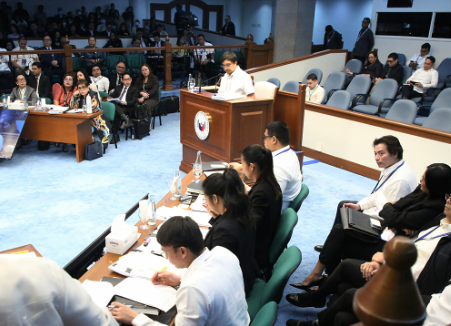
A senior investigator from the National Bureau of Investigation delivered a pivotal statement at the Senate impeachment trial of Vice President Sara Duterte on Tuesday, declaring that she possessed both the intent and operational capability to execute her publicly made assassination threats against President Ferdinand Marcos, first lady Liza Araneta-Marcos and former House Speaker Martin Romualdez. Jeremy Lotoc, who heads the NBI's regional office, told the impeachment court that the bureau's forensic analysis had determined the Vice President's remarks were "serious, real and active," satisfying the legal elements required to establish grave threats and betray public trust—central charges underpinning the impeachment effort against the country's second-highest official.
Lotoc's testimony marked a crucial moment in the trial, now in its fifth day, as prosecutors constructed their case that the Vice President's conduct, however extraordinary, constituted an impeachable offense that raised fundamental questions about her fitness to remain in office and her capacity to assume the presidency should circumstances demand it. The NBI official, formerly chief of the Cybercrime Division that investigated Duterte's remarks, stood firmly by the bureau's position that investigators had identified the foundational elements necessary to support charges of grave threats, leading the agency to recommend that the Department of Justice pursue criminal proceedings against her.
When Senate President Sherwin Gatchalian pressed Lotoc on whether Duterte genuinely possessed the capacity to carry out such threats, the NBI director offered an unambiguous response: "Definitely." He proceeded to outline the basis for this conclusion, emphasizing that her position as Vice President alone provided her with institutional leverage and access unavailable to ordinary citizens. More significantly, Lotoc expanded his analysis to encompass her broader political pedigree, noting that Duterte's father had served as president and that her family maintained substantial political influence, particularly in Mindanao, all of which combined to furnish her with demonstrable means to execute such intentions should she choose to do so.
The prosecution strategy hinged on establishing that Duterte had not merely uttered threats in the abstract but had allegedly engaged specific intermediaries to carry out retaliatory violence should she face harm. Lotoc explained that the NBI's conclusion rested principally on Duterte's own public statements, particularly remarks she made during a November 23, 2024 online press conference and subsequent media interviews in which she explicitly stated she had communicated with someone to exact revenge should she be assassinated. The official maintained that the bureau's assessment of her credibility—namely that she was not joking—derived from the deliberate, repeated nature of these statements across multiple public forums and the absence of any retraction or clarification suggesting she had been misunderstood.
A critical vulnerability in the prosecution's case emerged during questioning about the identity of the alleged contractual killer. Lotoc acknowledged candidly that the Cybercrime Division possessed no independent evidence identifying the person Duterte claimed to have engaged or confirming that such an individual actually existed. When pressed directly by Gatchalian, he conceded that the NBI's entire conclusion regarding the existence of a contracted assassin rested exclusively on Duterte's public statements and admissions—what he termed "statements and admission, Sir." This admission provided defence lawyers with a potent argument that the prosecution was essentially building charges on little more than the Vice President's own words, without corroborating evidence of an actual conspiracy or arrangement.
The defence strategy of requesting a written denial from Duterte offered little protection against the prosecution's framing. Lotoc dismissed such denials as legally insufficient to negate the underlying offense, arguing that her mere rejection of having hired an assassin did not erase the fact that she had made the utterances and claimed to have spoken with someone. Tellingly, the NBI official lamented that investigators had sought to conduct a direct interrogation of Duterte to probe whether she had genuinely contracted someone to carry out violence, but she had declined to appear before the bureau. This absence became, in Lotoc's view, a complicating factor that prevented the investigation from reaching complete clarity on the contractual element of the alleged crime.
During the prosecution's redirect examination, private prosecutor Amado Virgil Ligutan emphasized a crucial distinction that Lotoc reinforced: Duterte had never actually denied making the controversial assassination statements themselves. Her denials were narrowly confined to claims that she had not hired anyone to execute them. This bifurcation proved significant to the prosecution's broader narrative, as it allowed prosecutors to argue that by declining to retract or disavow the threats, Duterte was effectively reaffirming them. Lotoc pointed to her November 26 interview as evidence that she had reiterated rather than withdrawn the remarks, suggesting a consistency of intent that negated any possibility of misstatement or momentary rhetorical excess.
The defence attempted to undermine Lotoc's testimony by highlighting typographical and clerical errors scattered throughout NBI documents, a line of questioning that appeared designed to suggest broader investigative sloppiness. Lotoc, however, rebuffed this approach, testifying that such minor documentary imperfections did not compromise the substance of the NBI's findings or its conclusions regarding Duterte's commission of grave threats and incitement to sedition. Prosecution adviser Robert Ace Barbers later characterized the defence cross-examination as having focused exclusively on peripheral matters rather than engaging with the core allegations, effectively ceding the substantive points to the government's case.
A secondary issue emerged regarding "Operation Romanov," a term the Vice President invoked to justify her claims that her life faced genuine threat, thereby motivating her assassination remarks as defensive in nature. Lotoc testified that NBI investigations traced the origin of this reference to Davao City Mayor Sebastian "Baste" Duterte during a January 2024 rally, where it was directed at President Marcos and his family rather than at the Vice President herself. Furthermore, the bureau could not validate any other Romanov operation, effectively dismantling the factual foundation for Duterte's claimed justification. The information had originated from vlogger Princess Maui, whose credibility the NBI deemed unreliable after she failed to appear before the bureau to substantiate her extraordinary claims.
The investigation into alleged threats against Duterte herself reached an impasse that the prosecution framed as revealing: the NBI found no validated threat against the Vice President, and the bureau's inquiry stalled because neither Duterte nor her representatives provided actionable intelligence or cooperated with investigators. This standstill contrasted sharply with the government's robust evidence regarding Duterte's own public statements, creating an asymmetry that favoured the prosecution's characterisation of her as the active aggressor rather than a defensive responder to genuine threats. For Malaysian and regional observers, the trial illuminates broader questions about democratic accountability for sitting officials and whether extraordinary public statements by high-ranking officials, regardless of their likelihood of execution, constitute conduct incompatible with public trust and the constitutional succession to the presidency.

