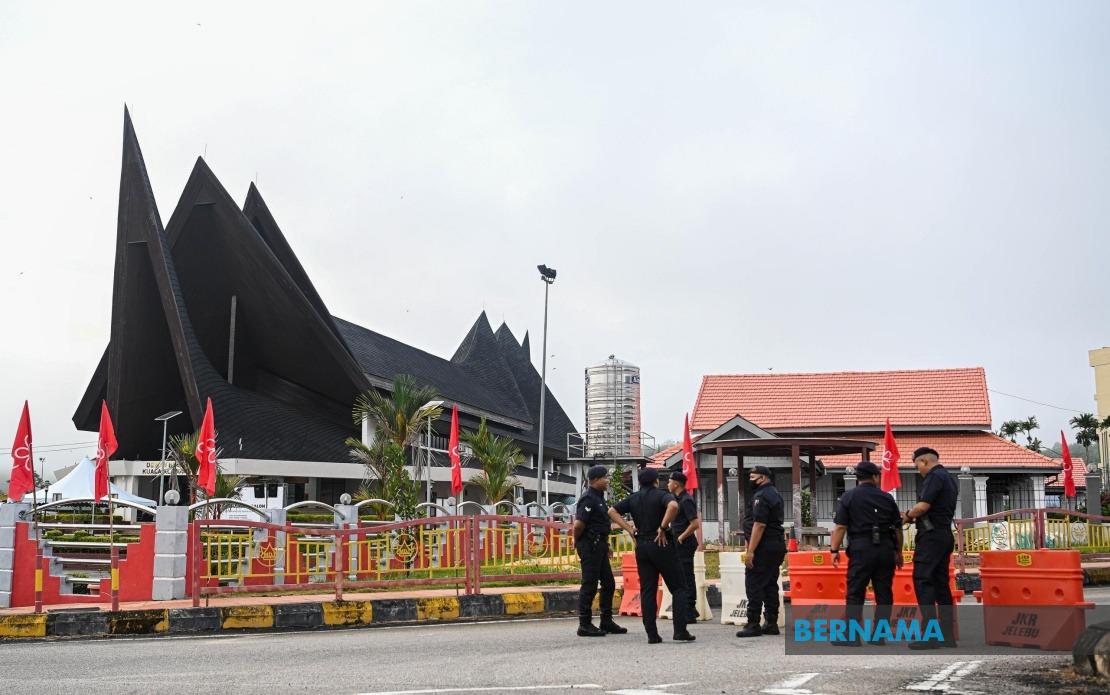
The nomination process for Negeri Sembilan's 16th state election unfolded without incident on July 18, with benign weather conditions providing an auspicious beginning to the formal campaign season. Eight nomination centres dotted across the state opened their doors at 9 am, with officials from the Election Commission arriving well in advance to establish the necessary infrastructure and procedures. The single-hour window for nominations proceeded as scheduled, demonstrating the administrative readiness that has become characteristic of Malaysia's electoral apparatus in recent cycles.
The Election Commission had meticulously prepared for the day's proceedings, evident in the deployment of personnel and materials at each of the eight centres distributed throughout Negeri Sembilan. Media representatives crowded the nomination venues from as early as 7 am, staking out advantageous positions to document the formal entry of candidates into the race. Party supporters materialized gradually as morning progressed, underscoring the mobilization machinery already in motion across competing political coalitions and independent formations. The scene reflected the rhythmic cycle of Malaysian electoral politics, where nomination days serve as opening ceremonies for intensified political engagement.
The breadth of voter participation available for this election underscores Negeri Sembilan's importance within Malaysia's political landscape. Approximately 889,490 eligible voters across the state would ultimately determine the composition of the 36-seat State Assembly. This electorate comprised several distinct categories: 867,151 ordinary residents, 16,884 military personnel and their family members, and 5,455 police officers. The inclusion of uniformed personnel within the voting population reflects Malaysia's constitutional arrangements, though their participation remains a sensitive dimension within broader discussions concerning electoral neutrality.
The electoral architecture established by the Election Commission had already been set in motion through the state assembly's dissolution on June 5. Polling day was scheduled for August 1, with an early voting opportunity designated for July 28. This timeline compressed the campaign season into a relatively brief span, necessitating rapid mobilization by all participating entities. The decision to hold the election in late July and early August placed Negeri Sembilan's political competition at the centre of national attention during an otherwise quieter period of the Malaysian political calendar.
Pakatan Harapan's decision to contest every available seat demonstrated confidence in their performance across the state, particularly given their victory in the previous election. The coalition captured 17 of 36 seats in 2023, establishing them as the strongest single formation heading into this contest. Barisan Nasional, traditionally the dominant force in Negeri Sembilan despite recent setbacks, would attempt to reclaim ground by contesting 25 seats. This strategic calculation reflected BN's assessment of competitive viability while acknowledging challenging electoral terrain in certain constituencies. Perikatan Nasional's more modest deployment of candidates across 11 seats indicated a concentrated approach targeting specific demographic and geographic strongholds.
The emergence of multiple smaller political entities contesting individual seats illustrated Malaysia's increasingly fragmented electoral landscape. Parti Orang Asli Malaysia, Parti Sosialis Malaysia, and Parti Barisan Jemaah Islamiah Se-Malaysia each nominated candidates for single constituencies, suggesting either ideological positioning or localized organizational strength in particular areas. These minor party interventions, while individually marginal, collectively represented the ideological and identity-based diversification occurring within Malaysian electoral politics.
Peculiarly noteworthy was Parti Pribumi Bersatu Malaysia's late announcement of its participation as an independent contender outside formal coalition arrangements. Bersatu's decision to contest 24 seats positioned the party as a significant player competing autonomously rather than under Pakatan Harapan's or Perikatan Nasional's umbrella. The party's allocation of two seats to Parti Bersepakat Hak Rakyat Malaysia, which would campaign under Bersatu's logo, demonstrated the complex inter-party arrangements that characterize contemporary Malaysian electoral competition. This configuration reflected ongoing tensions and strategic calculations within the broader Malay-Muslim political ecosystem.
Negeri Sembilan's electoral dynamics carry implications extending beyond the state's borders. As a state with historically moderate political orientation and diverse socioeconomic composition, outcomes here often signal broader trends affecting national politics. The state's voters have demonstrated willingness to shift support between coalitions in recent elections, making them particularly sensitive to prevailing political currents. The configuration of competing forces in this election—with PH defending recent gains against BN's comeback attempt while multiple other entities jostled for position—reflected the unsettled nature of Malaysian politics following the 2022 federal election.
The smooth execution of nomination procedures under favourable meteorological circumstances masked the substantial political stakes underlying the event. Each nomination represented not merely administrative formality but the opening move in competitive struggles that would intensify through the coming weeks. Party machinery would be tested, candidate credibility evaluated, and voter sentiment engaged in the intensifying campaign. For Negeri Sembilan voters, the nomination day marked the transition from electoral speculation to concrete political choice, with clear weather providing an appropriate metaphorical backdrop for the commencement of formal democratic engagement.

