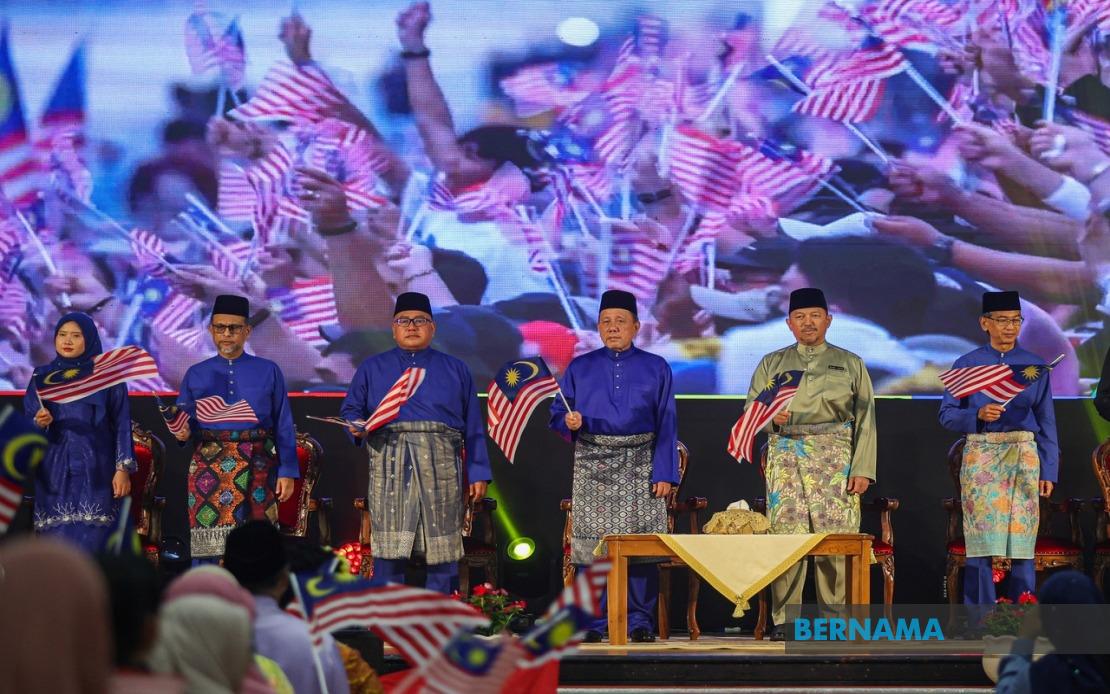
Negeri Sembilan's newly appointed Menteri Besar Datuk Ismail Lasim has articulated an ambitious governing vision grounded in three foundational pillars—stability, progress, and prosperity—designed to reshape how the state administration delivers services and responds to citizen needs. Speaking during the Negeri Sembilan State-Level Public Servants Assembly and the launch of the Kibar Jalur Gemilang campaign in Seremban, Ismail signalled a departure from transactional governance focused purely on legislative arithmetic, instead emphasising the institutional resilience required to sustain long-term development gains.
The Menteri Besar's emphasis on stability extends beyond routine political management. He articulated a distinction between a government merely commanding a majority in the State Legislative Assembly and one capable of anchoring institutional confidence. This nuance carries particular weight in Malaysia's federal context, where state administrations must navigate complex intergovernmental relationships whilst maintaining investor and public confidence. Ismail's stress on preserving the constitutional monarchy and established customs reflects an understanding that political legitimacy rests upon more than electoral mandates—it depends on institutional continuity and respect for constitutional frameworks.
Central to Ismail's framework is the protection of institutional independence and administrative integrity, which he positioned as essential preconditions for effective service delivery. In the Malaysian context, where state governments operate within a complex hierarchy of federal and state powers, this commitment to institutional stability signals an intent to strengthen Negeri Sembilan's administrative machinery without encroaching upon federal domains. The approach acknowledges the state's resource constraints whilst positioning institutional confidence as a platform for economic growth.
On the progress dimension, Ismail articulated a vision departing from conventional metrics of development. Rather than equating advancement primarily with GDP expansion, he advocated for a holistic understanding encompassing job creation, quality investment attraction, and equitable geographic distribution of benefits. This reframing aligns with evolving thinking across Southeast Asia regarding sustainable development, particularly in addressing persistent urban-rural disparities that characterise Malaysian economic geography. His specific reference to Felda settlements and rural advancement underscores recognition that development concentrated in major urban centres risks creating political instability and social fragmentation.
The state's recent economic performance provides a foundation for these ambitions. Negeri Sembilan's gross domestic product expanded 2.6 per cent year-on-year to RM55.8 billion, driven substantially by services and manufacturing sectors. Critically, state revenue has accumulated to RM522.4 million to date, positioning the administration within reasonable striking distance of its RM1 billion target by 2030. Achieving this trajectory requires sustained investment climate improvements and sectoral diversification, both dependent upon the institutional stability Ismail emphasised.
The inclusive prosperity objective directly addresses Malaysian anxieties regarding uneven development. By explicitly committing to equitable wealth distribution, Ismail positioned his administration to compete for investment whilst maintaining social cohesion—a delicate balance many Malaysian states struggle to achieve. The emphasis on balanced development resonates particularly with younger Malaysians concerned about career prospects and regional inequality, whilst also addressing long-standing grievances within rural constituencies where development initiatives frequently arrive tardily or prove inadequate.
Ismail's appointment of a diverse State Executive Council combining varied experiences and perspectives represents a deliberate governance choice. The strategy of leveraging distinct expertise and fresh perspectives suggests an administration conscious of the need to refresh approaches in key policy domains, from economic development to social services. This compositional diversity may enhance the administration's credibility with younger voters and emerging constituencies demanding more sophisticated policy responses than traditional patronage networks typically deliver.
Cooperation between the Executive Council and the public service emerges as a critical implementation mechanism. Ismail's explicit invocation of teamwork between political appointees and career officials reflects mature governance thinking; many Malaysian state administrations struggle with tension between elected leadership and institutional bureaucracy. By framing this relationship as essential to competitiveness in attracting investment and nurturing youth opportunities, Ismail signals that administrative effectiveness underpins all three pillars of his governance framework.
The agricultural and rural economic sectors receive particular attention in this governance model. Rather than treating agriculture as a declining sector suitable only for nostalgic development rhetoric, Ismail positioned it as integral to sustainable prosperity. This approach acknowledges the continuing importance of agricultural constituencies within Negeri Sembilan's political economy whilst recognising global trends toward value-added agricultural production and rural diversification. The implicit commitment to rural sector strengthening carries implications for how the state engages with federal agricultural policies and commodity support mechanisms.
Ismail's invocation of managing expectations for over 1.2 million Negeri Sembilan residents demonstrates awareness of the gap between administrative capacity and public demands. This candid acknowledgment—rare in Malaysian political discourse—suggests an administration conscious of the need to build credibility through realistic goal-setting rather than hyperbolic promises. The emphasis on trust in government and respect for public service directly addresses Malaysian concerns regarding institutional integrity, which recent years of political turbulence have tested.
The Kibar Jalur Gemilang campaign launch, concurrent with the Menteri Besar's governance address, situates patriotic symbolism alongside substantive policy commitments. In Malaysia's contemporary political environment, national unity messaging carries particular weight, reflecting anxieties regarding communal harmony and constitutional stability. The campaign's synchronisation with substantive governance announcements suggests an attempt to ground patriotic sentiment in concrete administrative performance rather than treating national symbolism as disconnected from policy delivery.
For Malaysian observers and policymakers across the region, Negeri Sembilan's new direction offers insights into post-transition governance priorities. The emphasis on institutional stability, inclusive growth, and administrative competence reflects adaptations to Malaysian political complexity and economic challenges. Success in executing this three-pillar framework will substantially influence whether smaller Malaysian states can compete effectively for investment and talent against more developed jurisdictions, with implications for national regional equity and political stability.

