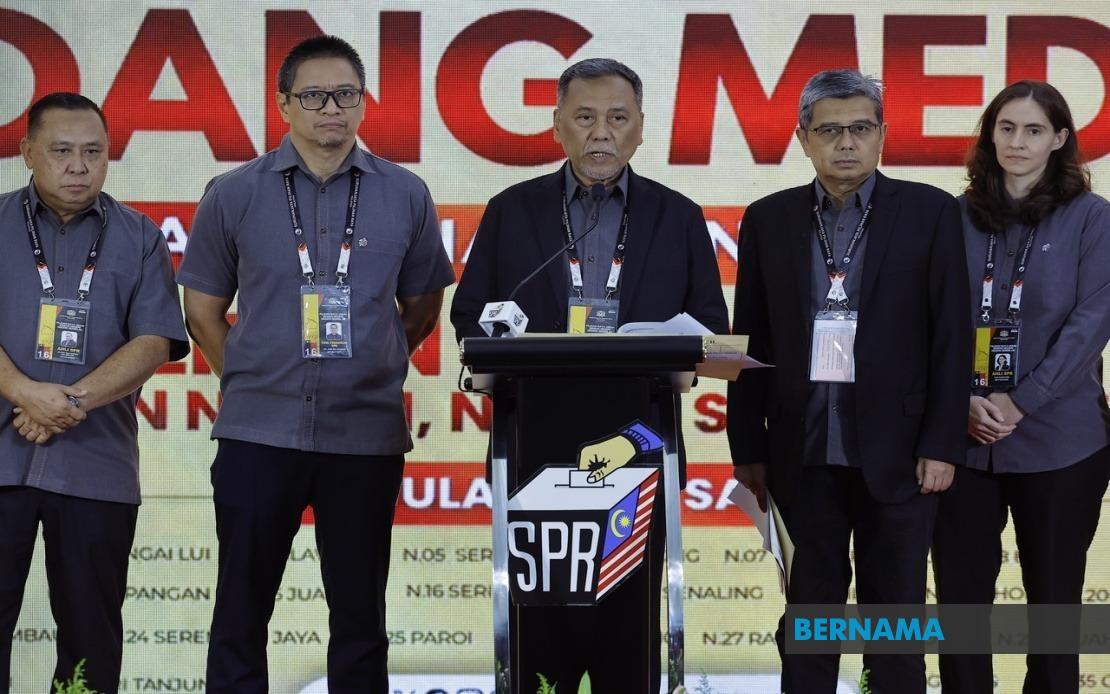
The Election Commission confirmed on July 18 that 103 candidates have been verified as eligible to contest in Negeri Sembilan's upcoming state election, with balloting scheduled for August 1. The race will be decided across 36 state assembly seats, with EC chairman Datuk Seri Ramlan Harun verifying all nominations at a press conference held after the candidate submission deadline closed at 10 am at eight nomination centres across the state.
Pakatan Harapan maintains a substantial lead in fielding contenders, having nominated 36 candidates across the 36 available seats. This represents a full slate and signals the coalition's confidence heading into the election. Barisan Nasional, the traditional ruling force in the state until recent electoral shifts, has put forward 25 candidates. Meanwhile, Bersatu has entered the fray with 24 nominees, positioning itself as a significant challenger, while Perikatan Nasional has fielded 11 candidates, indicating a more selective approach to contesting seats.
Beyond the major coalitions, several smaller parties are adding diversity to the electoral contest. Berjasa, the Malaysian Orang Asli Party (ASLI), and the Socialist Party of Malaysia (PSM) have each fielded a single candidate, reflecting their limited organisational reach but determination to participate in the democratic process. Additionally, four independent candidates are running without party affiliation, providing voters with alternatives outside established party structures.
The composition of the candidate pool reveals significant electoral competitiveness in more than half the state's seats. Twenty-one constituencies will feature three-way battles between different combinations of contenders, heightening unpredictability and potentially allowing split votes to determine outcomes. Eleven seats will be decided in direct one-on-one contests between two candidates, creating starker binary choices for voters. More exotic configurations exist in four constituencies: Nilai and Sri Tanjung will see five candidates competing, while Jeram Padang and Rahang will each host four-cornered races. These multi-candidate contests introduce complexity to voter behaviour and could enable lesser-known contenders to capture seats if votes split among stronger candidates.
Demographic representation among the candidate pool shows a pronounced gender imbalance. The 103 candidates comprise 94 men and only nine women, reflecting persistent challenges in political party candidate selection processes across Malaysia. The age range spans from a 23-year-old representing Bersatu in Sri Tanjung to a 70-year-old fielded by Pakatan Harapan in Gemencheh, demonstrating both youthful energy and experienced voices competing for constituent representation.
Negeri Sembilan's electorate encompasses 889,490 eligible voters, a substantial base that will determine the state government's composition. This includes 867,151 ordinary voters, 16,884 military personnel and their spouses, and 5,455 police officers. The state assembly itself comprises 36 seats, dissolved on June 5 following political developments that necessitated fresh elections. Early voting has been scheduled for July 28, providing registered voters unable to participate on polling day with an advance option, a mechanism increasingly relied upon by election authorities to ensure participation.
The electoral landscape in Negeri Sembilan reflects broader transformations within Malaysian politics. The presence of Bersatu, a splinter party that has dramatically reshaped national political alignments in recent years, indicates how fractionalisation has extended to state-level contests. Perikatan Nasional's limited slate suggests it views Negeri Sembilan as not among its priority battlegrounds, contrasting with areas where the coalition has concentrated resources. Smaller parties' participation underscores the fragmented nature of contemporary Malaysian democracy, where multiple political forces now compete for voter attention.
The prevalence of three-cornered contests across 21 seats introduces substantial uncertainty into vote outcomes. In Malaysia's first-past-the-post system, such races can benefit the candidate most successful at consolidating their vote base, while those who split opposition or coalition votes may lose despite receiving respectable vote counts. This dynamic particularly advantages parties with strong grassroots organisation and clear messaging that resonates with their target constituencies. Analysts view multi-candidate races as potential game-changers that could produce unexpected results, particularly if voters behave differently than in previous elections or if local issues gain prominence over national political narratives.
The timing of early voting on July 28 and polling day on August 1 compresses the formal campaigning period available to candidates and parties. Malaysian electoral rules restrict campaigning in various ways, and the schedule requires parties to mobilise supporters intensively within confined timeframes. For smaller parties with limited resources, this compressed period poses challenges in reaching dispersed voters, potentially advantaging larger coalitions with established machinery and higher name recognition.
Negeri Sembilan's election carries significance beyond the state itself. As a relatively wealthy state with a balanced urban-rural population distribution, its electoral trends offer insights into broader Malaysian voter sentiment. Results could influence calculations among national political leaders regarding coalition viability and voter receptivity to various platforms. The state has previously served as a bellwether, with electoral shifts in Negeri Sembilan sometimes preceding national political realignments, making the August 1 outcome potentially consequential for understanding wider Malaysian political trajectories.
The diversity of candidates and electoral contests reflects Malaysia's ongoing democratic maturation. While gender representation remains inadequate and larger parties continue dominating, the presence of multiple political forces competing across various configurations demonstrates electoral competition is functioning. Voters will have multiple choices and genuine contests in most constituencies, elements fundamental to democratic systems. The Election Commission's orderly administration of the nomination process and verification of candidates reaffirms institutional capacity to manage electoral processes, despite occasional controversies that periodically surround Malaysian electoral mechanics.

