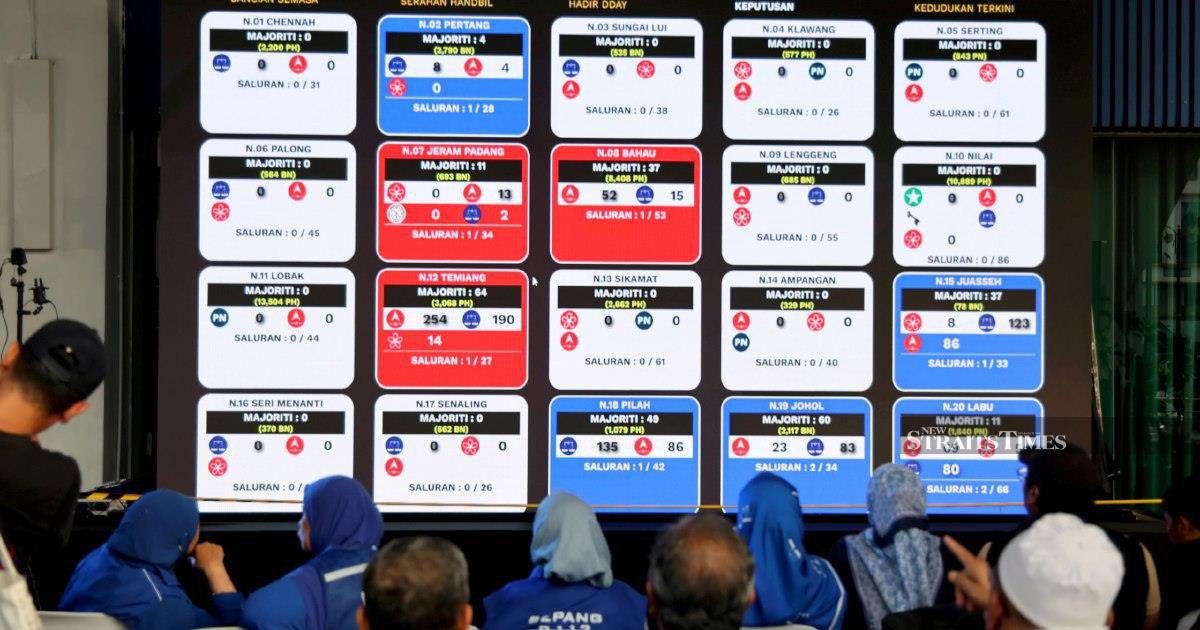
The Negri Sembilan state election has delivered uncomfortable truths for Pakatan Harapan, laying bare the coalition's persistent difficulties in securing and strengthening its appeal among Malay-majority constituencies. Results from the poll underscore a fundamental problem that has plagued the reformist coalition since its 2018 electoral breakthrough: despite winning federal power and implementing policies aimed at addressing Malay concerns, it continues to hemorrhage support in communities where Malays form the demographic backbone. This structural weakness raises serious questions about whether the coalition can sustain its electoral viability in a nation where Malay voters constitute the majority of the electorate.
The performance across Negri Sembilan constituencies revealed a troubling pattern. Pakatan Harapan appeared unable to translate governing experience or policy achievements into renewed voter confidence within Malay-speaking communities. Instead, opposition parties—particularly those positioning themselves as more assertively pro-Malay and pro-Islam—capitalized on lingering perceptions that the coalition insufficiently prioritizes Malay interests. This dynamic mirrors challenges Pakatan Harapan faced in previous electoral contests, suggesting the problem runs deeper than temporary dissatisfaction or local grievances.
The coalition's vulnerability among Malay voters carries profound implications for Malaysian politics. Since the country's independence, no government has successfully maintained power without securing substantial backing from Malay communities. Pakatan Harapan's declining fortunes in this demographic therefore threaten its capacity to recapture federal power in future elections. The 2023 general election already demonstrated this vulnerability, and the Negri Sembilan results confirm the trend has not reversed.
Analysts attribute the coalition's struggles to multiple overlapping factors. Some point to perceptions that Pakatan Harapan governments prioritize non-Malay interests or Chinese business concerns over Bumiputera protections. Others emphasize that the coalition's secular orientation and multi-ethnic composition generate suspicion among conservative Malay-Muslim voters who view opposition parties as more reliably Islamic in their commitments. Additionally, opponents have successfully painted Pakatan Harapan as insufficiently nationalist, a particularly damaging characterization when competing for Malay political allegiance.
The coalition's policy record during its 2018-2020 federal administration offers little apparent shield against these criticisms. Despite implementing programs addressing lower-income Malay concerns and maintaining Islamic institution funding, Pakatan Harapan struggled to translate these actions into political capital. Part of the problem lies in messaging—the coalition has proven less effective than competitors at communicating its achievements to target audiences. Equally important, structural skepticism toward multi-ethnic coalitions runs deep within certain segments of Malay society, where power-sharing arrangements appear inherently threatening to perceived community interests.
Regional factors compound Pakatan Harapan's predicament. Negri Sembilan, while relatively modest in size, holds symbolic importance as a state where Malay sensitivities around traditional authority and Islam remain pronounced. Performance here signals broader viability in other Malay-dominant states like Pahang, Terengganu, and Johor, where the coalition faces even steeper challenges. Should Pakatan Harapan's Malay voter base continue contracting, its prospects for any federal return effectively evaporate, regardless of performance elsewhere.
The internal dynamics within Pakatan Harapan compound the challenge. The coalition includes parties like the Democratic Action Party, whose predominantly Chinese membership and secular orientation generate particular suspicion among Malay voters despite the party's official commitment to Islam and Bumiputerism. Conversely, Malay-based coalition components like the Malaysian United Democratic Alliance have struggled to effectively champion Bumiputera concerns without appearing to sacrifice multi-ethnic coalition principles. This inherent tension limits Pakatan Harapan's flexibility in addressing Malay voter anxieties.
Opposition parties, particularly the Malaysian Islamic Party and Perikatan Nasional, have capitalized astutely on these vulnerabilities. By positioning themselves as unambiguous defenders of Malay-Muslim interests without the complications of multi-ethnic coalition management, they offer Malay voters an apparently simpler political choice. Whether this positioning accurately reflects policy differences matters less than the perception it generates among target audiences. In Malaysian electoral politics, perception frequently outweighs substantive policy comparison.
Forward, Pakatan Harapan faces a strategic dilemma without obvious resolution. Attempting to more forcefully emphasize Malay and Islamic concerns risks alienating non-Malay coalition supporters and potentially deepening perceptions of internal contradiction. Conversely, maintaining current coalition positioning and messaging guarantees continued hemorrhaging of Malay support. Some political observers suggest the coalition requires fundamental restructuring or rebranding to address these tensions, though such transformation would prove extraordinarily difficult given existing institutional arrangements and party leaderships.
The Negri Sembilan outcome thus represents not a temporary electoral fluctuation but rather confirmation of a persistent structural problem threatening Pakatan Harapan's long-term political viability. Until the coalition develops a more compelling narrative addressing Malay voter concerns while maintaining its multi-ethnic character, it will struggle to recapture power. Recent results suggest that window for corrective action may be narrowing with each successive election cycle.

