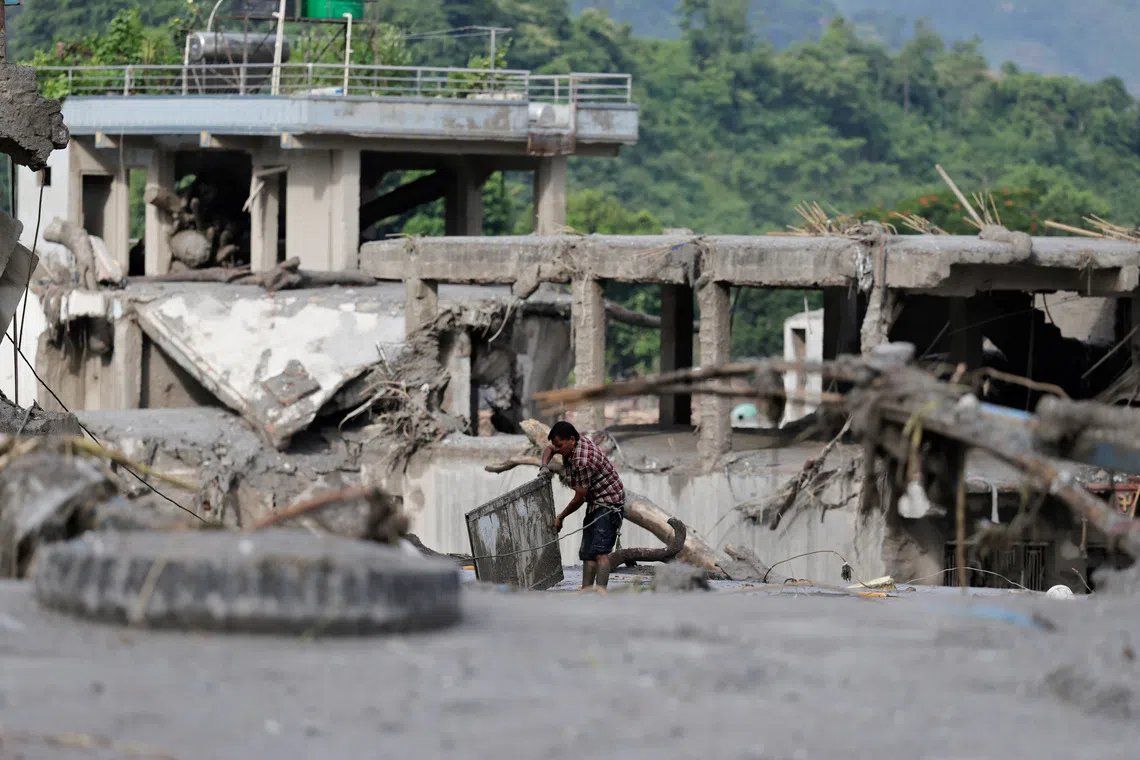
The humanitarian crisis unfolding across the Nepal-China border has taken a more ominous turn, with authorities in both nations alerting residents and rescue teams to an emerging secondary threat that could compound the devastation wrought by this week's glacier-triggered disaster. On Thursday, as search and rescue operations continued amid debris-filled valleys and mountainside settlements, officials warned that newly formed lakes—created when the glacier collapse blockaded river channels—now pose a potentially more dangerous risk than the initial catastrophe. The twin warnings underscore the cascading hazards that mountain disasters generate, where one calamity triggers a series of compounding threats across a vulnerable transnational landscape.
The original catastrophe struck with little warning on Wednesday when a glacier in the high Himalayas gave way, sending an enormous volume of rock, ice, mud and debris cascading into river systems that flow through the remote border region. The immediate impact has been devastating: at least 362 people have perished, with search teams still working to locate more than 1,000 individuals believed missing in the wreckage. Rescue operations have proven extraordinarily challenging, hampered by rugged terrain, damaged infrastructure, and the sheer scale of debris covering the landscape. Yet even as teams worked to extract survivors and recover bodies, a new hazard has emerged that threatens to render those heroic efforts futile and potentially cost additional lives.
Nepal's disaster management authority articulated the threat with stark clarity on Thursday. A massive lake has formed where debris from the glacier collapse has effectively dammed a river channel on the Nepali side of the border. Monitoring indicates this artificial lake continues accumulating water as runoff flows in from the surrounding catchment area, steadily rising toward a critical threshold. The authority issued an explicit public advisory urging residents downstream of this precarious dam to relocate to higher elevations and stay clear of river valleys and low-lying areas. The alert extended to rescue workers themselves, many of whom had been positioned along riverbanks and in vulnerable zones to access victims and search through debris.
China's warning conveys an even more quantifiable threat lurking on its side of the frontier. Officials project that approximately three million cubic meters of water—an almost incomprehensible volume equivalent to some 1,200 Olympic-sized swimming pools—will flow into an already existing dammed lake on the Chinese side within a seventy-two-hour window. This torrential inflow creates what water resource specialists classify as a high-risk scenario for dam breach or catastrophic overflow. Chinese hydrologists anticipate the flow will peak around September 1, potentially overwhelmed an already-pressurised water retention system that was never designed for such sudden, massive influxes.
The convergence of environmental factors amplifies the urgency of these warnings. Chinese state media outlets, citing advisories from the Chinese water resources ministry, have flagged that rainfall forecasted across the region over the coming week will substantially worsen both lakes' overflow potential. The additional precipitation will accelerate water accumulation, tightening the margin between current volumes and the point at which containment fails. Zhu Jinfeng, a researcher specializing in hydrology at the water resources ministry, conveyed this escalating predicament to state television, noting that the situation represents a dynamic threat where risk factors are constantly worsening rather than stabilising. The scientific community's consensus frames this as a rapidly deteriorating scenario with shrinking windows for preventive action.
The structural vulnerability of the dam on the Chinese side compounds the risk profile. Designed and constructed to manage seasonal and anticipated hydrological flows, the facility faces an unprecedented loading event entirely outside its engineering parameters. Should the dam's spillways or structural integrity prove inadequate for the approaching surge, a catastrophic breach could unleash a wall of water into downstream areas, creating a secondary disaster that could dwarf the casualties and destruction already tallied. Such a scenario would transform a regional emergency into a transnational catastrophe affecting communities across the Nepal-China border.
Recognising these dangers, rescue operations have begun adapting their deployment strategies. Pawan Koirala, a rescue worker coordinating a team of thirteen personnel, described on Thursday how his unit received the warnings and immediately began repositioning away from exposed riverbed locations toward elevated terrain. The decision reflects an uncomfortable calculation: continuing rescue efforts in high-risk zones could endanger the very personnel who have been instrumental in saving lives. This dilemma—balancing the moral imperative to search for survivors against the physical reality of mounting secondary hazards—exemplifies the impossible choices confronting disaster response coordinators in the aftermath of this catastrophe.
The glacier collapse itself remains the subject of investigation and debate between the two nations. Both Nepal and China have identified a sudden glacial failure as the root cause, distinguishing this event from purely weather-driven flooding. Climate scientists note that rapid glacial destabilisation in the high Himalayan peaks has become an increasingly frequent phenomenon, driven by warming temperatures and shifting precipitation patterns. The event in the Nepal-China border region thus carries implications extending beyond immediate disaster response, suggesting a recalibration of climate risk in one of Asia's most geologically sensitive regions.
For Malaysia and Southeast Asia more broadly, this crisis carries sobering implications. The Himalayan mountain system influences weather patterns and water cycles across the Asian continent. Large-scale glacial retreat and the formation of unstable mountain lakes represent emerging hazards in a warming climate. Southeast Asian nations with significant mountain terrain—particularly Myanmar, Laos, and sections of northern Thailand and Malaysia—may face comparable risks in coming decades as glacier dynamics shift and precipitation patterns become more erratic. The Nepal-China disaster offers crucial lessons in preparedness, early warning systems, and coordinated cross-border response mechanisms.
The immediate priority for both nations remains preventing the secondary flooding catastrophe now materialising. Chinese engineers are reportedly working to manage outflows from the dam on their side, while Nepali authorities coordinate with communities to implement evacuation protocols. International disaster response agencies have been alerted and are positioning additional resources to support containment and recovery efforts. The next seventy-two hours will prove critical in determining whether this secondary threat can be mitigated or whether the region faces additional tragedy compounding the already staggering human toll.

