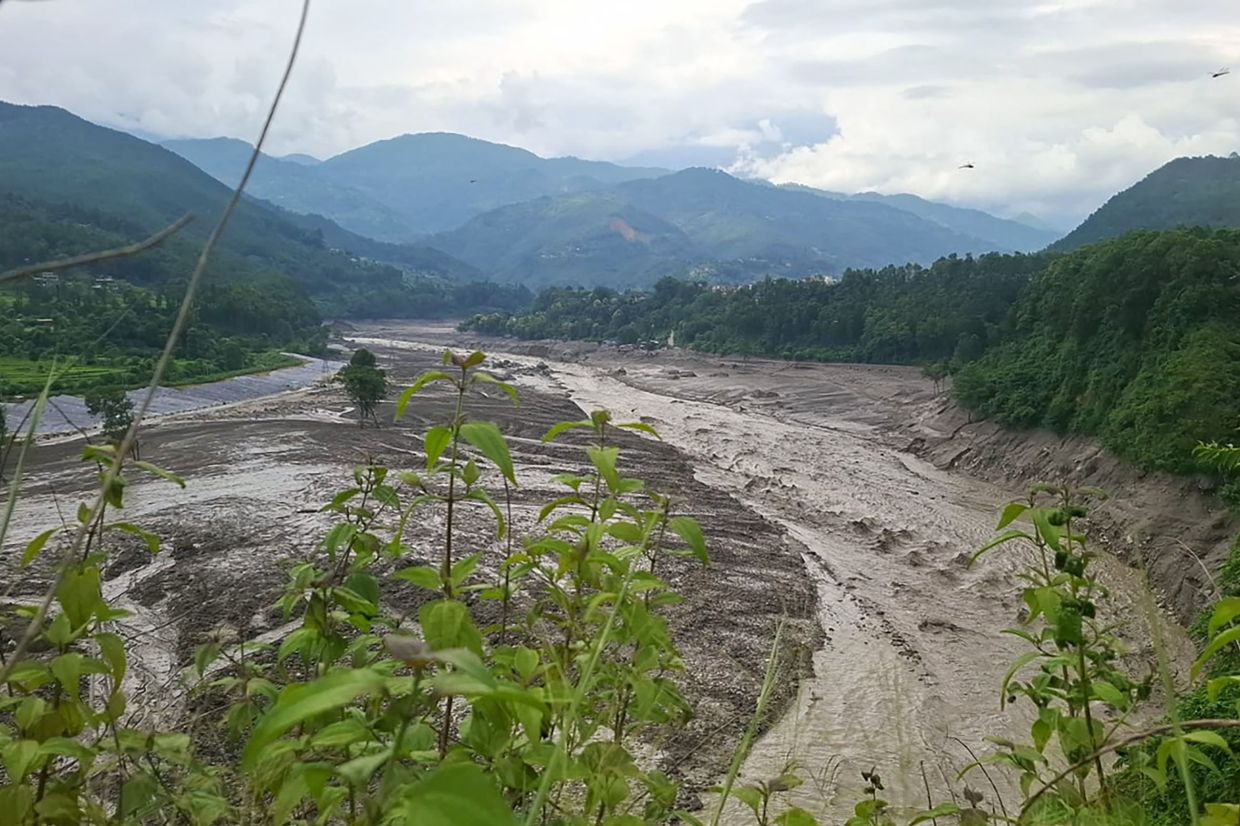
A mountainous region of Nepal descended into crisis on Wednesday when an avalanche-triggered flash flood tore through villages and tourist routes, claiming at least 22 lives and leaving hundreds unaccounted for. The disaster struck around 9am local time when the Bhotekoshi River burst its banks in a surge of water and debris, obliterating settlements, roads and hydropower installations across the Himalayan landscape. The scale of the missing vastly outweighs confirmed fatalities, with 384 people reported unaccounted for, underscoring the difficulty of search operations in remote mountain terrain and the likelihood that casualty figures will rise as rescue teams penetrate affected areas.
The missing include nationals from across the globe, reflecting Nepal's critical role as a gateway for Himalayan tourism and religious pilgrimage. Among the unaccounted are 291 foreign visitors from countries including India, the United States, the United Kingdom and Malaysia, many of whom were undertaking religious journeys to Mount Kailash in Tibet—a revered destination for Hindu devotees. Malaysia's Foreign Ministry confirmed that 11 citizens had lost contact with travel agencies and were believed stranded in the Rasuwa district, one of the regions most severely impacted by the flooding. South Korean workers engaged in hydropower construction projects were similarly reported missing, highlighting how such disasters imperil not only tourists but also international development workers.
The physical devastation reflects the ferocity of the water surge through narrow mountain valleys. The Nuwakot district bore particular brunt, with entire multistorey buildings, heavy trucks and vans buried beneath vast accumulations of mud and rock debris. Authorities moved swiftly to issue warnings across multiple districts, instructing residents to vacate areas bordering the Bhotekoshi, Trishuli and Narayani rivers as secondary flood risks persisted. Infrastructure damage extended beyond immediate destruction: roads connecting communities were severed, isolating villages and complicating rescue coordination, while hydropower plants that supply electricity to the region were severely compromised or destroyed.
The Nepalese government's response involved immediate diplomatic outreach. Sasmit Pokharel, speaking for the administration, announced that requests for assistance had been dispatched to both India and China, recognising that large-scale international coordination would be essential to locate and extract hundreds of missing people from mountainous terrain. Prime Minister Narendra Modi of India responded within hours, pledging comprehensive humanitarian support to Nepal's government led by Prime Minister Balendra Shah. Modi committed Indian rescue and relief teams to work in close coordination with Nepalese authorities, demonstrating how such transnational disasters create frameworks for urgent regional cooperation.
Across the border in China, authorities initiated extensive search and rescue operations in the Tibetan territory of Gyirong, where additional people may have been swept into the floodwaters that flowed downstream into Chinese territory. State broadcaster CCTV reported on these efforts, though Chinese officials refrained from releasing specific casualty or missing person figures. Chinese President Xi Jinping issued directives to escalate rescue operations and to evacuate populations at risk on the Chinese side of the border, according to state news agency Xinhua. This transnational dimension underscores how disasters in the high Himalayas respect no political boundaries and demand coordination across multiple governments and security frameworks.
Climate scientists have pinpointed the underlying cause with increasing certainty: an avalanche from a Himalayan glacier appears to have triggered the catastrophe. Researchers at the Kathmandu-based International Centre for Integrated Mountain Development noted that the Lhende Khola River, a tributary feeding into the Bhotekoshi, experienced maximum flooding when a mass of ice and rock from a glacier on the Nepal-facing slopes destabilised and collapsed into the watercourse. This sudden blockage dammed the river momentarily before the accumulated water burst through with overwhelming force, releasing a wall of water, mud and debris downstream. Saswata Sanyal, a disaster risk reduction specialist at the centre, observed that this represents the second major flooding event in the Lhende Khola within just fourteen months, a frequency that would have been extraordinary in historical records.
The recurring nature of these disasters in the same valleys reflects accelerating climate breakdown in the Himalayan region. The Hindu Kush Himalaya spans parts of Nepal, India and neighbouring territories, making it a shared geography of climate vulnerability. Research conducted earlier this year by Kathmandu-based scientists found that glaciers throughout this region are melting at rates that have doubled since 2000, driven fundamentally by rising global temperatures attributable to human-caused climate change. The region warms faster than most other areas on Earth, a phenomenon known as accelerated warming in high-altitude zones. As glaciers recede and destabilise, they release massive accumulations of ice and rock previously locked in frozen form, increasing the probability of avalanches and glacier-lake outburst floods.
The pattern mirrors conditions that produced similar devastation in August of the preceding year, when a glacial lake in neighbouring Tibet overflowed due to elevated temperatures in the mountain zone. That earlier event claimed nine lives and destroyed critical infrastructure, including a bridge connecting Nepal and China. The recurrence within twelve months demonstrates how climate-driven hazards are compressing into shorter timescales. Extreme weather phenomena, including intense rainfall and devastating heatwaves, have grown more frequent throughout the region, while the melting of glaciers has become a visible and accelerating process captured in satellite imagery and scientific surveys.
For Malaysia and other Southeast Asian nations with citizens operating or travelling in the Himalayas, the disaster signals the rising stakes of climate-related hazards in adjacent regions. Malaysian travellers and businesses engaging with Nepal's tourism and development sectors face escalating risks from events that climate scientists regard not as anomalies but as symptoms of systematic environmental change. Saswata Sanyal emphasised that in a warming Himalaya, early warning systems represent the first line of adaptation—a recognition that prediction and evacuation protocols must advance faster than the natural hazards themselves. This underscores the urgency for governments across Asia to invest in cross-border early warning networks, real-time data sharing on glacier and river conditions, and coordinated evacuation procedures that transcend national boundaries in recognition of shared climate vulnerability.

