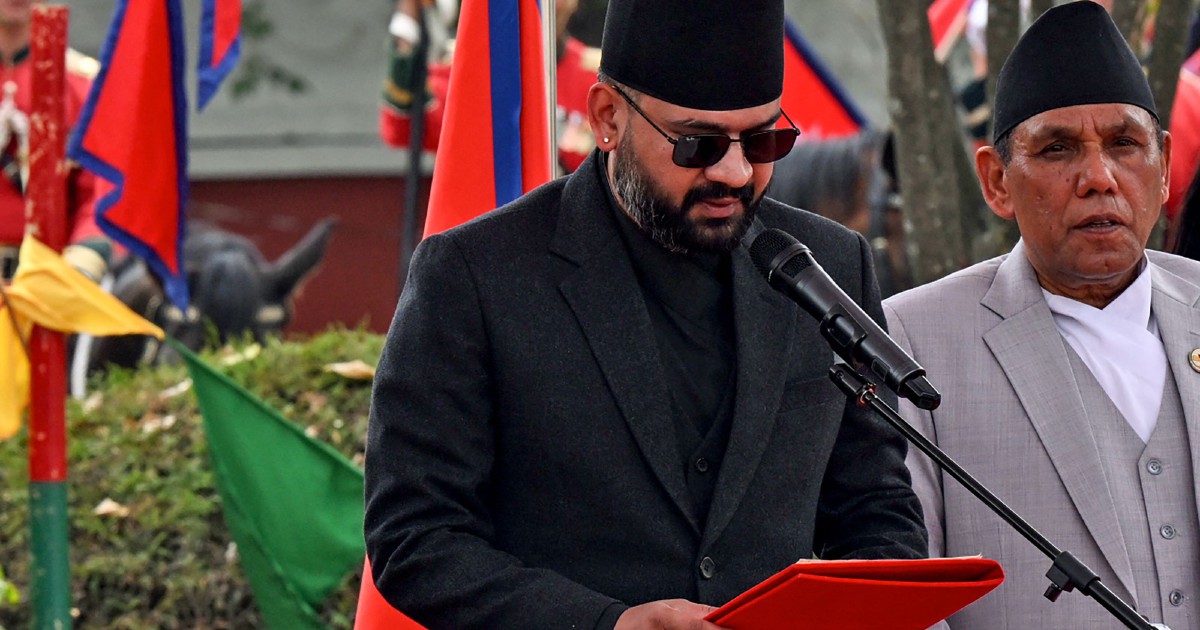
Nepal's Prime Minister Balendra Shah has secured formal clearance to retain his distinctive dark sunglasses whilst conducting parliamentary business, marking an unusual accommodation within the country's legislative procedures. An official statement released on Tuesday confirmed that the Premier's eyewear, a long-established personal trademark, will remain permissible during his presence in the legislature, following a determination that legitimate medical considerations support the exception.
The ruling represents a departure from conventional parliamentary decorum, which typically expects legislators to maintain direct eye contact and visible facial features during proceedings. The development arose after the parliament speaker initially discouraged the practice, citing established protocols governing comportment within the chamber. However, subsequent review by relevant authorities concluded that health-related factors justified an exemption to these standard expectations.
Prime Minister Shah has consistently worn dark sunglasses as part of his public persona, making them instantly recognisable to Nepali citizens and international observers alike. The eyewear functions not merely as a fashion statement but has become integral to his identity as a political figure. Their restriction would have presented an unprecedented constraint on his parliamentary participation and personal presentation.
The medical justification underlying the decision suggests that Shah may experience light sensitivity or other ophthalmological conditions that create legitimate necessity for protective eyewear. Whilst precise medical details remain private—as is customary with personal health information—the assessment conducted by appropriate medical professionals carried sufficient weight to override institutional custom. This speaks to a broader principle that individual medical requirements can reasonably supersede general institutional rules.
Parliamentary bodies worldwide have grappled with comparable questions regarding dress codes and personal presentation standards. Most legislative chambers maintain expectations about appearance and comportment designed to uphold institutional dignity and ensure that members present themselves in a manner befitting their office. Yet such rules increasingly must accommodate documented medical needs, reflecting evolving standards around accessibility and inclusion.
The decision carries particular significance within South Asian political contexts, where parliamentary tradition and institutional authority carry substantial weight. Nepal's legislature has historically maintained relatively strict protocols regarding member conduct and presentation. This accommodation suggests a pragmatic approach wherein institutional rules remain binding but accommodate genuine medical necessity without compromise to parliamentary function or dignity.
Speaker opposition to the sunglasses likely reflected concerns about maintaining traditional standards of transparency and openness in legislative proceedings. The ability to observe a politician's eyes is sometimes considered important for assessing sincerity and emotional engagement during parliamentary exchanges. However, the medical clearance implicitly acknowledges that such considerations cannot supersede documented health requirements.
The parliamentary approval also reflects contemporary discussions about disability accommodation and accessibility within governmental institutions. Whilst Shah's situation involves medical necessity rather than disability per se, the principle remains consistent: institutional rules should flexibly incorporate provisions for individuals whose health conditions require specific accommodations. This approach aligns Nepal with global best practices in inclusive governance.
For Malaysian observers and regional analysts, the Nepali precedent demonstrates how legislative bodies navigate tensions between institutional tradition and individual circumstance. As Southeast Asian parliaments become increasingly diverse and members bring varied backgrounds and health profiles, similar questions will inevitably emerge regarding dress codes, accessibility modifications, and other procedural accommodations. The Nepali resolution offers a model wherein principled adherence to standards coexists with measured flexibility.
The approval process itself reveals institutional maturity. Rather than rigidly enforcing rules or accepting practices without scrutiny, the parliament conducted appropriate review and grounded decisions in medical evidence. This approach respects both institutional integrity and individual circumstance, suggesting that legislative bodies need not be inflexible to maintain authority and dignity.
Moving forward, the decision will likely establish precedent within Nepali parliamentary practice. Future members experiencing comparable medical considerations may reference this authorisation, potentially leading to more generalised guidelines regarding medical accommodations rather than case-by-case approvals. Formalising such processes could reduce friction whilst maintaining institutional standards.
The broader implication for parliamentary governance across South Asia and Southeast Asia suggests that legislative institutions can adapt to contemporary understandings of accessibility and inclusion without sacrificing fundamental principles. The Nepali parliament's decision demonstrates that tradition and pragmatism need not be mutually exclusive, offering a balanced approach that other regional legislatures might consider when confronted with comparable situations requiring institutional flexibility in service of legitimate individual needs.

