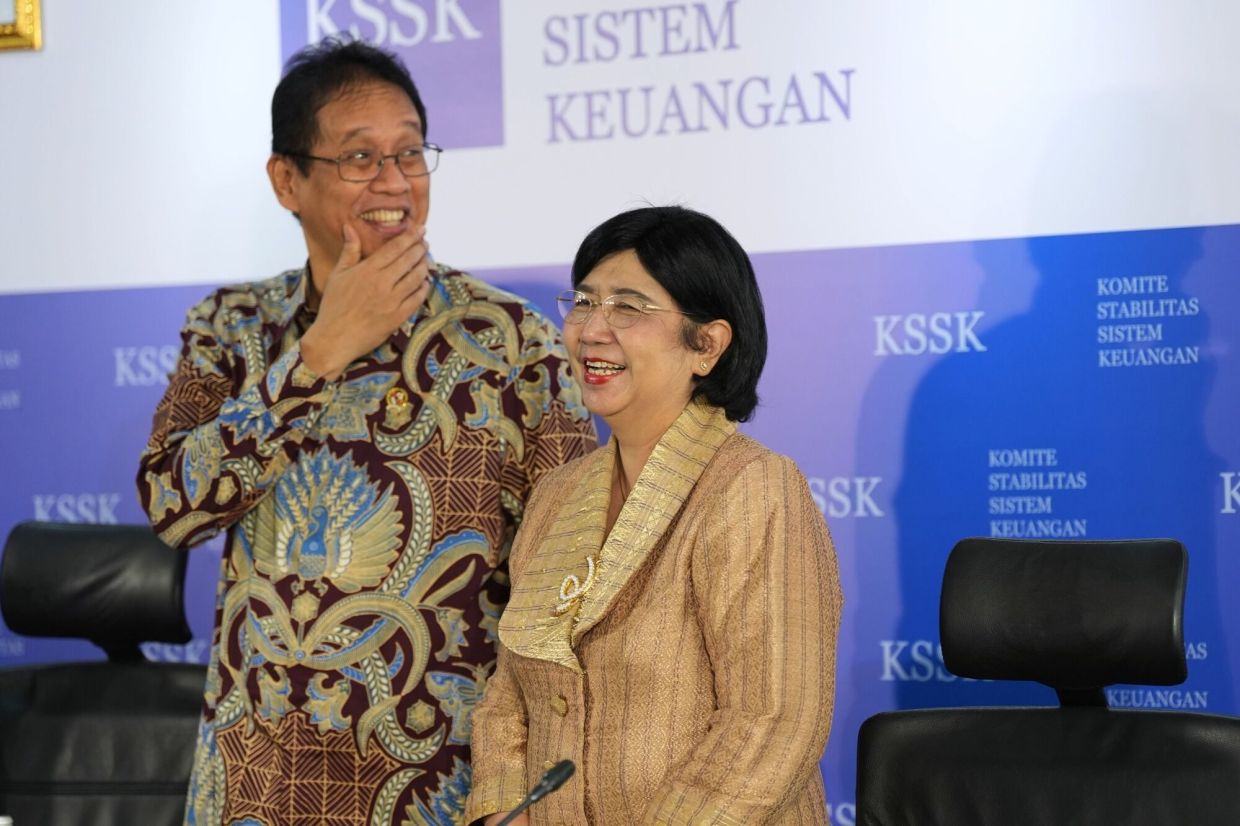
Destry Damayanti's swift appointment as acting governor of Bank Indonesia two weeks ago sent immediate signals about the central bank's evolving relationship with government. Within hours of her elevation, she made a deliberate stop at the office of Finance Minister Purbaya Yudhi Sadewa before visiting President Prabowo Subianto at the presidential palace. The choreography was unmistakable: a new central banker signalling her intention to work in close coordination with the government's fiscal authorities. This stood in sharp contrast to her predecessor Perry Warjiyo, who maintained greater institutional distance, with virtually all substantive meetings between the central bank and finance ministry taking place in formal settings at the presidential palace or within regulatory committees rather than through direct bilateral engagement.
Prabowo has now nominated Destry as the sole candidate for the permanent governorship, a position requiring parliamentary approval. The move represents an attempt to square a difficult circle: securing a market-friendly technocrat with genuine financial credentials while also appointing someone receptive to the administration's economic priorities. Destry's nearly seven-year tenure as Warjiyo's deputy and her prior role as chief economist at PT Bank Mandiri provide substantial grounding in monetary policy. Yet her willingness to cultivate proximity to Finance Minister Purbaya—a former head of the Indonesia Deposit Insurance Corp. where Destry herself served as a commissioner—raises questions about institutional independence that will preoccupy international investors.
The relationship between a central bank and its government sits at the heart of macroeconomic credibility. In emerging markets, where currency depreciation can rapidly erode purchasing power and destabilise external balances, investors scrutinise whether monetary authorities will maintain discipline even when politicians demand looser conditions to stimulate growth. Bank Indonesia faces precisely this tension. President Prabowo has charted an ambitious course toward 8 percent annual growth by 2029, backed by populist spending initiatives including free school meals and greater state control over commodity markets. These programmes, while politically popular, have spooked international capital markets. The rupiah has depreciated roughly 6 percent against the US dollar this year, making it Asia's worst performer. Fitch Ratings and Moody's have both placed Indonesia's sovereign credit rating on negative watch, citing policy uncertainty, though Standard & Poor's maintains a stable outlook.
Under Warjiyo's leadership, Bank Indonesia deployed a layered approach to monetary management. The central bank has raised its policy rate three times since May while simultaneously intervening in foreign exchange markets to support the rupiah and employing non-traditional tools to sustain credit growth and economic activity. This balancing act reflected an institution managing multiple, sometimes conflicting mandates: price stability, exchange-rate resilience, and financial system soundness. Whether Destry will maintain this disciplined framework or tilt toward accommodation remains the critical question for portfolio managers and traders monitoring Indonesian assets.
Economists and analysts have offered cautiously optimistic assessments so far. Helmi Arman at Citigroup noted that improved communication between the central bank and government could enhance policy coordination, though he cautioned that the broader institutional environment remains fluid. Markets themselves initially welcomed Destry's appointment, with the rupiah strengthening to its firmest level in a month and outperforming most regional peers on the day of her announcement. This positive reception reflects investor relief that a capable successor has been identified, yet it masks deeper anxieties about whether she will prioritise central bank independence when pressures mount.
Destry's professional background offers some reassurance. She holds an economics degree from the University of Indonesia and a master's qualification in regional science from Cornell University, giving her both deep local knowledge and international training in rigorous economic analysis. Throughout her career at Bank Mandiri and within the central bank system, she has cultivated relationships with the international investor and analyst communities, engaging regularly on policy matters and earning respect for her technical expertise. This profile suggests someone capable of earning market confidence through demonstrated competence rather than relying solely on institutional reputation.
Yet the external environment presents formidable headwinds that will test her resolve. Global interest rates remain elevated as the US Federal Reserve maintains its restrictive stance, and the dollar continues to strengthen against most emerging-market currencies. These global forces create persistent pressure on the rupiah regardless of Indonesian policy choices. Simultaneously, Prabowo's agenda demands faster domestic growth, which traditionally requires either looser monetary conditions or fiscal stimulus—precisely the combination that tends to weaken currencies. Irman Faiz, chief economist at PT Bank Danamon, articulated the core tension: central banks must coordinate closely with governments, but monetary decisions ultimately cannot be subordinated to political objectives. Decisions on interest rates, rupiah intervention, and liquidity must rest on technical assessments of inflation, exchange-rate dynamics, and financial stability.
Destry's appointment occurs at a moment when Indonesia's inflation remains relatively contained despite rupiah weakness, providing some operational room. However, sustained currency depreciation eventually passes through to import prices and domestic costs. The central bank's ability to hold policy discipline through this transmission process will determine whether Destry emerges as an independent voice or becomes seen as merely executing presidential directives. International investors, having observed monetary authorities in other emerging markets compromise institutional autonomy, will monitor her first major policy decisions with close attention.
Beyond immediate stabilisation, analysts argue that Bank Indonesia faces a deeper challenge. Fakhrul Fulvian, chief economist at PT Trimegah Sekuritas Indonesia, contends that the next phase requires translating macroeconomic stability into improved financial conditions. The central bank should work toward a normalised yield curve that accurately reflects economic conditions, stronger transmission of monetary policy into lending and investment decisions, and renewed confidence among private corporations in undertaking expansion. These objectives require not merely preserving stability but actively rebuilding confidence in institutional frameworks that have been tested by policy turbulence.
For Malaysian observers, Indonesia's central banking transition carries regional implications. As Southeast Asia's largest economy, Indonesian monetary stability affects regional capital flows and currency movements. A Bank Indonesia perceived as independent and credible helps anchor confidence across the region. Conversely, if Destry's appointment is interpreted as subordinating the central bank to political pressures, it could amplify volatility in regional currencies and risk premiums. Malaysian policymakers and investors therefore have material interest in whether Destry successfully navigates the institutional tightrope she has been given.
Destry's tenure will ultimately be judged on whether she maintains the technical discipline required to preserve Indonesia's financial stability while demonstrating sufficient openness to government coordination to avoid becoming an obstacle to reasonable policy objectives. This requires both genuine independence—demonstrated through maintaining interest-rate discipline and resisting pressure for excessive rupiah intervention—and genuine engagement, shown through improved communication and willingness to coordinate with fiscal authorities. The balance between these imperatives, neither of which can be sacrificed without cost, defines the central challenge before her.

