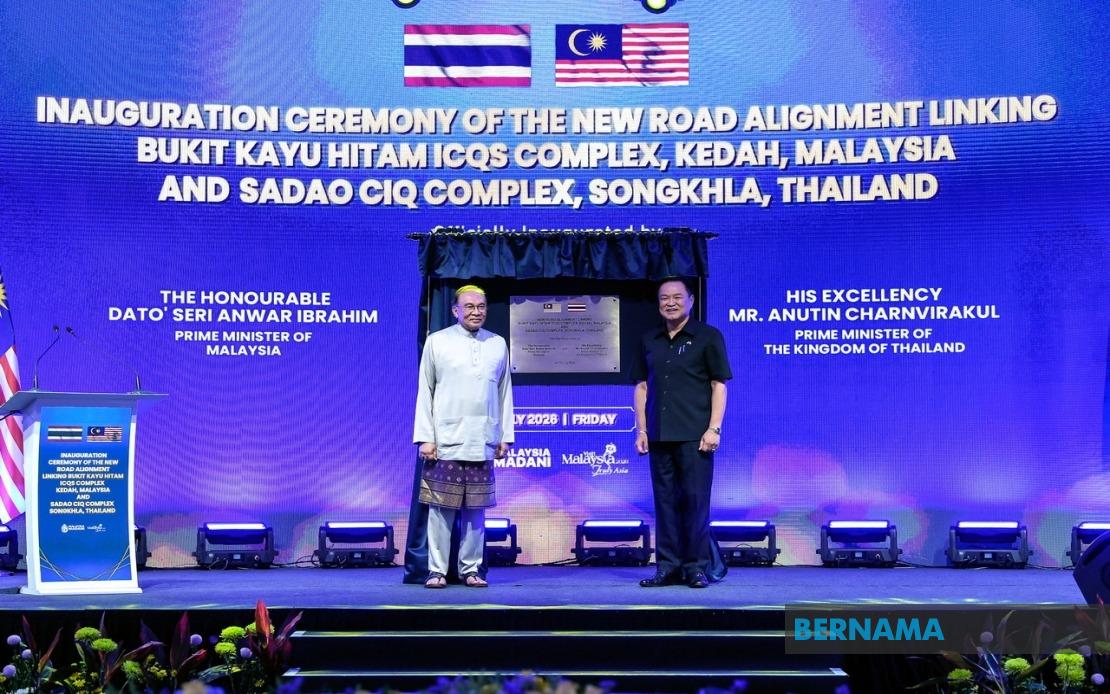
Prime Minister Datuk Seri Anwar Ibrahim has hailed a new road alignment connecting Malaysia's northern border checkpoint with Thailand's customs facility as a transformative step for cross-border prosperity. Launched jointly with Thailand's Prime Minister Anutin Charnvirakul at Bukit Kayu Hitam in Kedah, the infrastructure project linking the Bukit Kayu Hitam Immigration, Customs, Quarantine and Security Complex to the Sadao Customs, Immigration and Quarantine Complex signals a historic shift in bilateral relations centred on practical economic benefits rather than traditional diplomatic gestures alone.
The timing of the launch underscores regional momentum. Anutin's two-day official visit to Malaysia, conducted at Anwar's invitation, culminated in the ceremony at the border itself—a symbolic choice reflecting the two leaders' commitment to addressing the concerns of communities in peripheral regions rather than confining discussions to capital cities. By positioning themselves at ground level where trade flows converge, both governments are signalling that border development is no longer an afterthought but a strategic priority requiring top-level engagement and political will.
At its core, the new road represents infrastructure enabling what Anwar describes as a "special economic border zone" spanning northern Malaysian states and southern Thailand. This concept extends beyond conventional trade facilitation. The proposed zone would encompass Perlis, Kedah, Kelantan, Perak and Penang on the Malaysian side, creating a coordinated economic corridor designed to attract investment and generate livelihoods for communities historically marginalised from national development priorities. Such zones require aligned regulatory frameworks, harmonised business practices and regional coordination—elements that demand sustained leadership commitment from both capitals.
The road project itself addresses a longstanding bottleneck. Border crossings are notorious friction points where inefficient processes inflate transport costs, delay goods movement and discourage smaller traders from engaging in cross-border commerce. By providing direct connectivity between official clearance facilities, the new alignment should reduce transit times and operational complexity. For Malaysian exporters and Thai importers, this translates to lower logistics costs; for bilateral trade volume, it potentially removes a mechanical constraint on growth.
Anwar explicitly linked the infrastructure investment to ambitious trade targets. Malaysia and Thailand have committed to achieving USD30 billion in bilateral trade by 2027—a figure that underscores the scale of economic ambition driving the initiative. Current trade volumes fall short of this target, suggesting either optimistic projections or recognition that institutional and infrastructural barriers currently suppress genuine demand for cross-border commerce. Either way, the new road is positioned as an enabler, not a sufficient condition on its own.
Crucially, both leaders acknowledged that infrastructure alone cannot unlock economic potential. Anwar emphasised that Malaysia and Thailand have agreed to expedite resolution of longstanding procedural and regulatory obstacles. Customs protocols, immigration processing, fisheries governance and trade rules have accumulated complexities over decades—many reflecting bilateral tensions rather than contemporary economic logic. The commitment to "resolve it in the fastest manner possible" suggests both governments recognise these barriers as correctable institutional problems rather than structural inevitabilities.
The special economic zone proposal reveals sophisticated thinking about regional inequality. Northern Malaysia and southern Thailand share geographic proximity but have lagged their respective countries' development trajectories. Provincial economies in these regions are vulnerable to poverty and lack diversification beyond agriculture and small-scale commerce. A coordinated border zone could enable cross-border investment, allow businesses to achieve scale economies by accessing larger combined markets, and provide communities on both sides with tangible economic opportunities. This approach treats the border not as a dividing line but as a potential growth nexus.
For Malaysian stakeholders, the initiative carries particular relevance. Kedah, Perlis, Kelantan and other northern states have historically struggled to attract manufacturing and high-value commerce compared to the central corridor. A functioning Malaysia-Thailand economic zone could reposition these states as gateways to Thai and broader Southeast Asian markets, potentially catalysing industrial clustering and logistics hub development. This geographic reorientation of growth patterns would require domestic Malaysian alignment—investment in supporting infrastructure, alignment of state and federal policies, and coordination among multiple state governments.
The political dimensions merit attention. Anwar's framing of the project as resolving "long-standing issues" accumulated over "years, sometimes decades" hints at historical disputes—border demarcation questions, fisheries rights, and trade grievances that have periodically strained relations. By channelling diplomatic energy into mutually beneficial economic projects, both governments demonstrate pragmatism. Rather than allowing historical grievances to paralyse engagement, leadership commitment to tangible cooperation creates positive-sum outcomes that give communities shared interest in stability and expanding trade.
Thailand's perspective on the initiative deserves consideration. Southern Thailand has faced chronic underdevelopment, insurgency-related instability and economic marginalisation. A coordinated Malaysia-Thailand border economy offers Thai policymakers a development pathway for troubled provinces, potentially improving security through prosperity. From Anutin's standpoint, the project demonstrates responsiveness to regional development needs and represents productive cooperation with Malaysia—outcomes that enhance both governments' legitimacy in peripheral areas.
Implementation challenges will test political commitment. Harmonising customs procedures, immigration processing and quarantine standards requires bureaucratic coordination across sovereign borders. Creating investor confidence in a new economic zone demands certainty about regulatory stability and dispute resolution mechanisms. Cross-border labour mobility, currency arrangements and tax treatment of zone-based businesses all require negotiated agreements. These technical obstacles are resolvable through determined cooperation, but they demand sustained attention from officials beyond the inaugural ceremony.
The broader Southeast Asian context situates this initiative within regional integration trends. As ASEAN economies deepen trade connections and infrastructure linkages, border areas gain strategic importance. Malaysia-Thailand cooperation on their shared frontier potentially influences similar efforts across the region and demonstrates models for other countries managing cross-border development. Success could encourage comparable initiatives involving Malaysia-Indonesia or Thailand-Laos corridors, potentially catalysing a network of functioning economic borders across Southeast Asia.
Moving forward, the project's success will be measured not by ceremonial launches but by practical outcomes. Trade volume increases, investment flows to border regions, employment creation in Kedah and other northern states, and observable improvements in living standards for border communities will determine whether the initiative transcends political symbolism. The commitment from both Anwar and Anutin appears genuine, but translating aspiration into results requires sustained bureaucratic coordination, financial commitment and willingness to subordinate parochial interests to shared regional prosperity.

