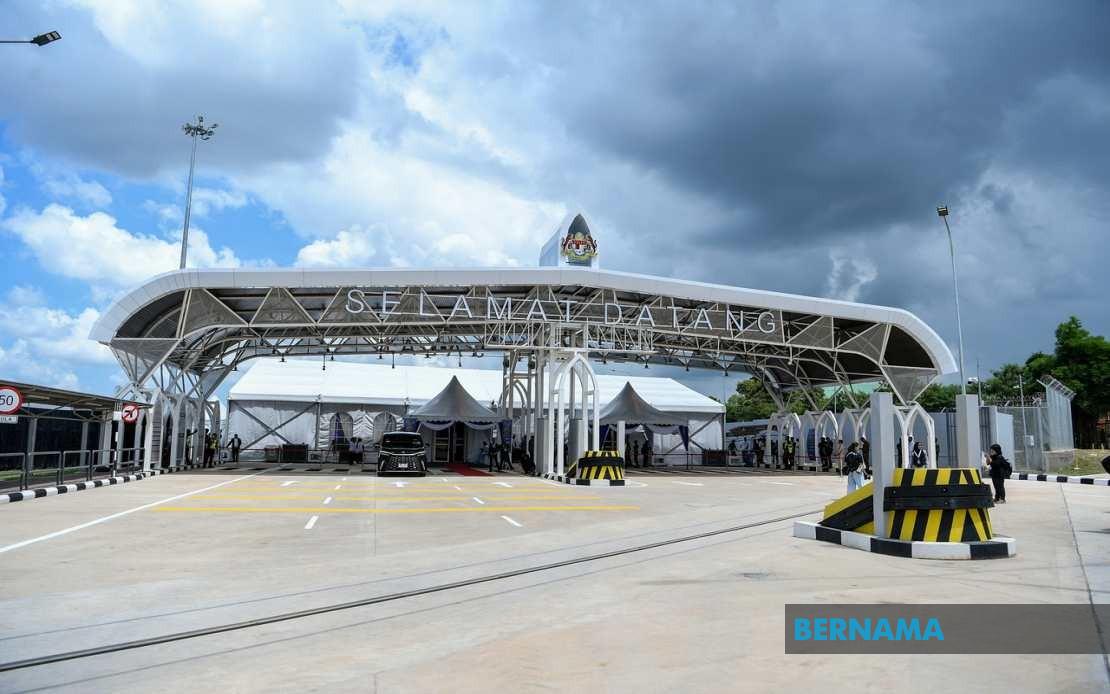
The Bukit Kayu Hitam-Sadao border complex's newly inaugurated route is delivering tangible benefits to regional commerce, with initial data revealing a marked acceleration in the movement of goods and vehicles between Malaysia and Thailand. Opened jointly by Malaysian Prime Minister Datuk Seri Anwar Ibrahim and Thai Prime Minister Anutin Charnvirakul on July 10, the facility became operational the following day and has already demonstrated capacity to handle over 1,000 logistics lorries daily. The 900-metre corridor directly connects Kedah's Bukit Kayu Hitam Immigration, Customs, Quarantine and Security Complex with Thailand's Sadao Customs, Immigration and Quarantine Complex, creating a streamlined passage for vehicles that previously contended with congestion and lengthy processing delays.
The transformation in traffic patterns has been swift and comprehensive. According to Sadao Customs director Buntoon Oucharoen, nearly all heavy vehicles—lorries, buses, and vans—have migrated to the new route within the first month of operation, effectively resolving the bottlenecks that characterised the older crossing. This wholesale shift reflects the operational advantages embedded within the modern infrastructure, which was deliberately designed to eliminate the friction points that had historically constrained bilateral trade volumes. The psychological and practical impact of this transition cannot be understated; for businesses reliant on time-sensitive logistics across the border, even modest improvements in processing times translate into substantial cost savings and competitive advantages.
Central to the new route's efficiency gains is the deployment of cutting-edge inspection technology that fundamentally reshapes how cargo moves through the checkpoint. The advanced X-ray scanning system, known as "Fast Scan," has compressed container inspection duration from approximately five minutes to under one minute—a tenfold acceleration that has cascading benefits throughout the logistics chain. Beyond equipment innovations, the integration of digital systems allows customs officials to access cargo information directly through computer networks, enabling lorries to proceed through the complex without accumulating in lengthy queues. This combination of hardware and software solutions represents a modern approach to border management that prioritises efficiency without compromising regulatory oversight, a critical balance for facilitating legitimate trade while maintaining security standards.
The commercial impact manifests starkly in the bilateral trade figures recorded since the route's launch. During July 11 to 31, import values through the crossing reached 19 billion baht—equivalent to approximately RM2.35 billion—representing a substantial increase from the 12 billion baht (RM1.48 billion) recorded during the identical period in 2023. Export movements proved even more dynamic, with values exceeding 24 billion baht (RM2.97 billion) compared to 13 billion baht (RM1.61 billion) previously. These are not marginal improvements but rather increases exceeding 50 per cent year-on-year, suggesting that the new infrastructure has unlocked considerable pent-up demand for cross-border commerce that the older facility could not adequately accommodate.
For Malaysian exporters and Thai importers, this performance carries significant strategic implications. The surge in bilateral flows indicates that many enterprises had previously deferred shipments or redirected trade through alternative routes due to congestion and delays at the conventional crossing. The new capacity appears to have recaptured this displaced commerce whilst potentially opening entirely new trade corridors that were commercially unviable under the previous constraints. For Malaysian manufacturers in agro-industry, automotive components, and electronics, Thailand represents a major market and assembly hub; similarly, Thai imports of Malaysian goods feed into both consumption and further processing. The speed and reliability of the Bukit Kayu Hitam-Sadao route therefore carries outsized importance for supply chains spanning the entire northern Peninsular region.
The benefits extend beyond freight logistics to encompass passenger movement, particularly tourism flows that prove seasonally significant. The opening of 11 inbound and 11 outbound lanes dedicated to tourist traffic has facilitated visitor movements, with the Hatyai-Songkhla Hotel Association noting improved weekend and public holiday crossing volumes. This dual infrastructure approach—separating heavy logistics from personal vehicle flows—represents thoughtful corridor design that prevents the congestion cycles typical of borders handling mixed traffic types. For Malaysian travellers, easier access to Thailand's beach destinations and commercial hubs strengthens regional tourism connectivity; for Thai visitors to Malaysia's retail and hospitality sectors, improved passage removes friction from leisure travel decisions.
Broader bilateral context underscores the route's strategic significance within Malaysia-Thailand relations. The two nations maintain diplomatic relations spanning seven decades, with 2026 marking the 70th anniversary of formal ties. Trade between them has demonstrated resilience and growth, with January-March 2026 bilateral commerce valued at RM31.33 billion (US$7.90 billion) compared to RM27.35 billion (US$6.15 billion) during the equivalent quarter in 2025—representing approximately 14 per cent growth year-on-year. These steady increases reflect deepening economic integration that extends far beyond simple goods exchange to encompass investment partnerships, joint industrial projects, and shared supply chain ecosystems.
Looking forward, both governments have established an ambitious bilateral trade target of US$30 billion (RM122.6 billion) by 2027, representing growth of roughly 20 per cent from current levels. The Bukit Kayu Hitam-Sadao facility becomes instrumental to achieving this objective, as infrastructure constraints represent genuine barriers to scaling trade volumes beyond current levels. Border corridors function as economic arteries; when they operate at capacity, they constrain the entire bilateral relationship regardless of demand or policy intentions. By investing in modernised infrastructure, both nations signal confidence in their commercial relationship and remove structural obstacles to growth.
For Malaysian policymakers and business stakeholders, the route's success validates the infrastructure-first approach to regional integration. The investment in modernised customs inspection, digital systems, and dedicated vehicle lanes has yielded measurable returns within weeks rather than requiring years for benefits to materialise. The model established here carries replicability value for Malaysia's other major border crossings, particularly those handling significant volumes with neighbouring countries. The Bukit Kayu Hitam-Sadao experience demonstrates that border efficiency represents not merely a convenience factor but a genuine competitive advantage capable of shifting trade patterns and commercial relationships.
The route also illuminates the importance of coordinated cross-border infrastructure development. Success required cooperation at the highest governmental levels, with both Prime Ministers participating in the official inauguration, alongside sustained collaboration between customs agencies, immigration departments, and logistics stakeholders. Such coordination transcends typical diplomatic courtesies; it reflects institutional commitment to dismantling artificial barriers that impede bilateral commerce. For the Association of Southeast Asian Nations region more broadly, the Malaysian-Thai example provides compelling evidence that intra-regional trade acceleration depends not primarily on tariff reductions or formal agreements, but on practical investments in the physical infrastructure enabling goods and people to move efficiently across jurisdictions.
The operational performance data and trade statistics gathered during the route's opening month will likely influence regional transport and infrastructure planning across northern Peninsular Malaysia and southern Thailand. Port authorities, logistics operators, and manufacturing clusters positioned to leverage improved connectivity between the two nations will adjust their commercial strategies and investment decisions based on these demonstrated capabilities. Companies currently considering relocation or expansion decisions may view enhanced border efficiency as lowering operational risk and improving return-on-investment calculations. This ripple effect through business decision-making could ultimately prove as economically significant as the direct trade volume increases already recorded.

