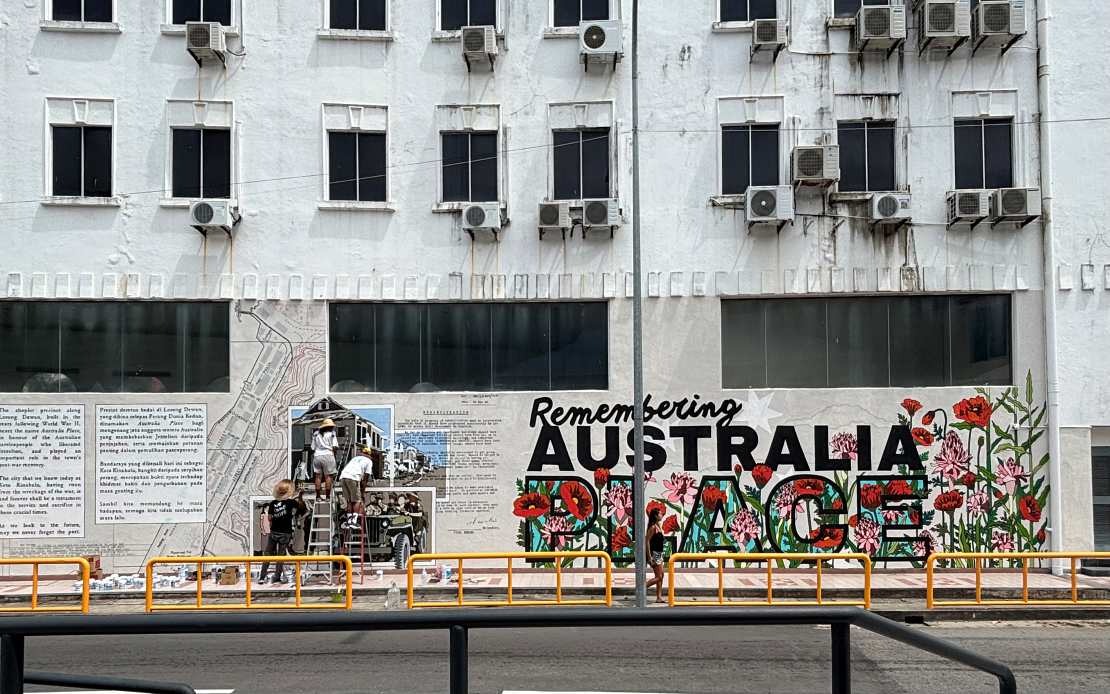
A newly unveiled mural in Kota Kinabalu has transformed a historically significant corner of the city into a living celebration of the multifaceted connections binding Sabah and Australia together. Titled 'Remembering Australia Place', the artwork adorns the Wisma Intiutama building in what locals have long referred to informally as 'Australia Place'—a neighbourhood steeped in shared memory and cross-border friendship. The mural's public debut on Friday arrived at a particularly poignant moment, coinciding with the eve of Sandakan Day, an observance that honours the courage and sacrifice of those who endured the brutal Sandakan Death Marches during World War II and the Sabahans who risked everything assisting prisoners of war.
Australian High Commissioner to Malaysia Danielle Heinecke described the mural as far more than decorative public art, framing it instead as a tangible manifestation of institutional commitment to the relationship between the two nations. In remarks delivered at the launch ceremony, Heinecke emphasised that the artwork encapsulates the recurring theme of Australians and Sabahans choosing partnership and solidarity across multiple generations and contexts. She characterised the mural as a vessel for stories—narratives of individual lives that have become interwoven between the two countries, creating bonds that transcend formal diplomatic arrangements and speak instead to genuine affinity at the community level. The commissioner underscored that these human connections remain central to shaping contemporary bilateral cooperation.
The unveiling ceremony drew a notably broad cross-section of Kota Kinabalu's civic and educational leadership. Kota Kinabalu Mayor Datuk Seri Sabin Samitah joined Heinecke in formally launching the artwork, while the event attracted parliamentarians, community organisers, and alumni of Australian universities—a demographic that represents the living legacy of educational exchange between the two nations. This gathering itself reflected the depth of institutional ties, with attendees spanning political, academic and civil society domains.
The mural's creation represents a collaboration between the Australian High Commission and Pillars of Sabah, a locally-based community arts organisation committed to amplifying regional narratives through visual storytelling. Rather than commissioning external artists, the decision to work with a Sabahan creative collective ensured that the artwork's conceptualisation and execution remained rooted in local perspectives and cultural sensibilities. The finished piece employs colourful, accessible imagery to articulate shared values—friendship, resilience, cooperation, and the connective tissue of people-to-people engagement that the two nations claim as foundational to their relationship.
Jared Abdul Rahman, a co-founder of Pillars of Sabah, brings a unique personal dimension to this artistic endeavour. Rahman's own biography—born to a Sabahan father and Tasmanian mother who met in Australia during the father's tenure as a Colombo Plan scholar—exemplifies the transnational family formations that have emerged from decades of institutional exchange. For Rahman, the project transcended professional commission, becoming instead a vehicle for processing and celebrating his dual heritage. He described the experience of bringing together multiple generations of Kota Kinabalu residents, particularly students and educators from Sekolah Menengah Kebangsaan Sanzac, as profoundly meaningful. The intergenerational dimension of the mural's creation signals an important continuity: younger Sabahans engaging with historical narratives that predate their births, internalising these stories as part of their own civic identity.
The Colombo Plan, referenced in Rahman's family narrative, deserves particular attention for Malaysian and Southeast Asian readers. Launched in 1951 as a coordinated effort to promote economic and social development across the Commonwealth and South Asia, the scheme became instrumental in facilitating educational mobility between Australia and Malaysia, including Sabah. Thousands of Malaysian students and professionals studied in Australian institutions under this framework, many returning to positions of influence in government, academia, and business. The programme thus created durable networks of mutual understanding and professional affinity that sustained bilateral relations even during periods of geopolitical realignment.
Sandakan Day itself carries immense emotional and historical weight, particularly for Sabahans. The commemoration honours 2,434 prisoners of war who perished during the Sandakan Death Marches—a brutal forced relocation of Allied captives from Sandakan to Ranau in 1945 that resulted in staggering casualties. Beyond the prisoners themselves, the observance extends recognition to Sabahans, many of whom acted as guides, couriers, and shelter providers for escaping prisoners, often at grave personal risk. This shared trauma and mutual assistance created a visceral bond between Australian and Sabahan communities, transforming abstract alliance into lived solidarity forged under conditions of extraordinary duress. The mural's positioning adjacent to this commemorative calendar suggests that contemporary Sabah-Australia relations consciously situate themselves within this historical continuum.
For Malaysian policymakers and regional analysts, the mural project illustrates a broader strategic trend in bilateral engagement: the deliberate elevation of cultural diplomacy and community-based narratives as complements to formal governmental interaction. Australia's substantial investment in educational exchanges, cultural programming, and heritage commemoration across Southeast Asia reflects both genuine historical connection and strategic interest in maintaining soft-power influence in the region. For Sabah specifically, which maintains distinctive historical experiences and political traditions within the Malaysian federation, cultivation of direct people-to-people ties with Australia can reinforce Sabah's international profile and diversify its partnerships beyond the dominant peninsular-centric axis.
The artwork also carries implications for how Sabah's youth engage with regional history and international relations. By incorporating local students in the mural's creation and unveiling, the project transforms abstract diplomatic ties into tangible, participatory experiences. Young people who contributed to the artwork or witnessed its creation gain direct stake in the Sabah-Australia relationship, potentially becoming future carriers of bilateral goodwill in their own professional trajectories. This generational transmission of relationship-consciousness represents a form of soft power investment with potential returns extending decades into the future.
Looking forward, the 'Remembering Australia Place' mural stands as a symbolic anchor for a relationship that shows no signs of diminishment despite evolving geopolitical circumstances. As Southeast Asia navigates great-power competition and shifting alignments, the Australia-Malaysia relationship—grounded in historical experience, educational networks, and now commemorated through public art—retains distinctive resilience. The mural's durability as a physical object carrying narrative weight ensures that coming generations of Kota Kinabalu residents will encounter this visual reminder of transnational connection, friendship sustained across decades, and the enduring legacy of shared sacrifice.

